
Parrots – March 2026
Summary
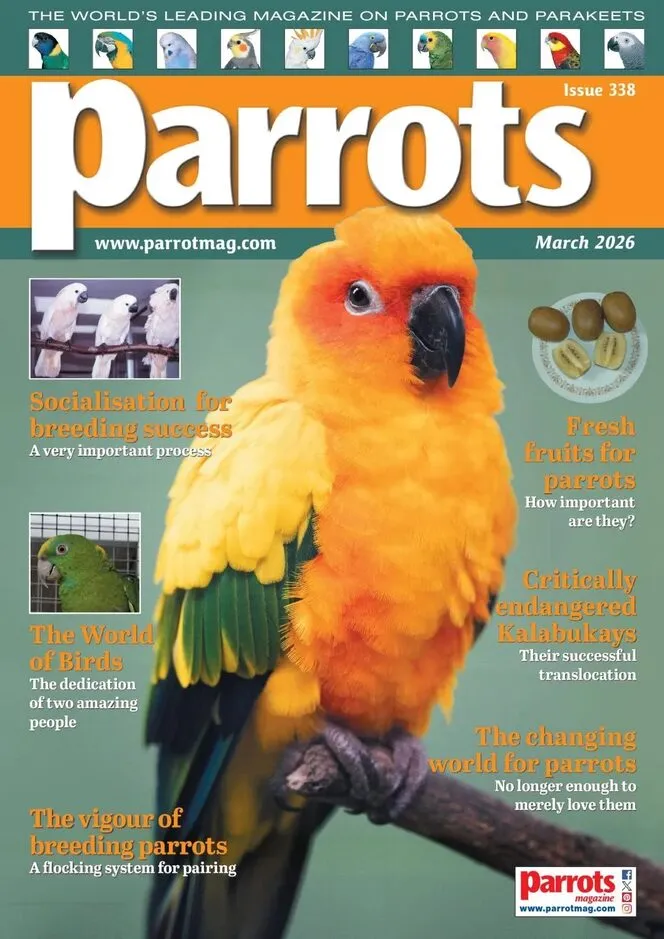
Parrots magazine issue 338 lands with Rosemary Low on socialisation and breeding, David Waugh on the Philippine Cockatoo translocation to Dumaran, and Pascal Stalder inside the World of Birds Foundation in Erica. Eb Cravens argues love alone no longer sustains aviculture; Leslie Moran ranks kiwi, pomegranate, carrot and pea.
Twelve pages of breeding advice open the issue. Rosemary Low reports a captive study of Spectacled Parrotlets in which four of six birds reared without siblings failed to form pair bonds, then warns that hand-reared male white cockatoos can kill a female in seconds. Rafael Zamora Padron explains Loro Parque Fundacion's flocking aviary, where odd numbers of males dilute competition and pairs are separated only after a second moult.
Two long reads cover institutions. Pascal Stalder, who interned at the World of Birds Foundation in 2022, describes two interconnected greenhouses in Erica, Drenthe, holding 2,000 to 3,000 birds across roughly 300 taxa, with 70 breeding aviaries and a points system that decides which subspecies get paired each year. David Waugh follows the September 2025 release of five Philippine Cockatoos, called Kalabukays locally, onto Dumaran island in Palawan.
Practical material sits alongside the theory. Catalina Tate lists the cage faults Feathers Together keeps seeing, from round cages to bar spacing wide enough for a parrot to push its head through. Leslie Moran compares kiwi, pomegranate, carrot and pea, quoting a 2012 Korean trial where Halla-Gold kiwi extract beat silymarin on two liver enzymes. Eb Cravens argues that breeding four clutches a year fills rescues, not aviaries.
—————
Content Guide
▸ Cover Story: Socialisation for Breeding Success
p.20 · How important is early socialisation in breeding success?
Rosemary Low's cover feature digs into why birds that look healthy never breed. The evidence comes from Kyra Garnetzke-Stollmann and Dierk Franck's 1991 Spectacled Parrotlet study: of six parrotlets reared alone, four struggled to form or keep pair bonds. Low also describes using surplus, human-shy males as 'guardians' for chicks before weaning, and explains why male white cockatoos, hand-reared and human-bonded, may treat an introduced female as a rival rather than a mate.
p.10 · Observe the vigour of our parrots
Loro Parque Fundacion's scientific director sets out the rules for pairing by flocking. Birds must be at the right age, since young ones get attacked by older birds in breeding condition and old ones lack agility. Use an odd number of males to break up direct competition; watch for persistent chasing regardless. Separate a chosen pair only after the second moult, and keep bloodlines varied even when the birds pick each other. More than 1,000 parrots hatch at the foundation each year.
▸ Cover Story: The Changing World for Parrots
p.14 · 'Tis no longer enough to merely love your parrots
Cravens opens his Complete Psittacine column with an admission of shared blame: keepers, breeders, dealers and zoos all built the surplus of captive hookbills now filling sanctuaries. He asks single pet owners to fund conservation groups, names Tui Parakeets, Plum-crown Pionus and Iris Lorikeets as species he wants paired in aviaries, and objects to Australian cockatoo trapping being sold as rescue. Commercial pairs pushed to four clutches a year are, he says, 'milking' parent birds.
p.12 · Plea for Morndyke Parrot Sanctuary
Morndyke Parrot Sanctuary at Thirsk in North Yorkshire needs 20,000 pounds for solar panels. Founder Tricia Phillips began in 2017 with rescue pigeons, then took on parrots kept in small pet-shop cages; the flock now runs past 100 birds, including macaws, cockatoos and African Greys. Running costs reached 52,000 pounds last year, most of it heating and lighting. Volunteer Emma Harris says the rescue turns birds away daily, and links the surplus to videos of dancing, talking parrots.
▸ Conservation
p.38 · Successful translocation of critically endangered Kalabukays
Fewer than 1,120 Philippine Cockatoos remain in the wild, about 75 per cent of them on Palawan. David Waugh explains how Katala Foundation Inc. moved five birds to Dumaran island in September 2025 after five months of acclimatisation and anti-predator training; three were captive-bred at the Katala Institute of Ecology and Biodiversity Conservation. The same facility saw its first Palawan Hornbill hatchlings in 2025. Dumaran's 1,500 ha critical habitat links two cockatoo reserves.
p.30 · World of Birds Foundation
Pascal Stalder spent five months at the Dutch rescue, and his feature reads like a facility tour with numbers: two former vegetable greenhouses covering 7,000 square metres, 2,000 to 3,000 birds across some 300 taxa, about half of them parrots in roughly 160 taxa, 70 breeding aviaries and eleven full-time staff. He documents the 2022 season, when 60 pairs produced 193 reared young. Founders Michel van der Plas and Bonny Talsma built the site at Erica, Drenthe, from a garden hobby started in 1982.
▸ Husbandry and Nutrition
p.18 · Parrot Cages – the good, the bad and the ugly
Feathers Together receives cages with nearly every relinquished bird, and Catalina Tate catalogues the ones that fail. Round cages stay top of the list because a bird has nowhere to retreat. Longer beats taller. Pull the bars with your fingers: if they bend, they will not hold a hookbill. Bar spacing matters more than cage size, with one to two fingers the maximum for Amazons and African Greys. Removable trays and absorbent substrate finish the checklist; plastic sheets and sawdust do not.
p.24 · The Holistic Parrot: Kiwis, pomegranates, carrots and peas
Leslie Moran ranks four fresh foods by antioxidant and essential fatty acid content. Kiwifruit carries 50 to 430 mg of vitamin C per 100 g, and a 2012 Korean trial found Halla-Gold kiwi extract lowered ALT and AST further than silymarin in liver-disease subjects. Pomegranate seeds and the white membrane both feed the bird, though Moran flags warfarin and tolbutamide interactions. Carrots are high in omega-6, and purple roots hold 246 mg of antioxidants per 100 g against orange at 29.
▸ News and Regular Features
p.6 · Parrot News from around the world
Six news pages. Guatemala declined to renew the lease on a 7,000-acre oil field inside Laguna del Tigre Biosphere Reserve, handing the land to the military. Robert Irwin introduced Occa, his late father Steve's roughly 60-year-old Sulphur-crested Cockatoo. Three Blue-and-yellow Macaws flew free above Tijuca National Park in Rio de Janeiro in January, the species' first record there since 1818. Twenty African Grey parrots were seized at Istanbul Airport, and undercover footage exposed four USDA-licensed bird mills in Oklahoma and Texas.
p.43 · Calendar Dates
Diary entries run from May to July. A Wild Parrots Up Close trip to Panama covers the Great-green Macaw and Azuero Parakeet. World Parrot Day falls on 31 May 2026. Think Parrots returns to Kempton Park Racecourse on 7 June, organised with the Parrot Society UK and the World Parrot Trust. The Parrot Society Summer Show follows at Stafford County Showground on 5 July.
p.45 · Postbag: Closing avian practice – an appeal from Virginia Trott
Virginia Trott's letter dominates the letters page, and it reads as a campaign document as much as correspondence. A client of Great Western Exotics in Swindon for almost 26 years, and co-owner of The Parrot Lodge boarding business, she asks readers to object to the practice's closure under IVC Evidentia. Referrals, pre-boarding health screening and disease testing all run through GWE, she writes, and specialist avian cover is already scarce.
p.50 · Parrots Helpline
Five volunteer advisers answer keeper questions on health, diet and behaviour, covering Bristol, Devon, East Kent, Oxon and Surrey with direct phone numbers. The page states plainly that the advisers are unpaid and asks callers to ring at reasonable hours unless it is an emergency. With Great Western Exotics closing, this list is the practical fallback for owners who cannot reach a specialist avian vet.
p.51 · Classified
Small ads, breeder listings and equipment sales fill the back page, free to private advertisers who call 01273 464777 or email the advertising desk. Lineage and boxed rates are printed for trade bookings, with a deadline of 20 March 2026 for issue 338. Also here: the Advertiser's Index running from Animal Genetics and Arcadia through to the World Parrot Trust.
—————
Editor's Take
This issue is strongest where writers bring data. Low's parrotlet numbers and Van der Plas's 193 reared chicks in one season tell a reader more than any philosophy piece, and Waugh's Dumaran report shows what 1,500 ha of legal habitat protection actually buys. Cravens, by contrast, writes a sermon: correct on bird mills and four-clutch breeding, but long on blame and short on the practical steps a keeper can take on Monday. Moran's nutrition column is the opposite problem, dense with citations yet quietly useful, especially the 246-versus-29 antioxidant gap between purple and orange carrots. Buy it for pages 20, 30 and 38.
Strengths
• Rosemary Low backs breeding claims with a named 1991 study and hard parrotlet numbers.
• Pascal Stalder supplies floor plans, aviary dimensions and staff counts instead of adjectives.
• David Waugh names the island, hectare figure and release date of the 2025 cockatoo translocation.
Weaknesses
• Eb Cravens recycles a familiar conservation sermon without dates or programme results.
• News pages mix hard seizure reports with TikTok cockatiel filler and sloppy editing.
Verdict: Recommended — Four grounded features on breeding, rescue and translocation outweigh one opinionated column and thin news padding.
