
Practical Reptile Keeping – November 2025
Summary
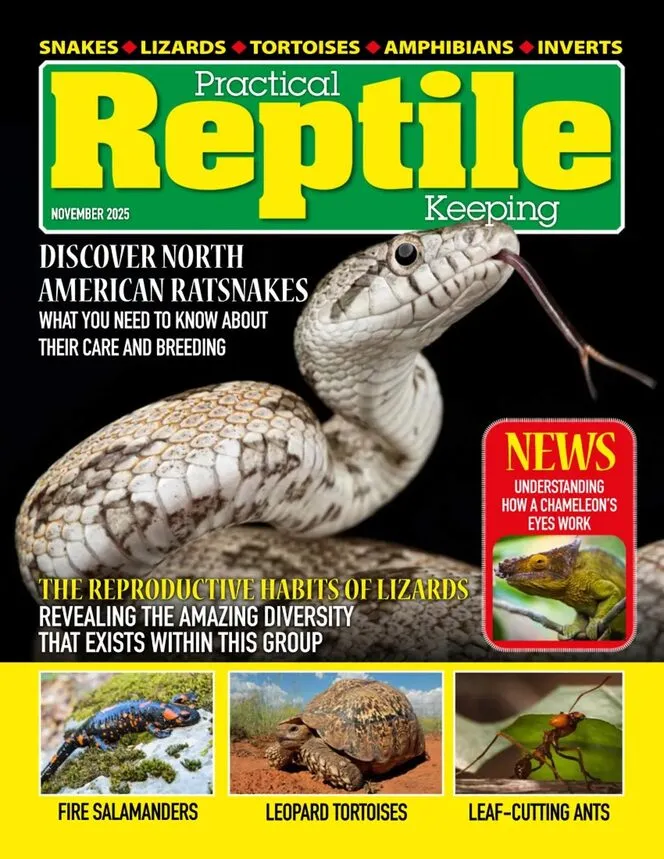
A Texas rat snake (Elaphe obsoleta lindheimeri), photographed by Murilo Mazzo of Shutterstock, takes the cover of Practical Reptile Keeping November 2025 under DISCOVER NORTH AMERICAN RATSNAKES. The cover also carries the reproductive habits of lizards, chameleon eyes, fire salamanders, leopard tortoises and leaf-cutting ants.
David Alderton's opening is the best story: an angler on a Derbyshire canal near Mercia Marina at Willington pulled out what he took for a dead crocodile about 90cm (3ft) long and left it on the towpath. It was taxidermy, stuffed with straw.
The chameleon eye research at p4 is the issue's science: two long coiled optic nerves behind the eye, found in 2017 by Edward Stanley in a minute leaf chameleon CT scan at Juan Daza's lab, giving near 360-degree vision and a tongue at almost 100kph (60mph).
—————
Content Guide
▸ Welcome — The canal crocodile
p.4 · A crocodile in the Peak District — David Alderton
An angler on a canal in Derbyshire, England's Peak District, near Mercia Marina at Willington, hooked what he first thought was a large fish. On landing it he found a reptile about 90cm (3ft) long that he believed to be dead, and left it beside the towpath. Passers-by photographed it and called police; Derbyshire Rural Crime Team attended, found no crocodile, and issued an urgent social media appeal that spread widely. The angler then came forward to say it was no threat — it was taxidermy, stuffed with straw, possibly once museum property or brought back from abroad years ago and finally thrown into the canal. A stuffed crocodile causing a police appeal is the funniest true story in any reptile magazine this year. Check what your local waterway is hiding before you cast.
The Thames precedent
Alderton notes a live crocodile lived in the Thames for about a month in the late 19th century. Opera impresario Richard D'Oyly Carte bought a private island near Weybridge and built a pond for a young crocodile about 60cm (2ft) long; it escaped into the river and was recaptured by a local boatman. J.M. Barrie often visited the house, and this crocodile is believed to have inspired the crocodile in Peter Pan. A Peter Pan crocodile is the footnote worth knowing. Read the original story before you repeat it.
▸ News and Views (p4, compiled by G. Valentine)
p.4 · How a chameleon's eyes work — the cover science
The species covered include Parson's chameleon (Calumma parsonii), one of the heaviest and largest, found only in Madagascar; the minute leaf chameleon (Brookesia minima); and the Ambilobe panther chameleon (Furcifer pardalis). Juan Daza, associate professor at Sam Houston State University in Texas, and Edward Stanley, director of the digital imaging lab at the Florida Museum of Natural History, are named. Chameleons have two long coiled optic nerves behind the eye that other lizards lack, allowing near 360-degree vision and the ability to look in two directions at once; eyes move independently like surveillance cameras but coordinate on prey to aim the ballistic tongue, which can reach almost 100kph (60mph). Stanley first found the structure in 2017 in a CT scan of a minute leaf chameleon at Daza's lab. Chameleons are native to Africa, Europe and Asia, with grasping tails, oven-mitt-shaped feet and ballistic tongues. Two optic nerves is the anatomical fact worth remembering. Compare one lizard's eye movement with a chameleon's.
Other news
Reptiles and invertebrates may offer new drugs from gout to breast cancer; turtles have a hidden sense for long ocean routes; a new ancestor of modern crocodilians was found in Brazil; and a frog unseen for more than 60 years has been rediscovered. A sixty-year gap is the number that measures a rediscovery. Look up one of these four stories this week.
▸ Features
p.20 · North American Ratsnakes — Tim Zedi
The cover species, the Texas rat snake Elaphe obsoleta lindheimeri, gets the lead feature from Tim Zedi. Rat snakes are the beginner snake with the most to teach. Compare your rat snake's locality with the article.
p.26 · The Reproductive Habits of Lizards
Lizard reproduction gets the cover strand. Reproduction is the part of lizard keeping owners misread most. Watch one courtship behaviour and name it.
p.36 · Celebrity Snake Owners
Celebrity snake owners are featured. Celebrity pages are the lightest thing in any magazine. Read one before you judge the hobby's image.
p.43 · The Mystery of the Green Anole
The green anole gets a feature. Anoles are the lizard most owners buy and fewest understand. Check your anole's humidity against the article.
p.48 · Tales from the Reptile House — born of fire — fire salamanders
Fire salamanders get the reptile house story, one of the cover animals. Fire salamanders are the amphibian with the strongest folklore. Read the story before the care sheet.
p.56 · New Diagnostic Techniques — Dr Joanna Hedley
Dr Joanna Hedley covers new diagnostic techniques. Diagnostics are the vet advance that saves animals silently. Ask your vet about one new diagnostic.
p.58 · Keeping Leaf Cutting Ants
Leaf-cutting ants get the invertebrate feature. Invertebrates are the most overlooked corner of the hobby. Set up one ant colony this month.
▸ Regulars and Advertising
p.32 · Q & A · p.34 · Reptile Focus
Keeper questions and a species focus run here. Q&A is where real keeping problems surface. Send in one question of your own.
p.38 · Out of Africa — spots and stripes — Paul Donovan
Paul Donovan writes on spots and stripes. Pattern is the adaptation owners rarely think about. Name one pattern on your own animal and why it exists.
p.44 · Veterinary Casebook
The veterinary casebook runs here. Casebooks are the most instructive pages in a magazine. Read one case before your next vet visit.
p.46 · Subscription offer and back issues
Subscriptions and back issues are offered at p46. Back issues are how a new keeper catches up. Order one back issue on a species you keep.
p.66 · How to Contact Us
Contact details close the issue. Contact pages are the start of any letter. Email one question this week.
British Chelonia Group
The British Chelonia Group is dedicated to the care and conservation of turtles, tortoises and terrapins, publishing a care manual, six newsletters and a scientific journal each year, with an annual symposium including CPD and student sessions and local meetings nationwide, at www.britishcheloniagroup.org.uk, P.O. Box 16216, Tamworth, Staffs B77 9LA. Six newsletters a year is the number that tells you how active a society is. Ask one chelonian society for its care manual.
Exo Terra and books
Exo Terra's Frog Terrariums and Frogs & Co range are advertised at www.exo-terra.com for bioactive planted vivariums. G. Valentine's HIDDEN CREATURES REVEALED Volume 1 shows newly discovered reptiles, amphibians and invertebrates, and Discoveries from the Age of the Dinosaurs Volume 2 covers new Mesozoic fossil finds, both at pocketmags.com/prac. Advertising is the real buying guide. Compare one product with your own vivarium's needs.
—————
Editor's Take
The Derbyshire canal crocodile is the reason Practical Reptile Keeping November 2025 is worth opening: an angler near Mercia Marina at Willington landing about 90cm of taxidermy, leaving it on the towpath, a police appeal going viral and the angler returning to explain it was stuffed with straw is the best true story in any reptile magazine this year, and Alderton's Thames crocodile of the late 19th century, about 60cm, bought by Richard D'Oyly Carte and inspiring Peter Pan, is the perfect footnote. The chameleon eye research is the issue's real science: Juan Daza at Sam Houston State, Edward Stanley at the Florida Museum, two coiled optic nerves found in 2017 in a minute leaf chameleon, near 360-degree vision and a tongue at almost 100kph. Weakest is the features: all seven are listed with authors and page numbers but no body text survives, so the North American ratsnakes, lizard reproduction, green anole and fire salamanders cannot be quoted, and the leopard tortoises on the cover never appear in the text. Buy this for the crocodile and the chameleon eyes; the features are a contents page.
Strengths
• Canal crocodile gives 90cm, Willington and taxidermy
• Thames crocodile gives about 60cm and Peter Pan
• Chameleon eyes give 2017, two nerves, 360°, 100kph
• British Chelonia Group gives six newsletters a year
Weaknesses
• No feature body text available to quote
• Leopard tortoises on the cover unconfirmed in text
• Advertising and book promotion fill the gaps
Verdict: Selective read — the crocodile and chameleon eyes, features unquoted.
