
Prima Health – Issue 1 2026
Summary
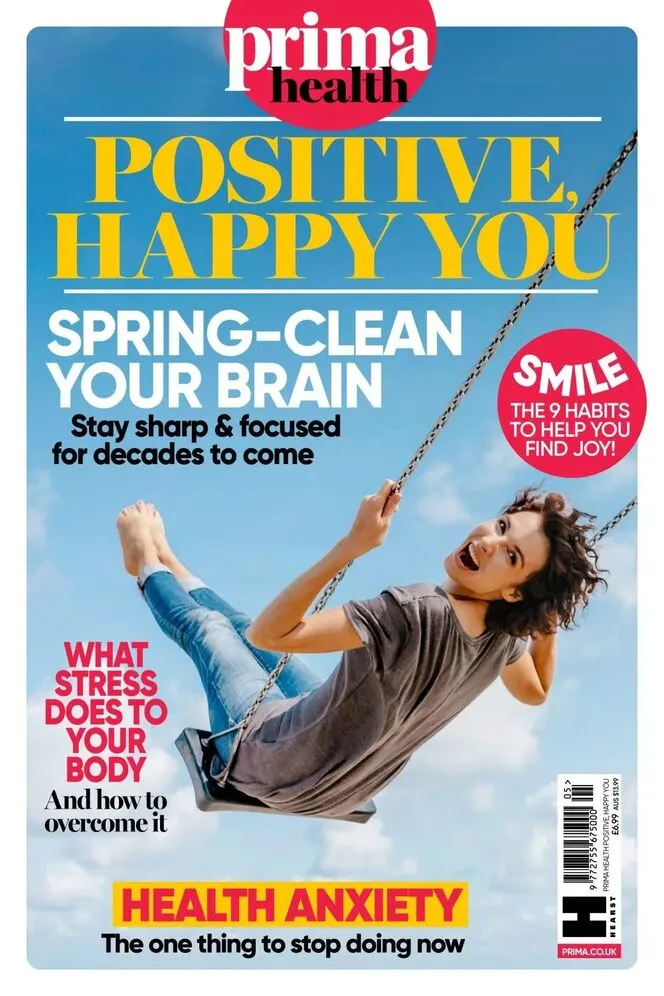
Prima Health Issue 1, February 2026 — "Positive, Happy You" — dedicates 92 pages to mental health, from breaking stigma through a 4-week mental-fitness plan, a "spring-clean your brain" guide, and a firm plea to stop googling symptoms. Erica Sweeney contributes "Mastering your mental health" (p.8), the issue anchor feature. The cover states FEBRUARY 2026, confirming the filename's year, though "Issue 1" is not printed on the cover itself.
Part 1 (p.16) opens with "How mentally fit are you?" — a self-assessment quiz — then covers stress and anxiety, workplace pressure, and 9 easy tricks to lower pressure. Part 2 (p.46) tackles motivation and therapy reluctance, with "The five worst reasons not to see a therapist" (p.49) and "Spring-clean your brain" (p.64). Part 3 (p.74) targets health anxiety with "Please, stop googling it" (p.74) and happiness as a habit (p.84). Part 4 (p.92) closes with helping others as a path to helping yourself.
Content Guide
▸ Introduction
p.6 · Let's Break the Stigma
An editorial introduction to the mental health theme, framing mental fitness as a trainable skill identical to physical fitness. The article opens with a statistic: 1 in 4 UK adults experiences a mental health problem each year.
p.8 · Mastering Your Mental Health
Erica Sweeney's 4-week plan: Week 1 builds awareness through journaling, Week 2 introduces cognitive reframing, Week 3 focuses on behavioural activation, Week 4 consolidates habits. Each week requires 15 minutes per day and includes a printable worksheet.
▸ Part 1: Diving In, Discovering You
p.16 · How Mentally Fit Are You?
A 20-question self-assessment covering sleep quality, stress frequency, social connection, emotional regulation and life satisfaction. Scores plot onto a 5-level mental-fitness scale from "flourishing" to "struggling."
p.28 · Focus On: Stress and Anxiety
Differentiates acute stress from chronic anxiety using physiological markers: acute stress triggers cortisol spikes that resolve; chronic anxiety keeps cortisol elevated, impairing sleep and immune function.
p.30 · Stressing 9-5
Workplace stress management: the 5-3-1 technique (5 minutes of deep breathing, 3 minutes of planning, 1 minute of gratitude) done at a desk. Boundaries around email and Slack outside work hours are non-negotiable.
p.36 · Nine Easy Tricks to Lower the Pressure
Includes: a 60-second breathing reset (4-7-8 pattern), walking away from the trigger for 10 minutes, naming the emotion aloud, squeezing a stress ball, listening to a specific song, calling one person, drinking a full glass of water, writing down the worst-case scenario, and laughing deliberately.
▸ Part 2: Give In to Moving Forward
p.49 · The Five Worst Reasons Not to See a Therapist
Myth-busting: "I'm not sick enough" (therapy is for skill-building, not just crisis), "It's too expensive" (NHS talking therapies are free, and low-cost options exist), "I can fix myself" (self-reliance and professional help are not mutually exclusive), "My problems aren't big enough" (all problems are big enough if they affect your quality of life), "I don't want to be on medication" (therapy and medication are separate decisions).
p.64 · Spring-Clean Your Brain
A 7-day mental declutter: Day 1, clear your physical space; Day 2, unsubscribe and unfollow; Day 3, write down recurring negative thoughts and challenge each with evidence; Day 4, set 3 boundaries; Day 5, do one thing you have been postponing; Day 6, forgive one small grudge; Day 7, plan your ongoing maintenance.
▸ Part 3: Stop the Spiral
p.74 · Please, Stop Googling It
A feature on health anxiety: why symptom-searching online worsens anxiety, how to recognise the urge to search, and a 10-minute rule (wait 10 minutes before searching, and if you still feel the need, call a GP instead). The article explains the "cyberchondria" concept.
p.84 · Happiness Is a Habit
The science of hedonic adaptation and how to counter it: practising gratitude (3 things daily), savouring (focusing on positive experiences for 30 seconds longer), and varying pleasurable activities to prevent habituation.
▸ Part 4: Making Changes That Last
p.92 · Help Others, Help Yourself
The mental health benefits of altruism: volunteering once per week is associated with lower depression rates and higher life satisfaction. A list of 5 ways to help without a big time commitment: check on one neighbour, donate one item, mentor one person, write one thank-you note, show up for one event.
Editor's Take
Issue 1 is a strong debut for Prima Health's mental health focus — the 4-week plan from Erica Sweeney is the standout feature, and "Stop googling it" addresses a genuinely modern anxiety trap. The self-assessment quiz is a smart engagement tool. Weakness: "Issue 1" is not printed on the cover, which is a cataloguing oversight for a launch issue. The "help others" closer feels rushed compared to the depth of earlier chapters. Best for anyone navigating anxiety or stress who wants a structured, non-clinical guide.
Strengths
• 4-week mental fitness plan is structured and worksheet-supported
• "Stop googling it" is timely and specific
• Self-assessment quiz drives reader engagement
Weaknesses
• "Issue 1" missing from cover
• Final chapter is thinner than the rest
Verdict: Recommended — A strong mental health issue that earns its "Positive, Happy You" subtitle with practical tools, not platitudes.
