
Reptiles Magazine – January-February 2026
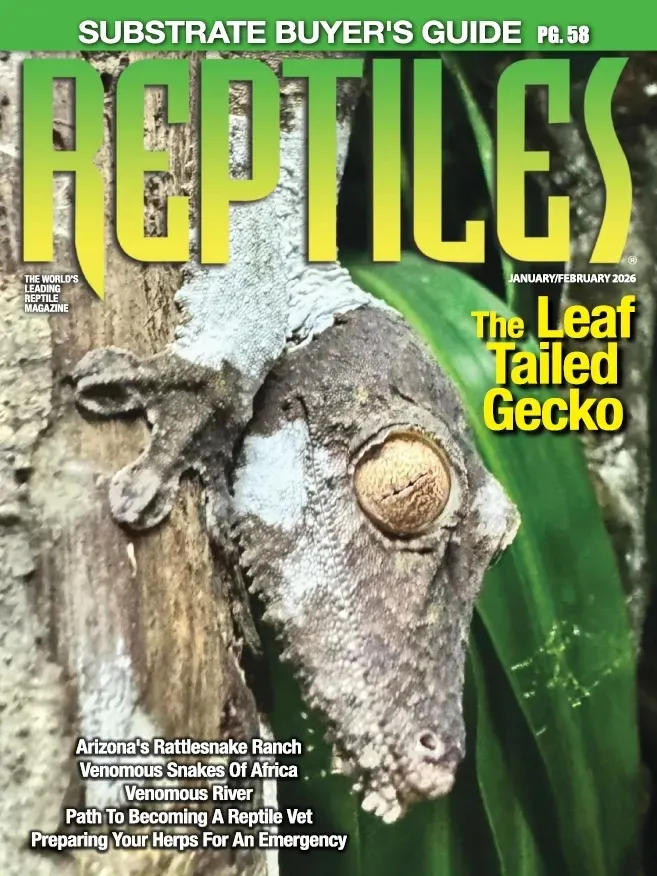
Summary
Reptiles Magazine kicks off Volume 34 with Uroplatus fimbriatus on the January/February 2026 cover – leaf-tailed gecko breeder Timothy Nealon walks through captive care of 13 species. Eli Greenbaum previews his Congo expedition book Venomous River, and J.V. Bolkan profiles 10 African venomous snakes including the 14-foot black mamba.
The January/February 2026 issue of Reptiles Magazine (Volume 34, Number 1) opens with a 10-page cover story on Uroplatus leaf-tailed geckos by breeder Timothy Nealon, who details husbandry for 13 species at his Nealon Reptiles facility. Foster Reves explains how to evacuate a reptile collection before wildfires, hurricanes, or floods, drawing on Hurricane Milton's 2024 destruction. Bryan Kao interviews Cody Will about Cave Creek, Arizona's Rattlesnake Ranch, a 2,400-square-foot exhibition hall displaying more than 50 rattlesnake species.
J.V. Bolkan catalogs 10 venomous African snakes with explicit fatality data: the black mamba's near-100% untreated mortality in as little as 20 minutes, Gaboon viper's 600-mg venom yield, and Cape cobra's 50% untreated bite fatality. Herpetologist Eli Greenbaum previews his book Venomous River with three snake encounters from the Democratic Republic of the Congo, including a stiletto snake bite that nearly killed his colleague Wandege Muninga. Juliana Virata's substrate buyer's guide rates cypress mulch, sphagnum moss, ABG mix, and aspen shavings.
Dr. Los Kamp's Vet Report column traces his path from Staten Island Zoo volunteer to reptile-focused associate at Winter Park Veterinary Hospital in Florida. Regulars include Herper's Most Wanted on Chrysopelea flying snakes, Herp Queries covering albino leopard frogs and rehoming Papuan pythons, and Reptile News on cane toads in Hawaii, Eastern indigo snake surveys on Sanibel Island, and Aldabra tortoises released on the Seychelles.
—————
Content Guide
▸ Cover Story
p.16 · Leaf-tailed Gecko Care and Breeding
Timothy Nealon of Nealon Reptiles runs through captive care of 13 Uroplatus species including U. fimbriatus, henkeli, sikorae, and giganteus. Daytime temperatures should stay between 74 and 80F with extended exposure above 84F proving lethal. Nealon advises misting systems timed for dawn, dusk, and night fogging since Uroplatus lap droplets rather than drink from bowls. He also covers UVB at Ferguson Zone 0.5 for hatchlings, 90 to 150 day incubation at 68 to 72F, and dry-season cycling to trigger reproduction.
▸ Husbandry & Safety
p.26 · Emergency Preparation For A Reptile Collection
Foster Reves uses 2024's Hurricane Helene and Milton as a wake-up call for keepers, noting his New River in SW Virginia surged 27 feet above normal. He lists concrete steps: styrofoam-lined shipping boxes from aquarium stores, ventilated deli cups for leopard geckos, and dog crates for medium tortoises. Pack hot and cold packs, dry-towel transport for aquatic turtles with 12-hour rehydration soaks, and never shut the breaker box while standing in water.
p.14 · Vet Report: Path To Becoming A Reptile Veterinarian
Dr. Eric Los Kamp of Winter Park Veterinary Hospital recounts his arc from Staten Island Zoo docent to reptile-focused associate via the University of Florida. He maps the ABVP private-practice certification route as an alternative to a three- to four-year zoo residency. Practical takeaways: get five vet opinions before settling a treatment plan, track calcium crash signs in female lizards during breeding season, and prioritize the human-animal bond over prestige.
▸ Species Profiles
p.32 · Venomous Snakes of Africa
J.V. Bolkan profiles ten species with hard data: the black mamba's untreated bites kill in as little as 20 minutes with 14% fatality even with antivenin; the Gaboon viper delivers up to 600 mg per bite from two-inch fangs; Cape cobra bites are fatal in about 50% of untreated cases within 10 hours. Range maps and antivenin availability are specified for each species, including the monovalent antivenin needed for boomslang bites.
p.42 · Rattlesnake Ranch
Bryan Kao's Q&A with Cody Will covers the 2,400-square-foot Cave Creek, Arizona exhibition hall displaying more than 50 Crotalus and Sistrurus species. Will shares that 2024 produced 100-plus baby rattlesnakes including a documented double-clutching event. Notable exhibits include four southwestern speckled rattlesnake morphs (white, pink, dark, blue) and a 72-inch Yucatan rattlesnake weighing 8 pounds. Tropical species stay on exhibit year-round; temperate species brumate in a hibernaculum from November through March 1.
p.50 · Venomous River
Eli Greenbaum previews his book with three Congo expedition encounters. Herpetologist Wandege Muninga survives an Atractaspis irregularis stiletto snake bite on a Lake Kivu ferry, slashing his arm and stuffing it with katumbanyi plant before reaching a Goma hospital. Greenbaum later identifies the captured powdered tree snake as a new species, Toxicodryas adamantea. The piece ends with the Snake Detection Theory linking primate visual evolution to venomous-snake coevolution.
▸ Buyer's Guide
p.58 · Substrates Buyer's Guide
Juliana Virata ranks substrates across humidity, burrowing, impaction, ease of cleaning, and bioactive compatibility. Cypress mulch and ReptiBark suit high-humidity enclosures; sphagnum moss aids shedding but should be damp, not soaking. ABG mix (five equal parts including tree fern fiber and horticultural charcoal) leads bioactive setups. Aspen shavings work for corn snakes and hognose; coco coir fits tropical setups for crested geckos and ball pythons. Zilla's organic topsoil rounds out the recommendations.
▸ Regulars
p.8 · Herper's Most Wanted: Flying Snake
John Virata profiles five Chrysopelea species of gliding colubrid. Paradise flying snakes (Chrysopelea paradisi) reach 3 feet; banded flying snakes (C. pelias) are the weakest gliders despite reaching 2 feet. Snakes launch between branches by flattening ribs into a pseudo-concave wing while continuing lateral undulation. Captive European keepers report lifespans past 15 years; wild snakes average 8 to 10 years due to predation and habitat loss.
p.10 · Herp Queries
This month's column tackles three reader questions. On albino leopard frogs, the editor notes the lack of melanin makes them prone to sunburn and predation, severely reducing wild lifespan. A 72-year-old keeper seeks a breeding home for two Papuan pythons, one over 14 feet. On cane toads in Hawaii, Virata explains the 1932 introduction from Puerto Rico failed to control scarab beetles in sugar cane stalks because the toads are ground-dwellers.
p.12 · Reptile News
Virata rounds up wild herp news. Florida researchers Lechowicz and colleagues document Eastern indigo snake surveys on Sanibel and Captiva Islands, citing road development as the primary threat. Fifty Aldabra giant tortoises were released on North Island in the Seychelles. In Anguilla, the Lesser Antillean iguana – wiped out by iguanas washed ashore in 1995 – has been re-established after a 20-year absence, per the Journal of Heredity.
—————
Editor's Take
The January/February 2026 Reptiles delivers unusually actionable content: Nealon's 13-species Uroplatus guide gives precise temperature ranges (74 to 80F daytime, lethal above 84F), seasonal breeding cycles, and incubation parameters of 90 to 150 days. The Rattlesnake Ranch Q&A reveals practical breeding milestones – 100-plus babies produced in 2024, including documented double-clutching. Venomous River is the standout narrative, with vivid Congo fieldwork and a stiletto snake bite scene you remember after closing the magazine. Weaknesses: the front-of-book pages carry heavy Zoo Med, RodentPro, and Hikari ad density that fragments reading flow, and several feature photos are credit-line-heavy stock rather than commissioned natural-history work. This issue best serves intermediate-to-advanced keepers working with venomous snakes, geckos, or rattlesnakes; beginners will find the substrate guide and Vet Report most accessible.
Strengths
• Nealon's cover story delivers hard numbers across 13 Uroplatus species, from incubation temperature (68 to 72F) to UVB exposure limits.
• Greenbaum's Congo excerpts combine first-person narrative with peer-reviewed context like the Snake Detection Theory.
• Bolkan lists specific antivenin requirements (monovalent for boomslang) and authenticated measurements (13-foot black mamba specimen).
Weaknesses
• Ad density in front-of-book pages fragments reading between short Reptihabitat, RodentPro, and Hikari insertions.
• Several feature photos are stock Shutterstock credit-line images rather than commissioned natural-history work.
Verdict: Recommended — Strong for intermediate keepers working with venomous snakes or Uroplatus; heavy ad density and stock photography hold it back from essential status.
