
Reptiles Magazine – November-December 2025
Summary
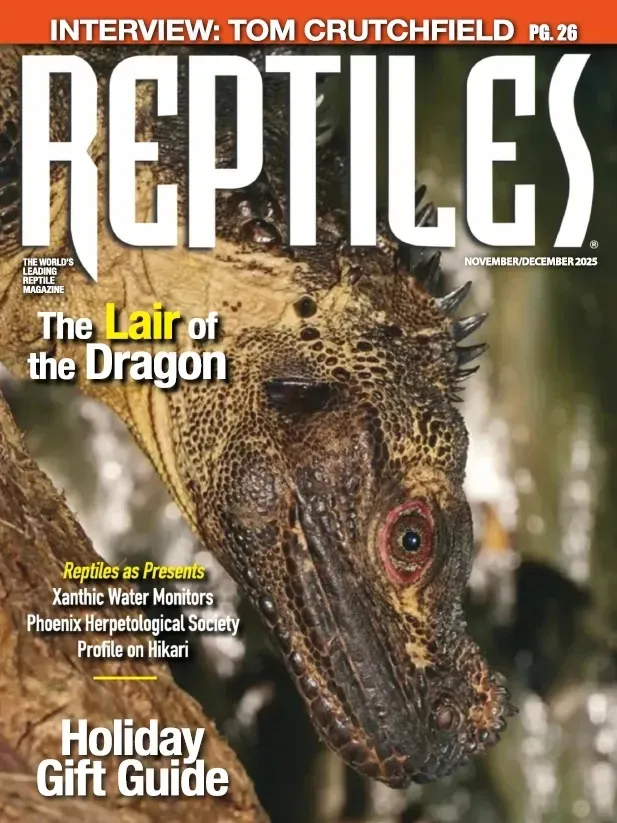
A Hydrosaurus microlophus, photographed by Alex Myers, takes the cover of Reptiles November/December 2025 (Volume 33, Number 6). The cover species is also the subject of the lead feature, The Lair of the Dragon at p18, written by Myers himself.
John Virata's editor's page is the issue's best writing: surfing at Bolsa Chica State Beach in Southern California he saw a juvenile green sea turtle, Chelonia mydas, part of a resident group that has lived for years in the San Gabriel River, now largely urbanised and running under the 405 and alongside the 605.
The IUCN removed the green turtle from endangered to Least Concern, with the population up 28% since it was listed in the 1970s. A 2019 PLOS One study counted more than 3,400 turtles at 53 Pacific islands, atolls and reefs between 2002 and 2015, of which 90.1% were green turtles.
—————
Content Guide
▸ From the Editor's Desk
p.4 · Turtles where you least expect them — John Virata
Surfing at Bolsa Chica State Beach in Southern California, Virata saw a juvenile green sea turtle, Chelonia mydas. He is used to seeing them surfing in Hawaii, and has also seen them at Doheny State Beach and Seal Beach in California. A group of green turtles has lived for years in the nearby San Gabriel River, now largely urbanised, running under the 405 freeway in one place and alongside the 605 in another; some say they are drawn by warm water from a nearby power plant. Urban rivers holding turtles is the conservation surprise of the year. Check what lives in your own local river.
The numbers behind it
The IUCN has removed the green turtle from the endangered list, where it now sits as Least Concern, with the population up 28% since it was listed in the 1970s. A 2019 study in PLOS One had researchers visiting 53 islands, atolls and reefs in the US Pacific between 2002 and 2015, counting more than 3,400 turtles, of which 90.1% were green turtles. Numbers around Hawaii grew 8%, and around American Samoa and the Mariana Islands by 4% a year; another account puts green turtle growth at 8% a year around Hawaii and the US Pacific island territories since counts began in 2002. Twenty-eight percent and 90.1% are the figures worth quoting. Read the PLOS One study before you repeat any recovery claim.
The local lizards
Cycling near the Bolsa Chica Ecological Reserve at Harriet Wieder Regional Park, Virata saw a pair of lizards dart into a burrow too fast to identify. The area holds Great Basin fence lizards and western side-blotched lizards, with the occasional San Diego alligator lizard, plus southern Pacific rattlesnakes, San Diego gopher snakes and California kingsnakes. In 25 years of walking the wetlands he has seen a kingsnake and a gopher snake once each, and a rattlesnake twice. Twenty-five years and four sightings is the truest field note in the issue. Keep your own sighting record for one season.
▸ Features
p.14 · Vet Report: Respiratory Infections — Eric Los Kamp, DVM
The vet report covers respiratory infections. Respiratory disease is the emergency that kills reptiles quietly. Weigh and watch one animal's breathing this week.
p.16 · Pets as Presents — USARK
USARK asks readers to think carefully before giving animals as presents. Christmas animals are the impulse the hobby regrets most. Wait until January before you give any animal.
p.18 · The Lair of the Dragon — Alex Myers
The cover species gets the lead feature, Alex Myers's passionate quest for the world's largest iguanid lizard. Photographer-as-author is the best kind of species article. Look up Hydrosaurus microlophus before you read.
p.28 · Tom Crutchfield — Foster Reves
Foster Reves profiles Tom Crutchfield, who has bred and produced more than 200 species of reptile. Two hundred species is a career almost nobody matches. Name one species Crutchfield produced.
p.36 · Xanthic Water Monitors — Zac Ala
Zac Ala covers the first axanthic-to-axanthic water monitor morph bred in the US. Morph firsts are the detail serious keepers follow. Ask what morph your own monitor is.
p.44 · Hikari — Rachel Presser
Rachel Presser profiles the company behind CrestGel, LeopaGel and other reptile foods. Feed companies are the businesses that decide what most animals eat. Check one gel's ingredients against your animal's needs.
p.50 · Phoenix Herpetological Society — Bryan Kao
Bryan Kao covers the society's conservation education and the rescue and rehabilitation of non-native and native species in Arizona. Rescue societies do the work magazines only report. Support one herpetological society this year.
p.58 · Holiday Gift Guide — Juliana Virata
The gift guide closes the features. Gift guides are advertising readers actually use. Buy one thing from the list for a keeper you know.
▸ Departments
p.6 · Mailbag
Reader letters run here. Letters are where a magazine's community shows. Send one letter this week.
p.8 · Herper's Most Wanted
The wanted-advertising page lists species. Wanted lists show what the hobby actually wants. Compare it with what you already keep.
p.10 · Herp Queries
Keeper questions are answered here. Queries are the practical core of any reptile magazine. Look up one problem you have not solved.
p.12 · Reptile News
News runs here. News pages are the only place conservation reaches keepers. Read one item before the features.
p.64 · Herp Events / Ad Index
Events and the advertiser index close the issue. Event calendars are how keepers meet each other. Check one show date before the year ends.
▸ Advertising and Publishing
Zoo Med and RodentPro
Zoo Med's ReptiTemp Dimming Thermostat is advertised with customisable day and night settings, adjustable ramp temperature control and a programmable alarm, at ZOOMED.COM. RodentPro.com supplies frozen mice, rats, rabbits, guinea pigs, hamsters, gerbils, chicks and quail plus live insects and supplies, at P.O. Box 118, Inglefield, IN 47618-9998, phone 812.867.7598, fax 812.867.6058, info@rodentpro.com. Thermostats are the purchase that prevents most heating accidents. Check one thermostat's settings tonight.
Subscription and contact
Six issues cost $24.00 and twelve $40, with Canada and foreign surface mail adding $6 a year in US funds; a single copy is $6.99. Published bimonthly by Living World Media, Inc., 52 Golf Oval, Springfield NJ 07081-2504, ISSN 1068-1965, USPS 13189. Editor John Virata, design director Liliana Estep, advertising director Peter Lymbertos on 818-624-6254. Customer service 800-876-9112 or repservice@cdfulfillment.com, and subscribe at ReptilesMagazine.com/subscribe. A save-Southern-California-red-legged-frogs promotion is mentioned. Check the rate before you subscribe.
—————
Editor's Take
John Virata's green turtle is the reason Reptiles November/December 2025 is worth keeping: a juvenile Chelonia mydas while surfing at Bolsa Chica, a resident group in the urbanised San Gabriel River under the 405 and alongside the 605, the IUCN's Least Concern relisting with the population up 28% since the 1970s, 53 islands and more than 3,400 turtles at 90.1% green, and 25 years of walking the wetlands yielding one kingsnake, one gopher snake and two rattlesnakes is a page written by someone who actually goes outside. Tom Crutchfield's more than 200 reptile species and Zac Ala's first US axanthic-to-axanthic water monitors are the hobby's own milestones. Weakest is the source: all eight features are listed with author and page but no body text survives, so the cover Hydrosaurus, the respiratory vet report, Hikari and the Phoenix society cannot be quoted. The Zoo Med and RodentPro advertising gives more concrete detail than the features. Buy this for the turtle page; the features are a contents page.
Strengths
• Green turtle gives Least Concern, 28%, 3,400, 90.1%
• 53 islands and 2002-2015 give the study its scope
• 25 years and four snake sightings is honest
• Crutchfield gives more than 200 species
Weaknesses
• No feature body text available to quote
• Cover Hydrosaurus feature unquoted
• Advertising is more detailed than the features
Verdict: Selective read — the turtle editor's page, features unquoted.
