
Science of Cycling 2026
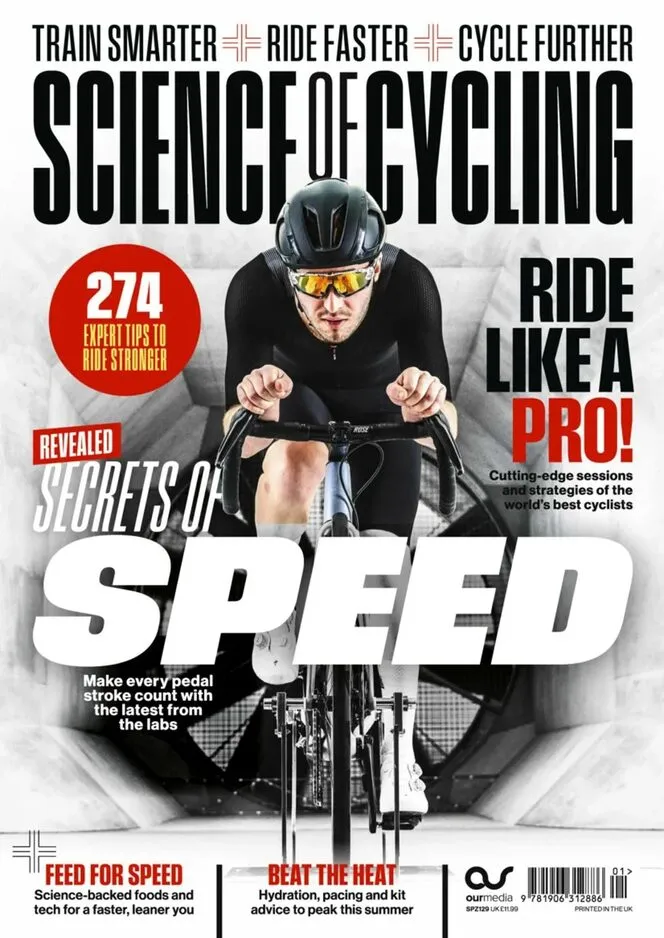
Summary
Science of Cycling 2026 (£11.99, ISBN 9781906312886) packs 274 expert tips into three sections — Tech Insight, Training & Nutrition, and Marginal Gains — with Dan Bigham, the former hour-record holder and Red Bull-BORA-hansgrohe head of engineering, opening the tech section. James Witts edits the annual, which promises that the ideas inside "require no extra riding time or fiscal outlay." Morgan Saussine's data science, Alex Dowsett's TT preparation, and Andrea Zignoli's bioenergetics modelling anchor the science-backed approach.
The Fast Show on page 6 covers how performance engineers and data scientists are reshaping professional cycling, from CdA tipping points to tyre rolling resistance. Tailor Made on page 20 explains why a professional bike fit reduces injury and unlocks speed — calibrated to individual limb lengths and flexibility limits. Power vs Heart Rate on page 26 debates whether beats-per-minute still matter in a world of wattage-based training. Influential Tour Tech traces innovations that flowed from Tour de France elites to everyday sportive riders.
The Training & Nutrition section (page 32) covers fuelling strategies, heat management, and periodisation. Marginal Gains (page 74) compiles essential tips covering equipment choice, recovery protocols, and positioning adjustments. The Bryton Rider S Series GPS, starting at £199.99, is advertised with Climb Challenge 2.0 and ANT+ FE-C Smart Trainer Control.
—————
Content Guide
▸ Tech Insight / Training & Nutrition / Marginal Gains / Reviews
p.6 · The Fast Show
James Witts reports on how data science is transforming cycling. Dan Bigham discusses wheel selection — power-to-weight tipping points, aerodynamic profiles, and rolling resistance trade-offs. Morgan Saussine, the data scientist who turned around XDS-Astana's WorldTour relegation battle, explains how marginal aero gains saved 12 seconds over a 40-kilometre time trial.
p.20 · Tailor Made
A professional bike fit reduces injury risk and increases power delivery. The article walks through the key measurements: saddle height relative to inseam, handlebar reach based on torso length, and cleat alignment tracking the knee's natural plane. A proper fit can increase sustained power output by 3 to 5 percent.
p.26 · Power vs Heart Rate
Is there still a place for beats per minute in a wattage world? Heart rate remains useful for endurance-zone demarcation and recovery monitoring, while power meters capture real-time output. Use heart rate to set Zone 2 ceilings and power to manage intervals above threshold.
p.32 · Training & Nutrition
The chapter covers fuelling strategies for rides over 90 minutes, pre-ride meal timing, and post-ride protein windows. Heat management includes sodium loading before hot-weather events and core-temperature monitoring during multi-hour efforts. Periodise carbohydrate intake around training intensity, not ride duration.
p.74 · Marginal Gains
Essential tips to become a better cyclist without spending more money: tyre pressure optimisation, helmet positioning, chain lubrication frequency, and drafting techniques. Drop tyre pressure by 5 psi on wet roads for better cornering grip without measurable speed loss.
p.04 · Tech Insight (Section Overview)
The innovations that equate to more speed. Covers computing power for aerodynamic modelling, the shift from wind-tunnel testing to real-world CdA measurement using AeroSensor units, and the trickle-down of WorldTour equipment to consumer-grade groupsets within two seasons.
—————
Editor's Take
This annual delivers exactly what the cover promises — 274 tips — but the format comes at a cost: the tips are aggregated rather than argued, which means no single idea gets the space to breathe. The Fast Show section with Dan Bigham and Morgan Saussine is the issue's editorial peak; the two-page bike-fit piece is genuinely useful for anyone who has never been properly measured. Weakness: the Training & Nutrition and Marginal Gains sections list tips without source attribution — readers cannot tell whether a claim comes from a peer-reviewed study or a team soigneur. The Bryton GPS ad occupies a full editorial page. Best suited for amateur racers and sportive riders who want a dense reference; casual cyclists may find the wattage focus alienating.
Strengths
• Dan Bigham interview delivers genuine pro-level insight
• Bike-fit section provides actionable measurement numbers
• Marginal Gains tip density is high — no filler pages
Weaknesses
• Training claims lack source attribution throughout
• Bryton GPS ad page reduces editorial count
Verdict: Recommended — Valuable as a reference annual; skip if you prefer narrative features over tip lists.
