
Shindig! – September 2026
Summary
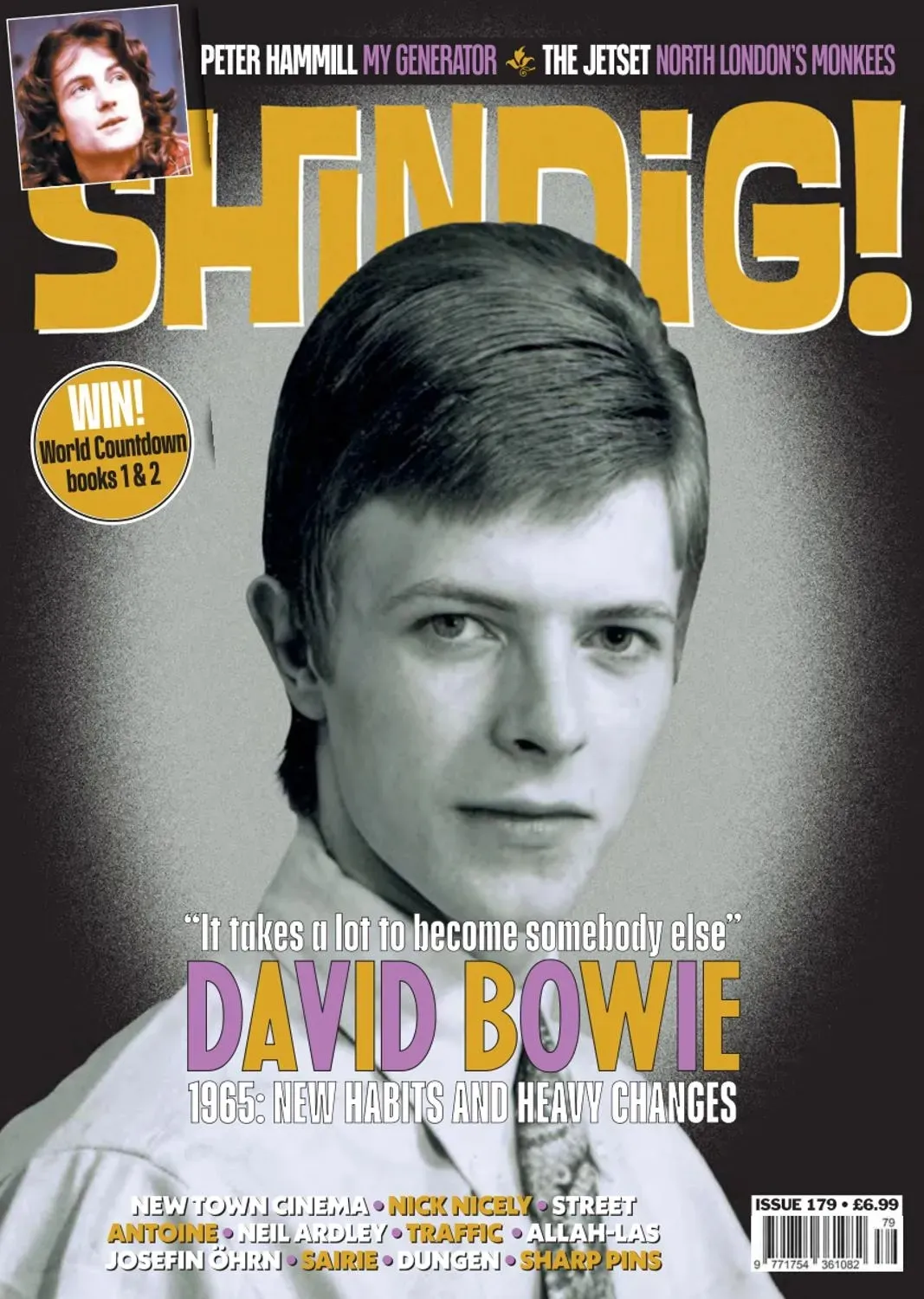
Parlophone has released David Bowie's Shel Talmy Recordings for the first time, and Shindig! Issue 179, September 2026, marks it with the cover line It takes a lot to become somebody else, tracking Davie Jones from long-haired R&B beatnik to sharp mod in a matter of months.
Martin Ruddock writes the Bowie feature as the first half of a two-part, picture-laden piece. Peter Hammill answers 20 Questions with Van der Graaf Generator approaching 60, nick nicely gets covered as the DIY enigma behind Hilly Fields (1892) and wonky psych, and France's original beatnik pop star Antoine opens the features.
Regulars stay busy. New Town Cinema at page 40 covers films made in Britain's new towns between the fifties and early eighties, Neil Erdley's Kaleidoscope Of Rainbows takes Family Album, and reviews run from Gil Scott-Heron's GILBOX 017 box to Automatic Fine Tuning's 1976 prog monster. The Kaleidoscope bookazine runs 132 pages.
—————
Content Guide
▸ Features
p.40 · New Town Cinema
The feature covers how futurism, optimism and redevelopment inspired a wave of TV episodes and movies made in Britain's new towns between the fifties and early eighties. Its pull quote singles out Here We Go Round The Mulberry Bush, where the whole new town aesthetic comes spectacularly to life as an explosion of colour and sound. The piece argues post-war Britain looked nothing like the inherited image of it. Watch one film named here and the concrete-and-glass locations read completely differently.
20 Questions: Peter Hammill
Van der Graaf Generator approaches 60 while continuing to attract new listeners, and the magazine gets an audience with its leader. Hammill is introduced on the cover banner as My Generator, and the editor calls him the mindful Peter Hammill. Twenty questions force short answers, which suits a subject this self-possessed. Play the earliest Van der Graaf records before reading and the answers carry more weight.
nick nicely
The DIY recording enigma pioneered wonky psych and dance music, mixing Beatlesque psychedelia with emerging synth technology. His Hilly Fields (1892) is described as trippy psych-pop with scratching, rooted in the Abbey Road studio scene of 1967, with the psychedelia stretching on into 1982. He never matched Bowie at his height, which the piece says outright. Start with Hilly Fields and the rest of his catalogue makes sense.
Antoine
The feature covers the unlikely origins of France's original beatnik pop star. Antoine sits with nick nicely and Street as one of three pieces here about scenes rather than superstars. French beat gets far less English-language coverage than it deserves. Track down his earliest singles before judging the beatnik framing.
The Jetset
Mod-pop, matching trousers and non-existent TV shows from early eighties north London. The editor remembers the impact of the Jetset's sixties pop obsession on the post-mod revival, and the cover bills them as North London's Monkees. A band built on an imaginary television series is a better story than most real careers. Listen for the television reference in the songs themselves.
Street
Genre-hopping folk-rock from New York City's sixties coffee-house scene, described in the editor's letter as the unheralded sixties New York psychedelic folk-rock band. Coffee-house circuits get documented here rather than the Fillmore. The city and the era anchor it. Find one Street recording and compare it against the San Francisco sound of the same year.
▸ Regulars
Family Album
Neil Erdley's Kaleidoscope Of Rainbows gets the Family Album treatment, described by the editor as a cosmic funk-jazz landmark. The spelling of his surname varies between Erdley and Ordley in the issue itself, which is worth noting before you search for it. Jazz gets a genuine retrospective slot here. Buy the record before the reissue markup arrives.
Songbook
Traffic spread Medicated Goo in this instalment, working from the song outward rather than the album. Songbook entries are short, which keeps them focused on one piece of music. Listen to the original before reading the breakdown of how it was put together.
It's A Happening Thing
The new-music round-up runs Allah-Las, Josefin Öhrn, Sairie, Sharp Pins, Dungen, Dr & The Medics, Biita Houdei, Nina Winder-Lind, Malcolm Catto, Julez & The Rollerz and Quiet Sun. Eleven names in one column is a working playlist rather than a curated few. Scan it for one act you have not heard and follow up this week.
Deep Cuts
The theme this month is the race for space, a subject that lets the column range across psych and prog. Short thematic columns work when the theme is narrow enough to be argued. Read it alongside nick nicely's psychedelia for the same period's obsessions.
▸ Reviews
Gil Scott-Heron
The Revolution Begins: The Flying Dutchman Masters arrives as GILBOX 017, a 3CD set with his first three Flying Dutchman albums, a rare track cut with Pretty Purdie's band, and a bonus disc holding an alternate version of the Free Will album. Three further Scott-Heron reissues follow with catalogue numbers HIQLP 007, CDBGPM 281 and CDBGPM 290, including Free Will as his final album for the label. The Revolution Will Not Be Televised was compiled in 1974 and adds nine tracks from his first three albums. Take the 3CD set over the individual discs and the bonus material justifies it.
The Seeds
The self-titled July 1966 debut is reissued as HIQLP 177. A stated month and year for a debut makes the reissue easy to place in the garage timeline. The Seeds get one line here but it is a specific one. Play it against the later psych in this issue and hear the difference.
2 Of Clubs
Walk Tall – The Fraternity Recordings gathers their complete recordings for the first time as a 10-inch vinyl mini-album, including every Fraternity Records release and two previously unissued tracks discovered in the label's tape archive. Tape-archive finds are the reason to buy reissues like this. Check the two unissued tracks before you file it as a compilation.
Vinyl Art
Bob James and Earl Klugh strike a light on One On One. The column takes a sleeve and works outward from it, which suits a record this photographed. Jazz-fusion sleeves reward close looking more than most. Pull the sleeve out while you listen rather than streaming it.
—————
Editor's Take
The Bowie cover is the draw and Martin Ruddock earns it, working from Parlophone's Shel Talmy Recordings release to track Davie Jones from long-haired R&B beatnik to sharp mod within months, with a second part still to come. Peter Hammill's 20 Questions, with Van der Graaf Generator nearing 60, and the nick nicely piece on Hilly Fields (1892) and the 1967 Abbey Road scene are both strong. The weakness is the contents page, which prints page numbers 32, 34, 48, 54, 60, 66, 6, 7, 8 and 10 detached from their titles, so only New Town Cinema at page 40 can be placed with confidence, and the cover renders Bowie as DAYID. The Kaleidoscope bookazine at 132 pages gets pushed hard. Best for sixties collectors and reissue buyers.
Strengths
• Ruddock's Bowie piece uses Parlophone's Shel Talmy release as a documented hook
• Reviews carry catalogue numbers, formats and bonus-disc contents
• Antoine, Street and nick nicely cover scenes rather than only household names
Weaknesses
• Contents page prints page numbers detached from titles; only page 40 pairs reliably
• Cover renders Bowie's name as DAYID, and Erdley appears as Ordley inside
Verdict: Recommended — the Bowie feature and the catalogue-numbered reviews outweigh a broken contents page.
