
Skeptic – Fall 2026
Summary
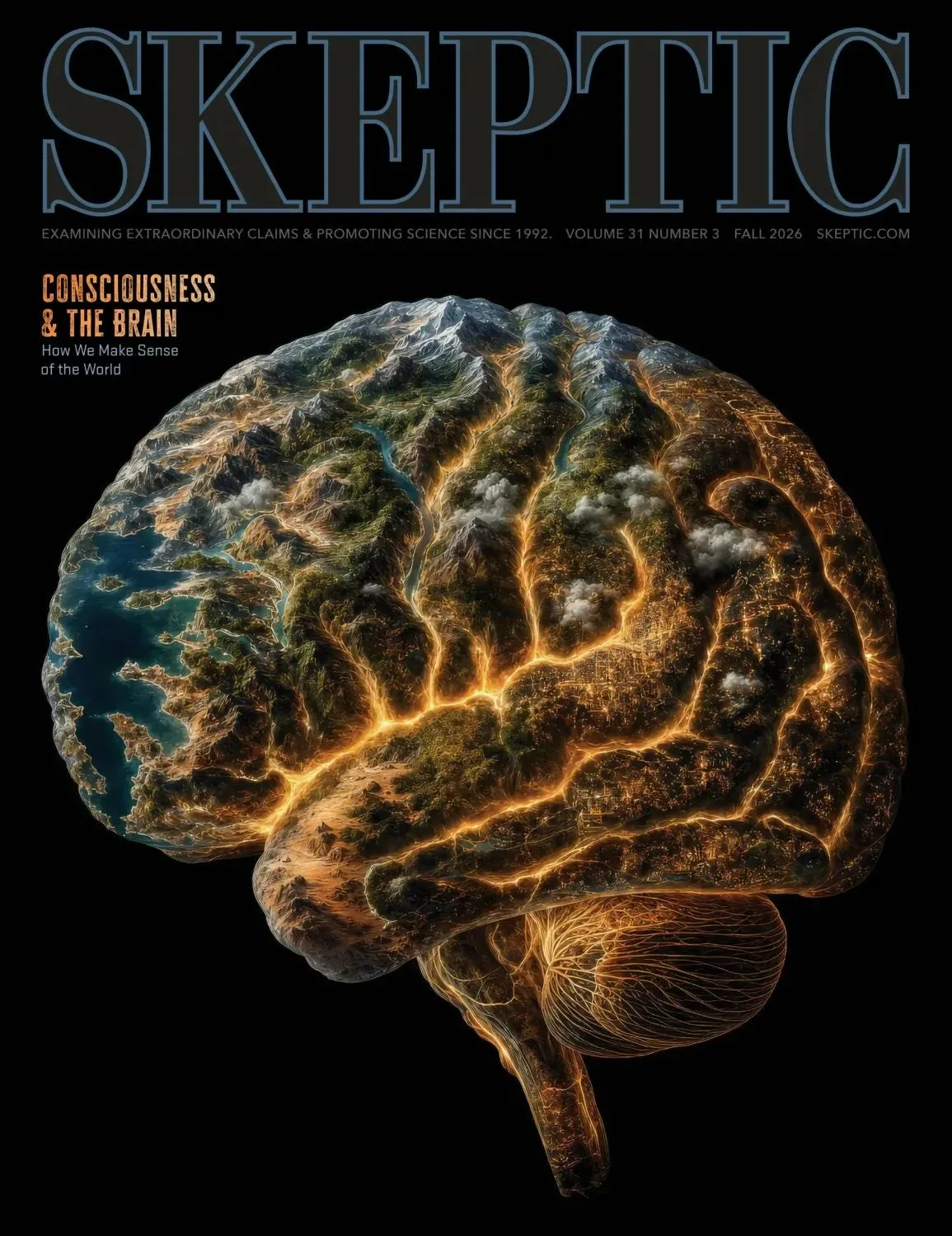
Skeptic's Fall 2026 issue (Vol. 31 No. 3, $7.95) puts consciousness and the brain on the cover, opening with Jashan Mahajan's "The Search for Consciousness" on page 4 and featuring duelling articles on the hard problem — Gary Whittenberger argues it is soluble, Michael Shermer argues it is not. Ralph Lewis examines how mind emerged from mindless matter. William Meller connects Robin Williams and Bruce Willis to frontotemporal dementia.
Adam Neiblum reflects on the nature of scientific thought from the perspective of a primate brain studying itself. J. Michael Menke argues that homelessness is fundamentally a brain problem — and that society intervenes too late. Daniel H. Robinson and Howard Wainer dissect the "Mississippi Miracle" in education, separating smoke and mirrors from reality. Gerald M. Rosen interviews an AI on EMDR's false origin story. Roman Polanski contributes "Hell is empty. All the devils are here." Anondah Saide and Kevin McCaffree present 20 findings from six years of Skeptic Research Center surveys.
The UFO/UAP debate continues with references to the Spring 2026 issue's cover story on "Unidentified Aerial Providence." The Conspiracy Grift issue from Summer 2026 is advertised on the back pages.
—————
Content Guide
▸ Cover Story: Consciousness / Brain & Behaviour / Pseudoscience / Surveys / Regulars
p.4 · The Search for Consciousness
Jashan Mahajan surveys the leading theories — global workspace, integrated information, higher-order thought — and asks which, if any, can be empirically tested. Start with the global workspace theory: it makes the most testable predictions using binocular rivalry experiments.
p.13 · The View From Inside
Ralph Lewis traces how mind emerged from mindless matter through evolutionary steps: sensation, perception, metacognition, and self-awareness. Each step adds a new feedback loop without requiring a ghost in the machine.
p.20 · The Hard Problem is Soluble
Gary Whittenberger argues that phenomenal consciousness reduces to neural information-processing and that a future neuroscience will explain qualia in physical terms. He points to the anaesthesia literature as evidence that consciousness is a brain state.
p.24 · The Hard Problem is Insoluble
Michael Shermer counters that the explanatory gap between neural activity and subjective experience is not merely unknown but unknowable — a limit of any science conducted by a conscious brain. The gap, he argues, is a feature of the explanatory domain, not a bug to be fixed.
p.38 · Why Homelessness Is a Brain Problem
J. Michael Menke presents data showing that untreated traumatic brain injury and cognitive impairment affect a majority of the chronic homeless population. He recommends cognitive screening at intake as the first intervention step.
p.56 · The False Origin Story of EMDR
Gerald M. Rosen interviews an AI to trace how Eye Movement Desensitization and Reprocessing therapy spread despite its origin story — Francine Shapiro's 1987 park walk — being largely fabricated. The article tracks which journal dropped the peer-review requirement for the founding paper.
p.72 · 20 Findings From 6 Years of Skeptic Research Center Surveys
Anondah Saide and Kevin McCaffree report that belief in conspiracy theories correlates more strongly with political alienation than with education level. The data set covers 18,000 respondents across six annual waves.
—————
Editor's Take
This is the strongest Skeptic issue in several quarters because it does not waste space debunking obvious nonsense — the UFO and conspiracy coverage is confined to ads for previous issues, and the editorial team lets the consciousness feature breathe across 30 pages. The dual Whittenberger/Shermer articles are the highlight: two qualified people who disagree fundamentally without strawmanning each other. Menke's homelessness-brain-link article is the issue's surprise strength. Weakness: Roman Polanski's contribution is a single-page quote with no sourcing or argument — it reads like filler. The illustrator credits page is unnecessary.
Strengths
• Whittenberger vs Shermer on the hard problem is genuinely instructive
• Menke's homelessness data is Skeptic at its most applied
• 18,000-respondent survey series adds empirical weight
Weaknesses
• Polanski page is a non-argument quote drop
• No Skeptic of the Month or letter section this issue
Verdict: Recommended — Consciousness coverage alone justifies the price; skip if you prefer applied skepticism over philosophy of mind.
