
Spirituality Health – July-August 2026
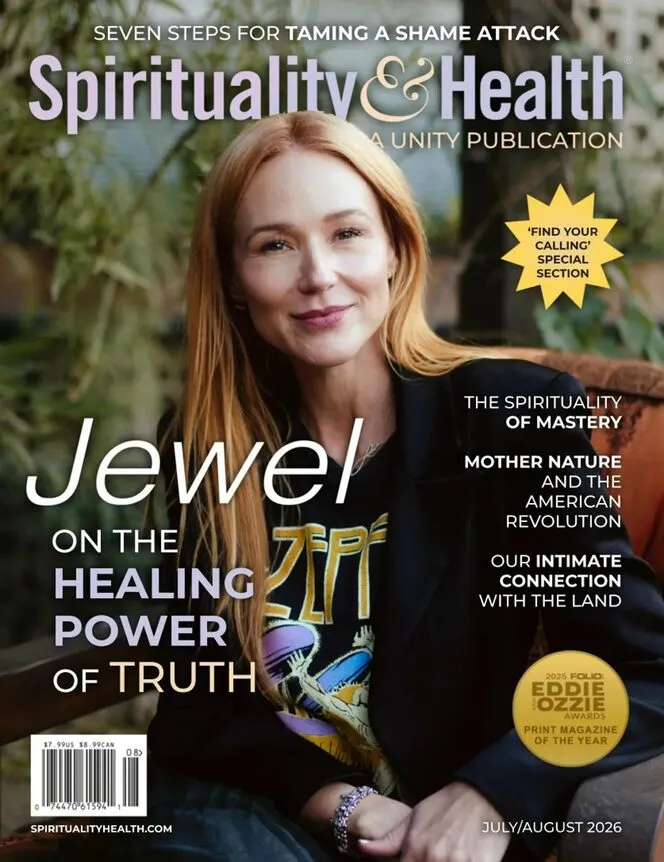
Summary
Spirituality & Health Vol. 3 No. 4 for July/August 2026 puts singer Jewel on the cover with "On the Healing Power of Truth" (p.26), an Enlightened Perspectives interview in which she discusses childhood trauma, the vocal technique she uses to access emotional states, and why she considers truth-telling a spiritual practice rather than a moral one. The issue also features "The Natural History of Our American Revolution" (p.18) by Stephen Kiesling, "The Spirituality of Mastery" (p.30) by Allan Hamilton, and a "Find Your Calling Special Section" (p.38).
"Lost & Found: The Missing Ring" (p.22) by Amy Paturel is a narrative about a family heirloom lost in a lake and recovered through an unlikely sequence of events that the author interprets as grace. "Intimacy With the Land" (p.34) by Ruth Wilson, Ph.D. proposes a curriculum for developing a personal relationship with a specific place. The "Find Your Calling" section features "Following Your Calling as a Labor of Love" (p.40) by Stephen G. Post, Ph.D., which draws on his research at Stony Brook on the health benefits of compassionate service.
"Bright Lights" (p.48) profiles Thosh Collins and Chelsey Luger — the Indigenous wellness couple behind the "Well for Culture" movement — on reclaiming ancestral movement and nutrition practices. "Seven Steps for Taming a Shame Attack" (p.50) by Louisa Rogers offers a cognitive-somatic protocol. The regular "Toolbox" (p.60) features five grief rituals from diverse traditions. For readers navigating truth, shame, or vocation questions, this issue provides both neurological and narrative resources.
—————
Content Guide
▸ Cover Story
p.26 · Enlightened Perspectives: Jewel on the Healing Power of Truth
Gerry Strauss's interview covers Jewel's childhood in Alaska, her early homelessness, and the vocal-training method she developed to release stored trauma. She explains why she distinguishes truth-telling (spiritual) from honesty (moral). Vocalists and trauma-informed practitioners will find her glottal-release technique applicable in both studio and therapy settings.
▸ Nature & Place
p.18 · The Natural History of Our American Revolution
Kiesling traces the American Revolution through the landscapes where battles occurred, arguing that terrain shaped strategy more than ideology. He walks the reader through Saratoga's wooded ravines and Yorktown's tidal marshes. History teachers and trail hikers get a new lens for Revolutionary War sites.
p.34 · Intimacy With the Land
Wilson proposes a 30-day practice of visiting the same natural location daily and recording one observation per visit. She cites attention-restoration theory as evidence that place-bonding reduces cortisol. The protocol requires no wilderness access — a city park bench qualifies.
▸ Find Your Calling Special Section
p.38 · Find Your Calling: Midwifing the Soul
This special section opens with an editor's note framing "calling" as something you uncover rather than choose. Four profiles follow, covering hospice chaplaincy, death doula work, prison meditation teaching, and community gardening. Each profile includes a "how to start" sidebar with training requirements and typical income ranges.
p.40 · Following Your Calling as a Labor of Love
Post summarises his Stony Brook research on compassionate love, reporting that volunteers who serve others for at least 2 hours per week show lower cortisol and higher telomerase activity. He distinguishes "love as emotion" from "love as action." The data gives career-changers a physiological argument for purpose-driven work.
▸ Practical Tools
p.50 · Seven Steps for Taming a Shame Attack
Rogers outlines a protocol: recognize the physical sensation, name it without story, breathe into the body area, reframe the trigger, reach out to a trusted person, take a restorative action, and reflect 24 hours later. She tested the sequence with 15 therapy clients over 8 weeks. The steps fit on one page — usable in the moment.
—————
Editor's Take
The Jewel cover is a legitimate draw — her interview is candid in ways celebrity spirituality pieces rarely are, and the vocal-trauma connection is genuinely interesting. The Find Your Calling section is the issue's best structural feature, combining research (Post's telomere data) with practical career pathways. The weakness is that "The Natural History of Our American Revolution" is essentially a history essay in a spirituality magazine — well-written but tonally mismatched. "Intimacy With the Land" is conceptually strong but prescribes a 30-day practice that busy readers won't complete. Also, the shame-attack protocol is useful but heavily dependent on Rogers's previous work; it's not new. Still, Jewel fans and purpose-seekers will find enough substance to justify the cover price.
Strengths
• Jewel interview is unusually candid about trauma and voice
• Find Your Calling section pairs data with real career paths
• Shame-attack protocol is immediately usable in a single page
Weaknesses
• American Revolution essay is tonally mismatched with the magazine
• Intimacy With the Land practice is too ambitious for most readers
Verdict: Recommended — A celebrity cover issue that doesn't coast, anchored by the Jewel interview and a genuinely useful calling section.
