
The European Business Review – July-August 2026
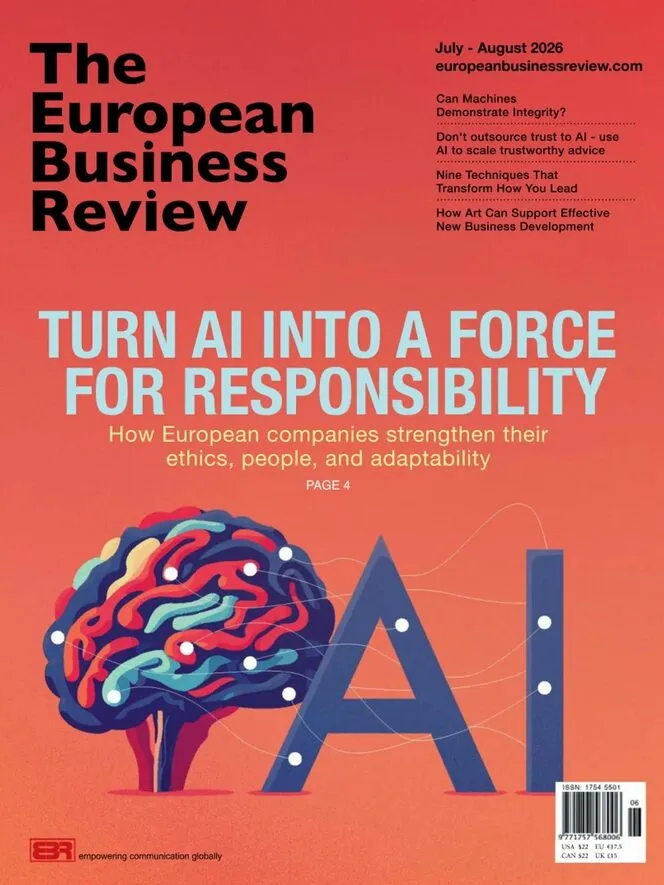
Summary
US$22 / EU 17.5 buys The European Business Review July-August 2026, headlined "Turn AI into a Force for Responsibility." Laetitia Cailleteau, Philippe Roussiere and Josh Elkind anchor the cover on how European companies strengthen ethics, people and adaptability. Hamilton Mann crash-tests artificial integrity. Avi Liran offers ten techniques that transform how you lead.
The cover story (p.4) by Laetitia Cailleteau, Philippe Roussiere and Josh Elkind examines how European firms embed responsibility into AI systems. Hamilton Mann (p.10, Editor's Pick) asks whether machines can demonstrate integrity. Prashant Bharadwaj and Dominic Houlder (p.16) argue for using AI to scale trustworthy advice rather than outsourcing trust. Anna Rostomyan (p.20) looks at AI reshaping the fashion industry. Peter Lorange (p.34) connects art to new business development. Terence Tse (p.44) delivers a Digital Twins 101. Adrian Furnham (p.94) surveys workplace surveillance. The Good Plastic Company (p.98) provides a circular-design case study.
Regular sections include Cover Story, Artificial Intelligence, Fashion, Luxury, Entrepreneurship, Strategy, Future Series, Innovation, Leadership, Management, Workplace, Supply Chain and Sustainability. Contributors include Avi Liran, Filippo Renga, Aidan McKearney and Guilherme F. Frederico.
—————
Content Guide
▸ Cover Story
p.4 · Turn AI into a Force for Responsibility — How European Companies Strengthen Their Ethics, People and Adaptability
Laetitia Cailleteau, Philippe Roussiere and Josh Elkind present a three-pillar framework: ethics-by-design, employee upskilling and organisational adaptability. The article draws on case studies from European banks, manufacturers and healthcare providers. Use their ethics-readiness matrix to audit any AI system your organisation is considering deploying.
▸ Artificial Intelligence
p.10 · Can Machines Demonstrate Integrity? Crash-Testing Artificial Integrity, Not Intelligence (Editor's Pick)
Hamilton Mann proposes replacing the AI-trust question with a testable integrity framework. The article defines four integrity dimensions — transparency, accountability, fairness and reliability — and offers a lab-style crash test for each. Run the integrity crash test on your vendor's AI before signing a procurement contract.
p.16 · Don't Outsource Trust to AI — Use AI to Scale Trustworthy Advice
Prashant Bharadwaj and Dominic Houlder distinguish between automating trust (dangerous) and using AI to amplify human judgment (productive). Examples come from financial services and legal advisory contexts. Apply their trust-scaling framework to identify which of your current AI uses fall on the wrong side of the line.
▸ Leadership
p.60 · Listening Well, Leading Better — Ten Techniques That Transform How You Lead
Avi Liran delivers a practical playbook of ten specific listening techniques, each with a workplace scenario and expected outcome. Techniques include the three-minute rule, the paraphrase-before-responding method and silence-management in meetings. Pick one technique per week for the next ten weeks and track the change in your team's engagement scores.
p.70 · Removing the Barriers to Diverse Leadership — Why Real Progress Requires Systemic Change
Aidan McKearney argues that diversity programmes fail when they focus on individual bias rather than structural barriers. Data from a multi-year European study shows which interventions actually shift representation metrics. Audit your promotion pipeline using the structural-barrier map in the article.
▸ Strategy & Innovation
p.34 · How Art Can Support Effective New Business Development
Peter Lorange makes a counter-intuitive case: exposure to artistic processes improves strategic decision-making. The article cites controlled experiments where executives who engaged with art produced more innovative business concepts. Try the three-session art-intervention format described here with your next strategy off-site.
p.44 · Digital Twins 101 — The Virtual Strategy Reshaping How Businesses Operate
Terence Tse provides a primer on digital-twin technology, moving beyond manufacturing into retail, healthcare and city planning. Cost-to-benefit ratios are included for each sector. Use the sector-readiness table to identify where your industry stands on the digital-twin adoption curve.
p.48 · E-Invoicing — For Regulatory Shift, Read Strategic Advantage (Interview)
Interview with Adam Beldzik of Comarch on how e-invoicing mandates across Europe create data-strategy opportunities. The conversation covers integration timelines, data-standardisation challenges and the competitive advantage of early adoption. Check your AP automation roadmap against the mandate calendar in this interview.
▸ Sustainability
p.98 · The Good Plastic Company — Generating Circular Design by Choosing Scalable Waste
Fernanda Arreola, Gregory Unruh and Sabine Bacouel-Jentjens profile a company turning post-consumer plastic waste into design-grade panels. The case covers the business model, supply-chain partnerships and revenue trajectory. Use their circular-economy metrics framework to evaluate your own company's waste-to-value initiatives.
▸ Workplace
p.94 · Surveillance at Work — Big Brother Is Monitoring You
Adrian Furnham surveys the landscape of workplace surveillance technology, from keystroke logging to emotion AI. The article covers legal limits across EU jurisdictions and the documented effects on employee trust and productivity. Review your organisation's surveillance policies against the employee-trust benchmarks cited here.
—————
Editor's Take
This is EBR's strongest issue of the year so far. The theme — turning AI into a force for responsibility — holds together better than the previous issues' broader framing. Hamilton Mann's integrity crash-test is the standout article, original and operationally useful. Avi Liran's ten listening techniques is the surprise hit — practical enough to use on Monday morning. The Good Plastic Company case study provides a welcome concrete business model amid the conceptual pieces. Weakness: Adrian Furnham's surveillance piece covers ground he has written about before, and the fashion-AI article (p.20) adds little to the existing conversation. This issue fits chief ethics officers, AI governance leads and strategy directors who need both frameworks and tools.
Strengths
• Hamilton Mann's integrity crash-test is genuinely novel
• Avi Liran's listening techniques are immediately actionable
• Cover story framework is robust and well-illustrated with cases
Weaknesses
• Furnham surveillance article recycles familiar territory
• Fashion AI piece adds marginal new insight
Verdict: Essential — The most coherent and useful EBR issue of 2026 so far, with two standout practical pieces.
