
The New Yorker – January 1, 2024
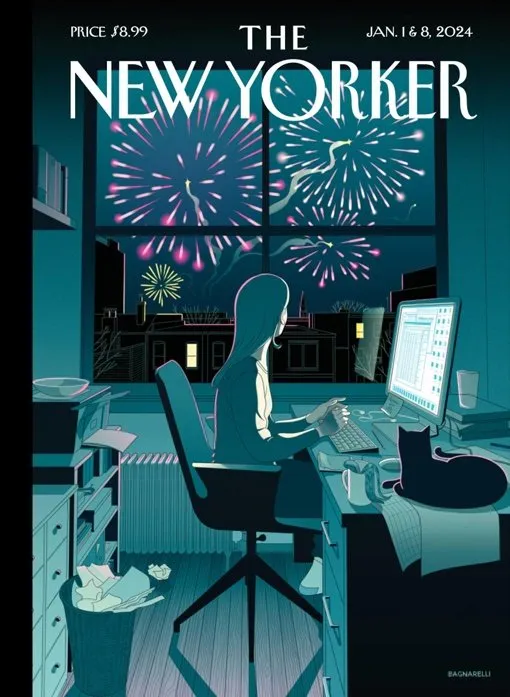
Summary
Mosab Abu Toha, a Palestinian poet shortlisted for the National Book Critics Circle Award, writes from Gaza as his family flees home — the letter that opens The New Yorker's January 1 & 8, 2024 double issue. At $8.99, this combined number packs Jonathan Franzen on L.A.'s cat overpopulation, Patrick Radden Keefe profiling a Hollywood script doctor, and Zach Helfand tracing the evolution of the gratuity.
Abu Toha's "Unsafe Passage" (page 12) is the emotional anchor — a first-person account of displacement that reads with the compression of his poetry. Franzen's "The Cats of L.A." (page 34) tackles the No Kill movement's unintended ecological consequences with his characteristic environmental rigor. Keefe profiles an anonymous script doctor who finally found his own voice ("The Ventriloquist," page 24). Helfand's "Tipping Points" (page 18) runs through the history of gratuity culture as Americans face tip fatigue.
The critics section covers Adam Gopnik on Camille Pissarro, Manvir Singh on the Mongol Empire's global impact, Anthony Lane on "Ferrari" and "The Crime Is Mine," and Helen Shaw on Branden Jacobs-Jenkins' "Appropriate." Fiction comes from Rivka Galchen; poems from Madeleine Cravens and Paul Muldoon.
—————
Content Guide
▸ Features / Reporting
p.12 · Unsafe Passage — Mosab Abu Toha
A Gaza poet documents his family's flight from their homeland as bombing closes in around them. Abu Toha, whose debut poetry book was a National Book Critics Circle Award finalist, brings a literary sensibility to war reporting. The details of checkpoint procedures and temporary shelter logistics are a record that human-rights researchers will cite.
p.34 · The Cats of L.A. — Jonathan Franzen
Franzen examines the No Kill shelter movement and its consequences for Los Angeles' bird and small-mammal populations. The piece traces how well-intentioned policies have led to feral-cat colonies that conservationists cannot control. If you volunteer with a rescue organisation, Franzen's critique of trap-neuter-return programmes gives you the opposing argument to engage with honestly.
▸ Profiles
p.24 · The Ventriloquist — Patrick Radden Keefe
Keefe (author of Empire of Pain and Say Nothing) profiles a Hollywood script doctor who spent decades fixing other writers' scripts before finding his own voice. The piece doubles as a craft study on what makes a screenplay work and what it costs a writer to stay anonymous.
▸ Annals of Society
p.18 · Tipping Points — Zach Helfand
A cultural history of gratuity from its European origins to the contemporary American tipping explosion. Helfand tracks how digital payment screens have normalised the 20-percent floor. Read this before your next restaurant visit — you will never look at a Square tablet the same way again.
▸ Critics & Culture
p.53 · Camille Pissarro's Profundities — Adam Gopnik
Gopnik re-evaluates the Impressionist painter often dismissed as the group's quiet member. The essay uses Pissarro's later urban views to argue for his radical social vision. Next time you visit the impressionist galleries, skip the Monets and stand in front of a Pissarro cityscape for five minutes.
p.58 · How the Mongol Hordes Made the World — Manvir Singh
A critic-at-large essay on the Mongol Empire's role in shaping global trade, diplomacy, and disease patterns. Singh reviews new scholarship that reframes the Mongols from destroyers to accidental globalisers. The trade-route data cited here updates what most world-history textbooks still get wrong.
p.54 · The Current Cinema — Anthony Lane
Lane reviews Michael Mann's "Ferrari" and François Ozon's "The Crime Is Mine." His assessment of the racing sequences in "Ferrari" tells you whether the big-screen experience justifies the ticket price — his verdict on the sound design alone is worth reading before you book.
▸ Fiction & Poetry
p.44 · "Crown Heights North" — Rivka Galchen
A new short story set in Brooklyn that examines class, race, and property through the lens of a neighbourhood dispute. Galchen's dialogue technique — characters talk past each other while revealing everything — is worth studying if you write fiction.
p.40 · "Leaving" — Madeleine Cravens
p.46 · "Federico García Lorca, Coney Island, 1929" — Paul Muldoon
Two poems that bookend the fiction section. Muldoon's Lorca piece imagines the Spanish poet's imaginary visit to Coney Island — a collision of modernist melancholy and American carnival kitsch.
—————
Editor's Take
This is a strong double issue anchored by Abu Toha's Gaza letter and Franzen's cat-population essay — both are essential reading. Keefe's script-doctor profile is the sleeper hit: a Hollywood story that avoids celebrity cliche. Weakest section: the "Goings On" front-of-book listings are skimpy for a combined issue that covers two weeks. At $8.99 for a double issue the value is fair, though regular single-issue subscribers effectively lose an edition. Suited for New Yorker regulars who want the Franzen and Abu Toha pieces; casual readers could wait for the digital single-article purchase.
Strengths
• Mosab Abu Toha's first-person Gaza account — literary and documentary value
• Jonathan Franzen's No Kill movement critique backed by ecological data
• Patrick Radden Keefe's portrait of an anonymous Hollywood craftsman
Weaknesses
• "Goings On" listings thinner than a standard issue — short-changes two-week coverage
• Combined issue means one fewer delivery for annual subscribers
Verdict: Essential — The Abu Toha and Franzen pieces make this a historically important issue, not just a temporary read.
