
The Strad – September 2026
Summary
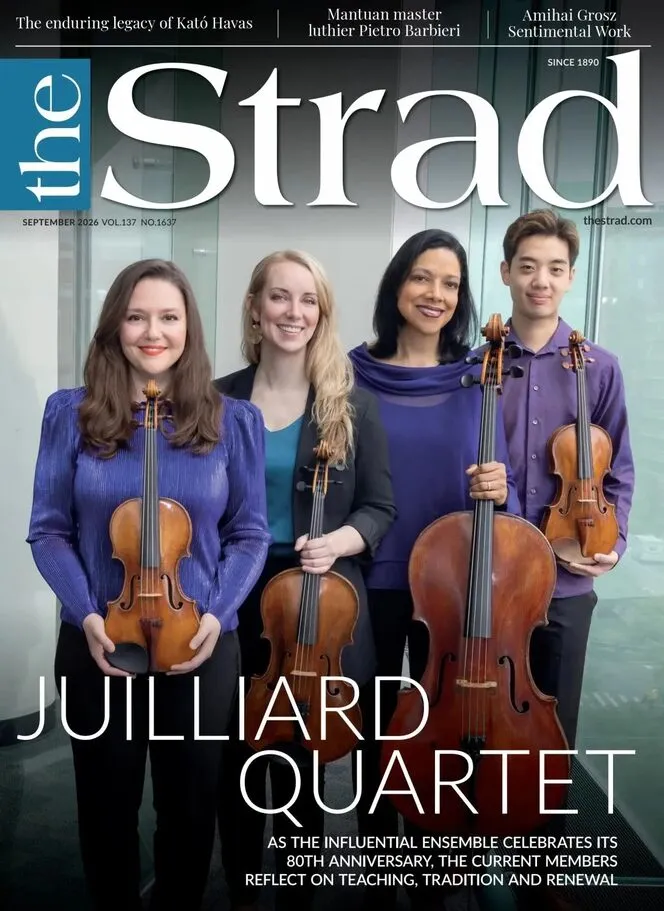
The Juilliard Quartet was formed in 1946 at the Juilliard School, and every current member joined between 2016 and 2025, a turnover that Thomas May puts directly to them in The Strad September 2026, Vol.137 No.1637, whose cover story asks how an 80-year-old ensemble handles teaching, tradition and renewal.
Alongside the anniversary feature, Clifford Hall assesses the modern legacy of Hungarian-born pedagogue Kató Havas, whose New Approach unsettled string teaching in the mid-twentieth century, while Florent Boyer concludes his two-part study of the French transitional period by examining Nicolas Lupot and his Parisian contemporaries. Philip Kass and Andrea Zanrè reconstruct the Mantuan maker Pietro Barbieri from a handful of surviving violins and one viola.
Practical pages run deep. David Kettle collects practice routines from leading players, Alessandro Peiretti demonstrates a Gofriller-style cello scroll, Tamás Guminár argues for kaolin's role in chatoyancy, and Elene Meipariani of Trio E.T.A. teaches the first movement of Haydn's Piano Trio Hob.XV:27. Reports cover the 2026 Queen Elisabeth Cello Competition and young artists' programmes.
—————
Content Guide
▸ Cover Story
p.28 · JUILLIARD QUARTET AT 80
Thomas May puts four current members of the New York ensemble in conversation as it reaches 80 years since its 1946 founding at the Juilliard School. The line-up has been entirely rebuilt between 2016 and 2025, which makes the questions about inherited tradition concrete rather than ceremonial. The players speak as teachers as much as performers. Anyone coaching a student quartet can lift their language about handing over repertoire.
▸ Teaching And Practice
p.38 · KATÓ HAVAS
Clifford Hall examines what survives of the New Approach developed by the Hungarian-born violin pedagogue whose ideas caused shockwaves in the mid-twentieth century. Hall separates the teaching that has been absorbed into mainstream practice from the parts still considered contentious. It is a serious assessment rather than a tribute. Teachers can test one Havas principle in a lesson this week and see what changes.
p.48 · HOW I PRACTISE
David Kettle asks leading string players to describe their actual practice methods and routines, and the answers diverge sharply. The value lies in the disagreements: there is no single model presented as correct. It is the most portable article in the issue for students. Take one routine that contradicts your habits and try it at tomorrow's session.
p.94 · MASTERCLASS
Elene Meipariani, violinist of Trio E.T.A., works through the first movement of Haydn's Piano Trio Hob.XV:27, bar by bar. She writes from chamber-music experience, so the advice covers ensemble balance as well as violin technique. The specificity of a single movement makes it usable rather than general. Bring the score and her notes to your next trio rehearsal.
p.100 · TECHNIQUE
Valentina Scheldhofen Ciardelli, double bassist and Trinity Laban professor, addresses expressivity in bass playing, an area usually treated as a secondary concern. She connects physical technique to phrasing choices rather than treating them separately. Bass players get rare dedicated column space here. Apply her approach to one slow passage and listen for the difference in line.
p.23 · LIFE LESSONS
Matthew Jones, head of chamber music at the Guildhall School of Music and Drama, reflects on the lessons that shaped his own playing and teaching. His institutional position gives the piece weight when he discusses what students actually need. It is short and quotable. Note the habit he singles out and check whether your own practice contains it.
▸ Making And Instruments
p.56 · FRENCH TRANSITIONAL PERIOD – PART TWO
Florent Boyer closes his two-part investigation of Parisian makers of the eighteenth and early nineteenth centuries, with Nicolas Lupot and his contemporaries at the centre. Boyer treats the transition as a set of documented workshop changes rather than a stylistic label. Readers without part one will still follow the argument, though they will want it. Use his comparisons when dating French instruments of that period.
p.72 · PIETRO BARBIERI
Philip Kass and Andrea Zanrè examine a lesser-known Mantuan luthier whose nineteenth-century reputation rests on a handful of violins and a single viola. The authors work forward from the surviving instruments rather than from local legend. It is careful attribution scholarship of the kind The Strad does best. Check the identifying features they list against any Mantuan claim you encounter.
p.81 · IN FOCUS
The instrument under examination is a violin by Lorenzo Arcangioli dated around 1850, described by Peter Körner, who has run a violin-making shop in Mainz since 1985. The write-up combines physical description with market context. Körner's maker's eye picks out details a player would miss. Read it before viewing any mid-nineteenth-century Italian violin.
p.84 · TRADE SECRETS
Alessandro Peiretti sets out his method for carving a Gofriller-style cello scroll, step by step. His credentials are specific: prizes at the Cremona International Triennale competition in 2015, 2018, 2021 and 2024, including first prize in the cello category in 2024. The sequence is written to be followed at the bench. Makers can take his template straight into the next scroll.
p.90 · MAKING MATTERS
Tamás Guminár, a Budapest maker who works from Stradivari, Guarneri del Gesù and Gasparo da Salò models, argues that kaolin may be crucial to chatoyancy in varnish. He treats the question as a material problem with testable consequences. It is a technical piece aimed squarely at makers. Try his ground preparation on a test panel before committing to an instrument.
p.88 · MY SPACE
The column visits the workshop of Daniel King and Joe Roach at Cardiff Violins in the UK, documenting how the two share a bench and a business. Layout, tooling and division of labour all get covered. It is practical for anyone setting up a shared workshop. Note how they separate repair traffic from making time.
▸ Reports And Regulars
p.70 · SESSION REPORT
Théotime Langlois de Swarte tells Harry White about recording Le Violon de Rameau with organist and harpsichordist William Christie. The conversation covers instrument choice and the decisions behind the programme rather than studio anecdotes. It works as a listening guide to the release. Hear the album with his reasoning in mind and the phrasing choices register.
p.26 · POSTCARD FROM BRUSSELS
The report covers the 2026 Queen Elisabeth Cello Competition, one of the few contests that reliably shapes careers. It reads the results as evidence of where cello playing is heading rather than simply listing prizes. Competition-bound students get a realistic picture of the standard. Watch the named finalists' rounds before planning your own repertoire.
p.62 · YOUNG ARTISTS' PROGRAMMES
Hattie Butterworth examines the schemes and networks that support emerging string players, and what they actually provide beyond a title. The piece compares structures rather than advertising them. It is useful reading before an application deadline. Match your own stage of career against the programme types she sets out.
p.122 · SENTIMENTAL WORK
Violist Amihai Grosz explains his attachment to Schubert's Arpeggione Sonata D821, a work violists have adopted from an obsolete instrument. His account is personal but specific about passages. It closes the issue on a player's voice rather than an editorial one. Revisit the sonata with his reading of it in hand.
—————
Editor's Take
This issue is at its strongest when it does attribution and bench work: Kass and Zanrè rebuilding Pietro Barbieri from a handful of Mantuan instruments, Boyer on Lupot and the Parisian transition, and Peiretti's Gofriller scroll method backed by four Cremona Triennale prizes. The Juilliard Quartet cover feature is more than an anniversary lap because the entire line-up has changed since 2016, which forces real answers about tradition. The weakness is fragmentation. Makers get Barbieri, kaolin, scrolls and Cardiff Violins while players get practice routines and one Haydn masterclass, so neither readership owns the whole magazine, and the French transitional feature depends on a part one you may not have. Best for luthiers and serious students rather than casual concertgoers.
Strengths
• Barbieri attribution built from surviving violins, not local legend
• Peiretti's scroll method comes with verifiable Cremona Triennale results from 2015 to 2024
• How I Practise prints conflicting routines instead of one prescribed model
Weaknesses
• Content splits between maker and player readerships with little overlap
• French transitional feature is part two and assumes the previous issue
Verdict: Essential — for luthiers and string teachers, the Barbieri, Lupot and Trade Secrets material alone justifies the issue.
