
The Times Literary Supplement – 7 August 2026
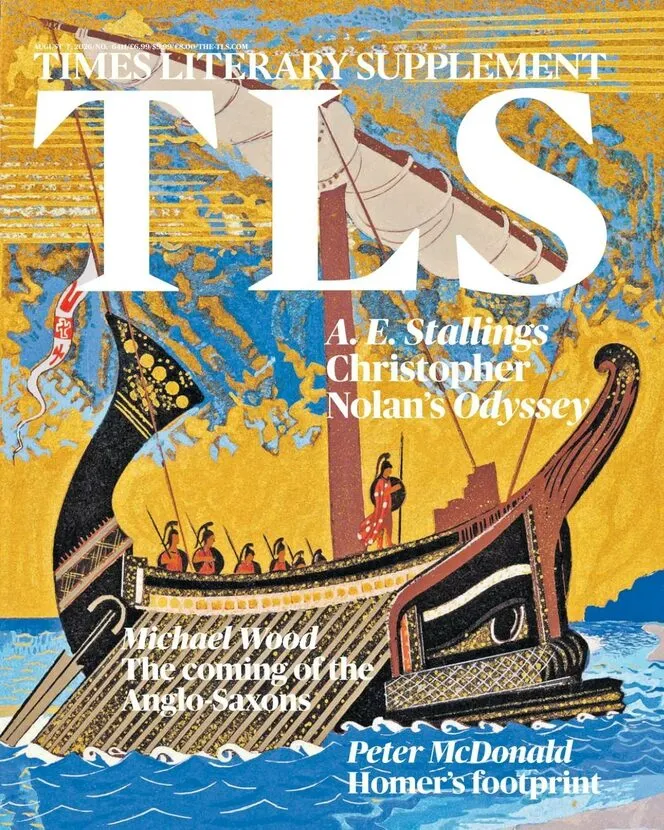
Summary
A.E. Stallings on Christopher Nolan's Odyssey, Michael Wood on the coming of the Anglo-Saxons, and Peter McDonald on Homer's footprint — these three cover lines anchor The Times Literary Supplement August 7 2026, Number 6411. The 48-page weekly delivers its usual density of academic book reviews across 20 departments.
The department structure runs across history, politics, classics, arts, fiction, francophone literature, French food and literature, German studies, memoirs, science fiction, natural history, Jewish studies, literature, art history, and in brief. The arts section covers The Odyssey in cinemas and The Cherry Orchard at the Swan Theatre. The fiction section reviews Amit Chaudhuri's Incompleteness and Donal Ryan's Where Are the Kings. The poem section features Selima Hill's "Wittgenstein's Hatred of Daylight" and Sam Riviere's "Warm War." NB closes with headless introductions and Alan Turing's story.
Content Guide
▸ Arts / Culture
p.22 · The Odyssey — A.E. Stallings on Christopher Nolan's Film
Stallings reviews Nolan's adaptation of Homer's epic. She analyzes the director's choice to set the film in a post-apocalyptic framing device. The review notes that Nolan's cyclops is a machine, not a mythological creature. Stallings gives the film a qualified defense but questions the runtime: 2 hours 45 minutes is too short for the full poem.
p.22 · The Cherry Orchard — Anton Chekhov at the Swan Theatre
Michael Caines reviews the RSC production in Stratford-upon-Avon. The production sets the play in 1990s Russia with mobile phones substituting for telegrams. Caines argues the update works until the third act.
▸ History / Politics
p.3 · The Coming of the Anglo-Saxons — Michael Wood
Wood reviews 5 books on early medieval England, including Nicholas Higham's How England Began and Robin Fleming's The Material Fall of Roman Britain. He argues that the Anglo-Saxon migration was smaller and slower than popular histories claim. The Fleming book uses archaeological data from 400 burial sites to support the slow-migration thesis.
p.14 · US Grand Strategy and the Madman Theory — Sam Freedman
A review of James D. Boys's book on Nixon-era foreign policy. Freedman assesses whether the "madman theory" — making an adversary believe a leader is irrational enough to use nuclear weapons — has modern relevance. The book uses declassified White House tapes from 1971.
▸ Fiction / Literature
p.26 · Incompleteness — Amit Chaudhuri
Michael Caines reviews Chaudhuri's novel about a composer completing an unfinished work by his dead mentor. The reviewer notes the novel's structure mirrors a musical fugue with 3 interwoven narratives. The novel was shortlisted for the 2026 Goldsmiths Prize.
p.26 · Where Are the Kings — Donal Ryan
Dinah Birch reviews Ryan's latest novel set in rural Ireland. The book follows 4 families over a single calendar year. Birch praises the dialogue but finds the ending unresolved.
▸ Commentary / Poetry
p.19 · Poem — "Wittgenstein's Hatred of Daylight" by Selima Hill
Hill's poem imagines the philosopher's discomfort with bright mornings. The poem uses 14 lines of irregular meter. It is Hill's first publication in the TLS since 2023.
p.18 · Matches Struck in the Dark — William Empson and Virginia Woolf
A commentary piece examining Empson's unpublished diaries and their references to Woolf. The diaries are held at the British Library and were deposited in 2025. The author argues Empson admired Woolf's prose but resented her social circle.
Editor's Take
TLS Number 6411 is a standard-issue week in the best sense: 20 departments, no weak links, every review written by a subject expert. Stallings on Nolan's Odyssey is the marquee piece — she is one of the few classicists who can write for both academics and film critics. Michael Wood's Anglo-Saxon round-up is the most useful review section; the 400-burial-site evidence base gives readers a concrete number to cite. The fiction section is thin this week — Chaudhuri and Ryan are solid but not revelatory. The Letters page takes up valuable space with a running dispute about Godot productions. At 6.99 pounds, the value-per-review ratio remains high.
Strengths
• Stallings on Nolan's Odyssey with post-apocalyptic reading and runtime critique
• Wood's Anglo-Saxon review using 400-burial-site archaeological data
• 20-department breadth with no single weak section
Weaknesses
• Fiction section lacks a major-review title this week
• Letters page consumed by a niche Godot production dispute
Verdict: Recommended — Reliable TLS quality; buy for the Stallings and Wood features.
