
The Week Junior Science+Nature UK – August 2026
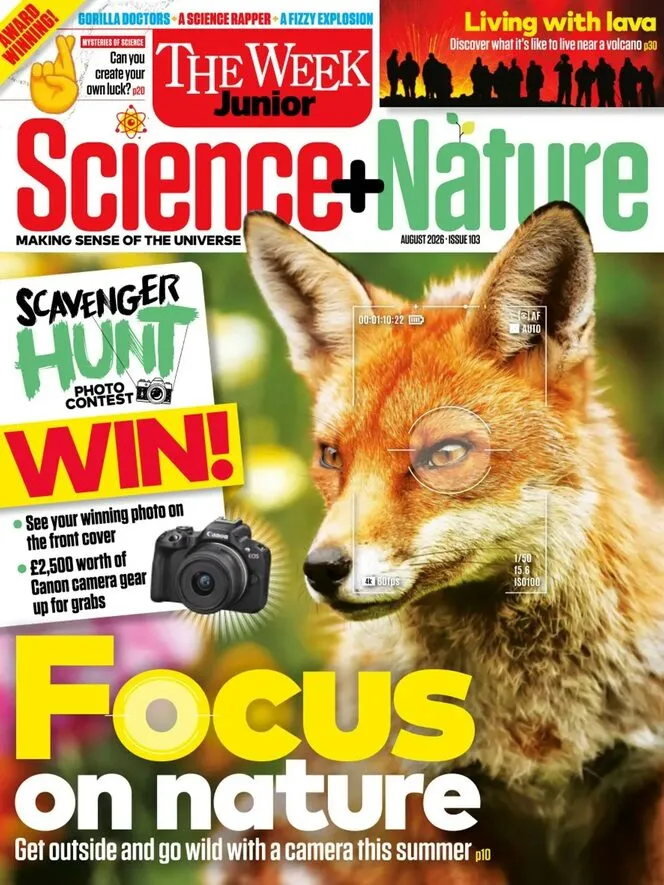
Summary
The Week Junior Science+Nature's August 2026 issue puts a Canon gear bundle worth £2,500 at the centre of its Scavenger Hunt Photo Contest, open from July 17 to August 23. Ten nature-themed challenges send readers outdoors to photograph wildlife, weather, and natural patterns. Inside, a new breed of self-driving cars roars into the UK on page 14, and scientists explain what it takes to live beside an active volcano on page 30.
The Living with Lava feature on page 30 takes readers inside communities near volcanoes from Iceland to Indonesia, covering evacuation drills, lava-diverting barriers, and the soil fertility that keeps people coming back. Cruise Control on page 14 profiles autonomous vehicles now testing on UK roads, including sensor arrays and legal frameworks. Heroes of Science on page 16 meets a science rapper who turns equations into lyrics. Planet Protectors on page 24 shadows the gorilla doctors of the Virunga Mountains.
The Big Question on page 34 explains what seashells are and where they come from. Weird Science rounds up strange research. The Lab on page 42 offers three summer science activities. Puzzles on page 48 test animal-themed brain-teasers. The plastic-free pledge — the magazine has eliminated plastic packaging since 2018, saving six tonnes of waste — runs in the masthead.
—————
Content Guide
▸ Features / Nature & Wildlife / Science & Tech / Puzzles / Regulars
p.10 · Scavenger Hunt Photo Contest
Ten nature-themed challenges — from "creature close-up" to "weather snapshot" — run from July 17 to August 23. The winner receives £2,500 worth of Canon camera equipment, magazine cover placement, and a family holiday ticket. Submit entries via the magazine's website with the subject line "Photo Contest."
p.14 · Cruise Control
A new breed of self-driving cars tests on UK roads, using lidar arrays and real-time traffic mapping. The article breaks down the six SAE autonomy levels and explains why Level 4 robo-taxis are hitting British suburbs before private cars. Check your local council's autonomous-vehicle trial zone map.
p.16 · Heroes of Science: Meet a Science Rapper
A UK-based science communicator turns equations into hip-hop verses, covering topics from quantum physics to photosynthesis. His YouTube channel posts a new science lyric video every two weeks — start with the periodic table rap for classroom icebreakers.
p.24 · Planet Protectors: The Gorilla Doctors
The Gorilla Doctors veterinary team in the Virunga Mountains treats mountain gorillas injured by snares and respiratory illness. Donations directly fund field surgeries; the programme has treated over 240 gorillas since 1998.
p.30 · Living with Lava
What it takes to live beside an active volcano: evacuation drills, lava barriers, and the ash-enriched soil that makes farming profitable despite the risk. Icelandic communities use a three-zone alert system — practice evacuating your local zone before the sirens sound.
p.34 · The Big Question: What Are Seashells?
Seashells are the external skeletons of molluscs, built from calcium carbonate extracted from seawater. A single giant clam can produce a shell weighing over 200 kilograms over its lifetime.
p.38 · For or Against: Should We Control Invasive Species?
Readers weigh arguments for and against culling invasive species, from grey squirrels in the UK to cane toads in Australia. The article presents both ecological and ethical cases without a prescribed answer.
p.42 · The Lab: Three Summer Science Activities
Three hands-on experiments: building a solar oven from a pizza box, extracting strawberry DNA with dish soap, and creating a rain gauge from a plastic bottle. Each activity uses household items and takes under 30 minutes.
—————
Editor's Take
This issue succeeds because it sends children outdoors rather than keeping them on screens. The Scavenger Hunt Photo Contest is a genuine hook — £2,500 in Canon gear is substantial for a kids' magazine prize. The autonomous-vehicle feature is timely and pitched at the right reading level. Weakness: the "Thirty work" page (page 4) has a confusing headline that survived editing, and the Book Club spread is essentially a single-page awards list. Best for families with children aged 8-14 who are already curious about nature and prefer projects over passive reading.
Strengths
• Photo contest with real hardware prize drives engagement
• Living with Lava brings real disaster-science to a young audience
• Three home experiments require zero specialist kit
Weaknesses
• "Thirty work" page header is unclear for the target age
• Book Club section lists nominees without sample pages
Verdict: Recommended — Strong summer issue with genuine outdoor activation; skip if your child prefers screen-based science.
