
Tokyo Journal – Issue 287 2026
Summary
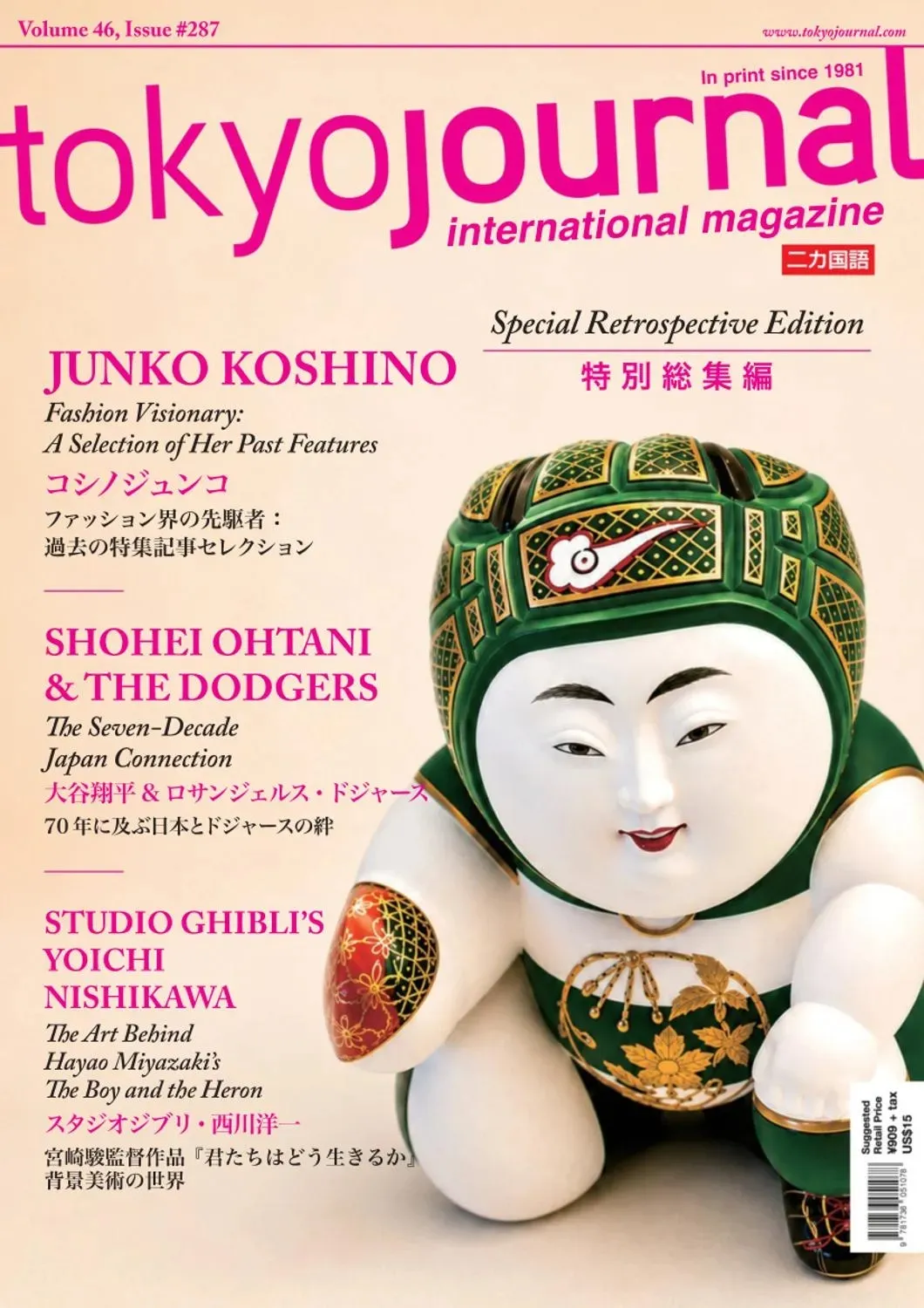
Issue 287 of Tokyo Journal wraps 2026 as a Special Retrospective Edition, pulling the year's best features on fashion designer Junko Koshino, baseball star Shohei Ohtani's seven-decade Dodgers connection, and Studio Ghibli background artist Yoichi Nishikawa. The cover splices all three subjects into a single composite image.
The 104-page retrospective is organized around five big stories from the 2026 publishing cycle. Junko Koshino contributes a first-person essay on fashion as festival. Shohei Ohtani's path to the Dodgers is traced through a 70-year backstory beginning with the 1956 Brooklyn Dodgers-Japan exhibition. Yoichi Nishikawa reveals how he painted background art for Hayao Miyazaki's The Boy and the Heron. The food section runs 12 pages with recipes from Iron Chef Masaharu Morimoto (fresh halibut XO), Nobu Matsuhisa (chocolate soufflé bento box), and Yumiko's home-cooking column (katsu curry).
Photography by Hiroyuki Suzuki appears across 5 spreads — Fujisan, construction in progress, and shadow studies. The travel section covers HOSHINOYA Kyoto, OMO5 Tokyo Otsuka, and ramen-bridge building between Japan and the world.
Content Guide
▸ Cover Features / Retrospective
p.6 · Life Is Like a Festival — Junko Koshino
The fashion designer reflects on her 50-year career in a first-person essay. She describes her first Paris show in 1978, when she carried 12 suitcases of kimono silk alone. The essay includes a sketch of her 2026 autumn collection. Borrow Koshino's layering technique: wear obi-width belts over Western blazers.
p.42 · Ohtani's Dodger Destiny — A Seven-Decade Secret
The feature traces the Dodgers-Japan connection from the 1956 exhibition series through Hideo Nomo's 1995 rookie season to Ohtani's 2024 signing. Peter O'Malley, the former Dodgers owner, gives a 2-page interview about scouting Japanese players since the 1960s. Ohtani's 2026 season OPS is referenced in the career timeline on page 44.
p.52 · Crafting Enchanting Worlds — Yoichi Nishikawa's Journey as a Studio Ghibli Background Artist
Nishikawa describes painting the underwater sequences in The Boy and the Heron. He mixed 14 custom green pigments for a single forest scene. The piece includes production stills of his pre-digital watercolor studies. Squint at the Ghibli forest backgrounds to see the layered brush strokes Nishikawa leaves as his signature.
▸ Food & Drink
p.74 · Celebrating Sake — Evolution and Trends
A survey of Japan's sake industry: 2025 export figures show a 12 percent increase, with the U.S. as the largest market. The article profiles three breweries — one using 200-year-old yeast, one using AI-monitored fermentation, one organic. The AI-monitored brewery ships to 14 countries.
p.78 · Chu-hi — Japan's Original Cocktail
A history of the shochu-based drink from its 1950s origins to modern canned versions. The article includes a recipe for yuzu chu-hi using 3 ingredients. Substitute sudachi for yuzu if you cannot find it fresh.
p.80 · Fresh Halibut XO Recipe — Iron Chef Masaharu Morimoto
Morimoto's recipe pairs poached halibut with a homemade XO sauce using dried scallops, shrimp, and chili. The recipe calls for 12 ingredients and takes 45 minutes. Toast the dried scallops before rehydrating for deeper umami.
▸ Travel & Culture
p.24 · The Exquisite HOSHINOYA Kyoto
A review of the luxury ryokan perched above the Katsura River. The piece details the seasonal kaiseki dinner, the onsen with river views, and the 2-hour tea ceremony experience. Book the room with the private garden; the public areas fill with day-trippers by 11 a.m.
p.87 · OMO5 Tokyo Otsuka by Hoshino Resorts
A moderately priced hotel in Otsuka, a 3-minute walk from the Yamanote Line. Rooms start at 12,000 yen per night. The rooftop bar serves a Tokyo skyline view without the Shinjuku markup. Book the twin room if you need workspace; the single rooms have only a lap desk.
p.90 · Experiencing Other Cultures in Japan
A round-up of non-Japanese cultural experiences available in Tokyo: a Brazilian samba school in Asakusa, a Finnish sauna in Kichijoji, and an Indian classical dance class in Setagaya. The samba school welcomes beginners on Tuesday evenings.
Editor's Take
A retrospective issue is a cheat — repackage past content as a special edition — but Tokyo Journal executes it with enough new material to justify the price. The Nishikawa Ghibli interview is the standout: 14 custom green pigments is the kind of concrete detail a cover feature should have. The Ohtani piece is long (12 pages) but the Peter O'Malley interview saves it from being a stats recap. The food section is stronger than any single feature, especially the Morimoto XO recipe. Photography is the weakest element; Suzuki's spreads are technically competent but repetitive across 5 placements.
Strengths
• Nishikawa Ghibli background art with pigment-specific production detail
• Peter O'Malley interview on 7 decades of Dodgers-Japan scouting
• Morimoto's halibut XO recipe with 12-ingredient precision
Weaknesses
• Retrospective format recycles previously published material
• Suzuki photography overused across 5 spreads
Verdict: Recommended — Buy it for the Nishikawa and Ohtani long reads.
