
Wisconsin Magazine of History – Fall 2026
Summary
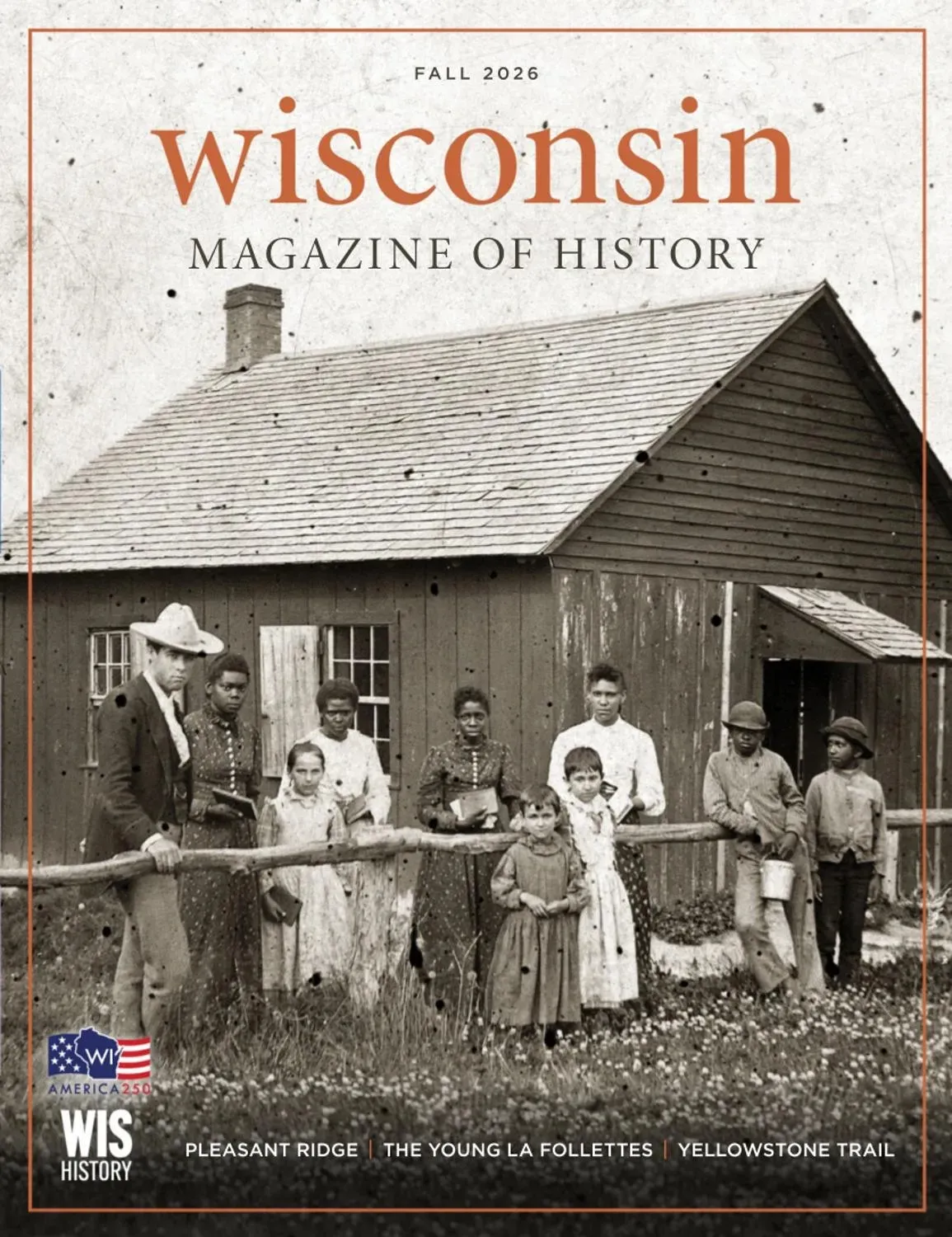
The Wisconsin Magazine of History's Fall 2026 issue (Vol. 110 No. 1) places Pleasant Ridge on the cover — a community of free and formerly enslaved Black Americans who built one of the first integrated schools in the United States in Grant County a decade before the Civil War. Christy Clark-Pujara writes that the story is not about rising from the ashes but about the joy of creating a community where Black people could flourish. The cover shows a teacher and students outside Pleasant Ridge School in 1890.
Clark-Pujara's feature on page 12 documents how, by the 1870s, Pleasant Ridge had a functioning integrated public school, thriving farms, and a church — a "powerful sanctuary of freedom and success" in rural southwest Wisconsin. Jerry Prout on page 24 covers Robert and Philip La Follette, the sons of "Fighting Bob" who engineered the blueprints for the New Deal and Social Security with UW economist John R. Commons. Alice A. Ridge on page 36 traces the Yellowstone Trail — America's first transcontinental highway — and its fight for Wisconsin's early road network.
John H. Nondorf's Curio department revisits America's Bicentennial fervor in 1976, when fire hydrants became patriotic displays and Little House on the Prairie outdrew Monday Night Football. Andrew S. Holbrook spotlights a space experiment conceived by a Wisconsin high school student. The book excerpt from Lambeau Ladies reveals the unheralded women who supported Vince Lombardi's Green Bay Packers.
—————
Content Guide
▸ Features / History & Culture / Departments / Book Excerpt
p.4 · Curio: Bicentennial Fervor
John H. Nondorf revisits 1976, when the nation's 200th birthday turned everything red, white, and blue — lawnmowers, grocery bags, fire hydrants, kids' bikes. Little House on the Prairie became the most-watched show on television, earning more viewers than Monday Night Football. The Bicentennial Wagon Train crossed the country welcoming participants.
p.6 · Spotlight: Cosmic Kraft
Andrew S. Holbrook profiles a space experiment conceived by a Wisconsin high school student and flown on a NASA mission. The experiment tested how microgravity affects crystal growth — a question with implications for semiconductor manufacturing in orbit.
p.12 · "Those Were Good Times" — Pleasant Ridge
Christy Clark-Pujara documents the Black community of Pleasant Ridge, Wisconsin, which built an integrated school in 1873 — 81 years before Brown v. Board of Education. The community's success challenges the narrative that Black prosperity began only after the Civil Rights movement. Visit the Pleasant Ridge Cemetery in Grant County for a list of founding families.
p.24 · The Young La Follettes
Jerry Prout traces how Robert La Follette Jr. and Philip La Follette translated their father's progressivism into national policy. Philip signed the nation's first statewide unemployment compensation bill. Robert championed the economic recovery plan that became the New Deal. John R. Commons, the UW economist, provided the academic framework for Social Security.
p.36 · The Yellowstone Trail in Wisconsin
Alice A. Ridge documents America's first transcontinental highway as it crossed Wisconsin, and the rival booster groups that fought to control the state's early road network. The trail entered Wisconsin at Hudson and exited at Manitowoc, following what is now largely US Highway 12.
p.45 · Book Excerpt: Lambeau Ladies
Laura Kostelnik Biskupic and Katherine Biskupic excerpt their WHS Press book on the women who supported Vince Lombardi's Packers from the sidelines. They built a community that organised team meals, managed player housing, and raised funds for equipment — work omitted from the official franchise history.
—————
Editor's Take
This is the most focused Wisconsin Magazine of History issue in years: three features that each speak to a different dimension of the state's progressive tradition — racial integration, economic reform, and infrastructure — without editorial overlap. Clark-Pujara's Pleasant Ridge piece is the standout: she treats the community's success as a structural achievement, not a sentimental one. The La Follette feature fills a genuine gap, since most coverage concentrates on "Fighting Bob" and skips his sons. Weakness: the Curio department is charming but too long at four pages, and the book excerpt from Lambeau Ladies is advertised in the contents but gets only a single page. Best for readers interested in Midwestern progressive history and pre-Civil War Black community studies.
Strengths
• Pleasant Ridge feature reframes Black history around joy, not trauma
• Young La Follettes corrects the historical record on New Deal authorship
• Yellowstone Trail piece is a model of infrastructure history
Weaknesses
• Bicentennial Curio runs four pages with diminishing returns
• Lambeau Ladies excerpt is too short to convey the book's argument
Verdict: Recommended — Three features with genuine historiographical weight; skip if you read only national-history magazines.
