
Writer’s Digest – January 2023
Summary
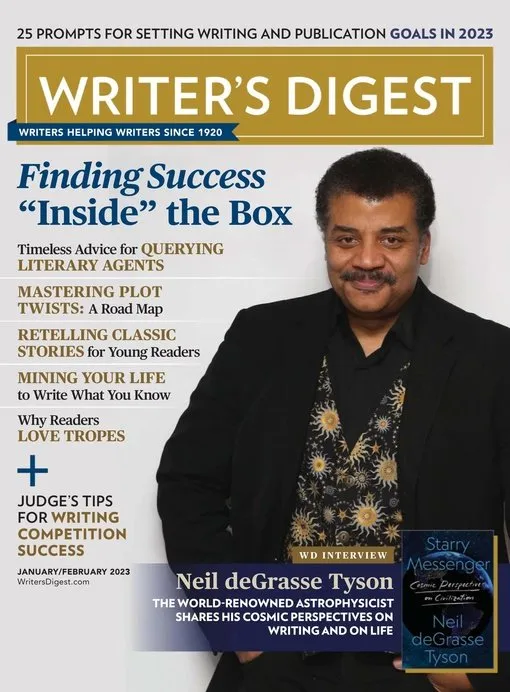
Writer’s Digest January/February 2023 leads with 26 prompts for setting writing and publication goals, not vague resolutions. The WD interview with astrophysicist Neil deGrasse Tyson at page 54 covers his book Starry Messenger and what writers can learn from a scientific perspective on civilisation. Jane K. Cleland’s road map for mastering plot twists at page 40 and Jordan Rosenfeld’s breakdown of why readers love tropes at page 36 anchor the craft section. The 92nd Annual Writing Competition opens with a $5,000 grand prize and a trip to the New York conference.
The querying guide at page 46 by Eric Smith offers timely advice for an agent market that has shifted post-pandemic. Ran Walker’s Making It Past the First Round at page 50 targets competition entrants specifically. Regular columns include IndieLab, Meet the Agent, Breaking In debut author spotlight, and the Publishing Insights column by Robert Lee Brewer on seven inside-the-box rules writers can bend.
The MFA Workbook on negative space by Jacinda Townsend at page 63 adds an academic craft layer. The 5-Minute Memoir, Poetic Asides, and the Your Story prompt at page 60 provide generative exercises. A goal-oriented issue for writers who want structure over inspiration.
—————
Content Guide
▸ Craft & Technique
p.40 · Mastering Plot Twists
Jane K. Cleland delivers a road map for planting clues without telegraphing the reveal. She uses the staircase method: one visible clue, one hidden, one that looks like something else. Re-read your manuscript and highlight every clue in yellow before you decide which need dimming.
p.36 · Tropes and Why We Love Them
Jordan Rosenfeld argues that tropes are not lazy shortcuts but narrative shorthand that signals genre contract to readers. She categorises six major tropes by genre and explains when a trope becomes a cliche. Use the love-hate romance trope in any genre, not just romance, for instant reader orientation.
p.32 · Writing What You Know: Yourself
Whitney Hill pushes past the cliche by showing how to mine personal history without writing autobiography. She provides a timeline exercise that turns family stories into fiction frameworks. Map three family legends onto different genre templates to see which sparks a full draft.
▸ Publishing & Career
p.46 · Querying: These Days, We’re All Just Trying Our Best
Eric Smith covers the 2023 query landscape: shorter attention spans, rising page-count expectations, and the role of social platform in agent decisions. He includes a template that puts the hook in the first paragraph. Keep your query letter to 350 words and paste the full text into the email body.
p.50 · Making It Past the First Round
Ran Walker dissects what competition judges actually look for in the first 50 pages. The advice covers opening hooks, submission formatting, and genre-appropriate word counts. Open a contest manuscript with a character doing something, not thinking about something.
▸ Interview
p.54 · The WD Interview: Neil deGrasse Tyson
Zachary Petit interviews Tyson on his book Starry Messenger: Cosmic Perspectives on Civilization. Tyson discusses how scientific objectivity can sharpen a writer’s argument, why ego is the enemy of good research, and what writers get wrong about scientists. Read one paper from outside your discipline before writing an expert character.
▸ Business & Marketing
p.16 · IndieLab: The Problem With Promotion Isn’t What You Think It Is
Kim Catanzarite argues that self-promotion fails for indie authors because it pushes product before relationship. She offers a content-first approach: teach something before you sell something. Publish three free educational posts for every one book promotion post.
p.70 · Publishing Insights: 7 Inside-the-Box Publishing Rules That Writers Can Break (Or Bend)
Robert Lee Brewer identifies seven conventional rules – write every day, never self-publish, avoid adverbs – that are less rigid than they seem. He gives specific scenarios where breaking each rule works. Break the write-every-day rule if your best work comes in 8-hour weekend binges.
▸ Inspiration & Community
p.26 · 26 Writing Goals and Intentions for 2023
Amy Jones provides one goal per letter A-to-Z, from Acquire an agent to Zero in on your niche. Each goal comes with a measurable milestone and a realistic timeline. Pick one letter per week and complete the milestone before moving to the next.
p.60 · Your Story: The Tree Stands Alone
The regular fiction prompt series challenges readers to write a 750-word story based on a provided opening line. Past winners are published online and in the magazine. Set a timer for 45 minutes and do not edit until the timer rings.
▸ Regulars
p.22 · Writers on Writing: Kate Baer
The poet and author shares her morning routine, revision process, and advice for handling online criticism after viral success. She recommends reading your work aloud at the exact pace you want readers to follow. Print your manuscript in a different font for the final revision pass.
p.66 · Funny You Should Ask: How do I know this is the right agent for me?
Barbara Poelle answers the question with a decision matrix: communication speed, editorial vision, contract knowledge, and career-arc thinking. She recommends calling three of the agent’s current clients before signing. Ask each client how fast the agent returns email within business hours.
—————
Editor’s Take
This issue earns its cover line Finding Success Inside the Box by delivering practical, not platitudinous, craft advice. Jane K. Cleland’s plot-twist road map is the strongest single piece – concrete enough to apply immediately, and her staircase metaphor sticks. The Neil deGrasse Tyson interview is wide-ranging but leans heavy on his book promotion; the best takeaway is his research-ego point. The IndieLab column on promotion is overdue honesty for the self-publishing readership. Weaknesses: the 26 writing goals feature is well-intentioned but 26 items are too many to land – 10 would have been more effective. The MFA Workbook by Jacinda Townsend feels disconnected from the rest of the issue’s practical tone. The competition promo sections take up significant space with repetitive prize listings. Best for early-career writers setting annual targets.
Strengths
• Cleland’s plot-twist staircase method with concrete before-and-after examples
• Eric Smith’s 2023 query landscape update with template
• IndieLab column reframes promotion as teaching, not selling
Weaknesses
• 26 writing goals would have been stronger as 10
• Competition promotional pages repeat the same prize information
Verdict: Recommended — A craft-heavy January issue that earns its place on the desk, though the goal-setting feature overreaches its format.
