
Practical Reptile Keeping – February 2026
Summary
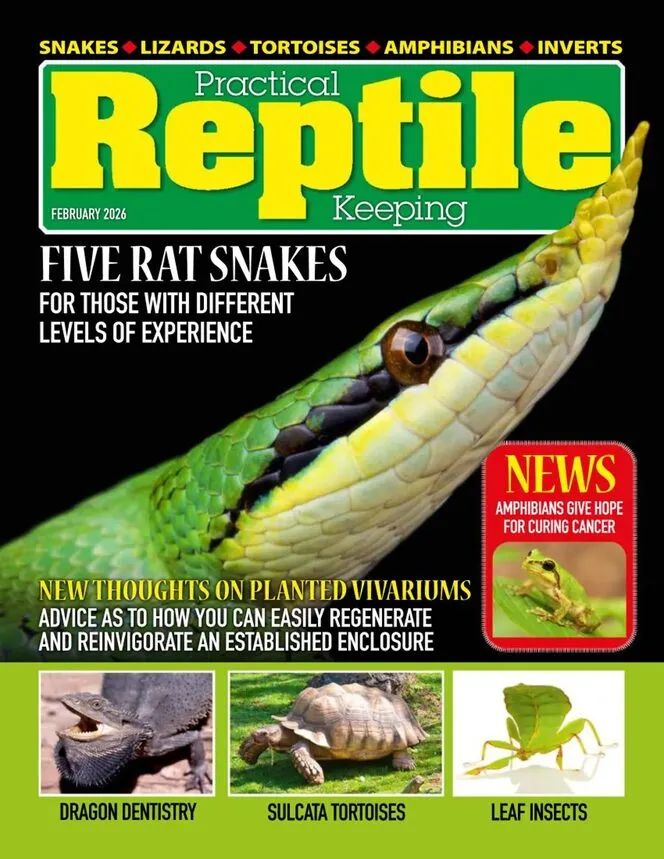
Practical Reptile Keeping's February 2026 issue opens with a rhinoceros ratsnake on the cover and Timothy Zedi's five-species rat-snake roundup inside, but its biggest talking point is the news section: Professor Eijiro Miyako's JAIST team isolated Ewingella americana from Japanese tree frog intestines, and a single injection cured colorectal cancer in 100% of mice.
Practical Reptile Keeping's February 2026 issue anchors its cover on a green rhinoceros ratsnake (Rhynchophis boulengeri) and runs a 14-page lead feature by Timothy Zedi ranking five rat snake species for keepers of any experience level: black, Taiwanese, rhinoceros, Russian, and Japanese. Zedi specifically argues black rat snakes (Pantherophis obsoletus) are a better starter pet than corn snakes because their larger hatchlings accept bigger pinky mice. The breeding section sets clutch sizes from 5–30 eggs and incubation times of 50–75 days at species-specific temperatures, with rhino rat snakes needing moderate cooling to 13–16°C.
Three long-form features round out the core. Dr Jason Randall begins a two-part planted vivarium rebuild, walking through his silicone-and-soil background method in six numbered steps and the Mourning gecko enclosure it produced. Dr James Brereton and Mark Myhill profile sulcata tortoises at Beale Wildlife Park, including target-training a 70kg individual onto scales using broccoli. Paul Donovan surveys five giant frogs in 'Out of Africa', from the cane toad's 1935 Australian introduction to the 3.25kg goliath frog.
News and Views opens with the JAIST cancer-bacterium report (DOI 10.1080/19490976.2025.2599562), alongside three new Pristimantis frogs from the Cordillera de Huancabamba, microplastics in the Antarctic midge Belgica antarctica, and 'Hulk lizards' eliminating the orange-throated morph of common wall lizards. Regulars include Dr Joanna Hedley on bearded dragon dental disease, John Courteney-Smith on eyed lizards (Timon lepidus) in Q&A, and Dr Tariq Abou-Zahr's handling guide for colubrids, ball pythons, and large boids.
—————
Content Guide
▸ Cover Story
p.20 · My top five rat snakes
Timothy Zedi ranks five rat snakes for keepers of any experience level: black (Pantherophis obsoletus), Taiwanese (Orthriophis taeniurus friesei), rhinoceros (Gonyosoma boulengeri, the cover subject), Russian (Elaphe schrenckii), and Japanese (Elaphe climacophora). Each profile lists adult length (1.2–2m), enclosure dimensions from 90×60×60cm up to 1.5m long, basking temperatures (25–30°C), and brumation requirements. Zedi argues black rat snakes are a better beginner pet than corn snakes because their larger hatchlings accept bigger pinky mice. The breeding section sets clutch sizes from 5–30 eggs and incubation times of 50–75 days.
▸ Species Features
p.28 · Turning Over A New Leaf!
The Phylliidae family of leaf insects gets a husbandry primer covering 50 species, with Phyllium philippinicum (formerly PSG 278) flagged as the easiest beginner species, having been formally described in Zootaxa recently. Enclosure should be at least three times the longest insect's length; vermiculite, compost, or damp paper towel substrates sprayed daily work well. Three tricks for stubborn hatchlings: light misting, co-housing with another phasmid that breaks leaf edges, and a fan for periodic airflow. Males mature first with longer antennae for tracking female pheromones; eggs drop from the canopy.
p.38 · Keeping sulcata tortoises
Dr James Brereton and Mark Myhill profile the world's third-largest tortoise, with verified individuals exceeding 100kg and a potential lifespan of 148 years. Diet centres on constant hay access with low protein to avoid shell pyramiding. The Beale Wildlife Park pair is target-trained to climb onto scales using broccoli and cabbage treats. Females lay 15–30 eggs per clutch in a sand laying bank, incubated at 28–30°C. Indoor housing needs a conservatory-style room with a 250W basking bulb, a high-wattage UV source (UV does not pass through glass), and regular faecal parasite screening.
p.58 · Gigantic frogs and toads
Paul Donovan profiles five mega-anurans in the hobby. The marine or cane toad (Rhinella marina) tops the list at 38cm and 2.65kg, infamous for Australia's 1935 introduction that released 62,000 toads and produced a still-running government task force with bounties. The European common toad (Bufo bufo) reaches 16cm with parotid-gland toxin used defensively against grass snakes. The American bullfrog and African goliath frog (32cm, 3.25kg) round out the set. Donovan flags that regular handling causes anorexia in cane toads and warns against co-housing large and small specimens due to cannibalism.
▸ Vivarium & Art
p.44 · New thoughts on planted vivariums
Dr Jason Randall starts a two-part series by rebuilding a 60×30×50cm glass vivarium after losing an 8-year-old male green anole to old age. He favours front-opening glass tanks, a silicone-and-soil background applied in six numbered steps, and either hydrolecca drainage balls or a false bottom made from plastic egg-crate. Lighting pairs an Arcadia 6% T5 D3 UV tube with a Jungle Dawn plant-grow LED, and a thermostat prevents overheating. The finished Mourning gecko enclosure reuses Neoregelia 'Fireball' bromeliads, Ficus pumila, and substrate-maintaining millipedes. Part two will cover substrate choices.
p.52 · The stark beauty of reptiles and invertebrates
Susie Kearley profiles Oregon-based artist Christopher Marley, who frames three-dimensional real specimens — reptiles, butterflies, and insects — in hand-made sealed displays, positioning his work against Damien Hirst's animal preservation. Marley sources vertebrates that have died of natural causes; insects are wild-collected for reasons he openly justifies. A veiled Yemen chameleon, gila monster, and Chrysomelid leaf-beetle array appear in the photo plates. Restoration notes and a sidebar on 'Christopher's views on art' round out the feature. The visual emphasis makes this the issue's most photograph-driven feature.
▸ Regulars
p.26 · Veterinary Casebook: Dental issues in bearded dragons
Dr Joanna Hedley walks through 'Simon's' calculus build-up under general anaesthetic, noting that up to 35% of bearded dragons seen in veterinary clinics show some degree of dental abnormality. Bearded dragons have acrodont teeth (firmly attached to the jawbone crest and rarely replaced), unlike iguanas and monitors with pleurodont dentition. Treatment uses an ultrasonic dental scaler and chlorhexidine rinse. Prevention centres on swapping soft waxworms and squash for crickets and locusts, plus reducing sugary fruit. Owners are advised to inspect the mouth regularly at home rather than attempt tooth-brushing with cotton buds.
p.32 · Q&A: Looking after ocellated lizards
John Courteney-Smith answers a Q&A query on the eyed lizard (Timon lepidus), a 60cm Iberian lacertid that lives in social groups with paternal hierarchy. Minimum vivarium 1.2×0.6×0.6m for a pair; substrate must be deep, organic, and bio-active with springtail custodians. Heating uses a 75W HabiStat repti-radiator at 34°C basking paired with twin 24W 6% and 12% UVB T5s in a ZooBar reflector to deliver a UV index of 6–7 at the basking slate pile. Diet is varied omnivore — crickets, locusts, calciworms, dubia roaches, mixed salads — gut-loaded with EarthPro InsectFuel.
p.34 · Reptile Focus: Dione's rat snake (Elaphe dione)
A short photo-feature portrait of Elaphe dione, the Asiatic/Dione's rat snake. Females reach up to 1.2m, smaller than many keepers expect, and males do not grow as large. The species is described as less widely kept than New World rat snakes but with equally straightforward care, and adaptable feeders. Females lay in late spring and sometimes again around October. The visual treatment — close-up reptile photography — is the main draw; no dedicated enclosure dimensions or brumation temperatures are given in the printed copy.
p.36 · Handling snakes
Veterinary surgeon Dr Tariq Abou-Zahr groups snakes by handling approach: typical colubrids (bare-handed, fast and gentle), rear-fanged species like western hognose (mostly bare-handed but treat racers and mangrove snakes as venomous, using a hook), ball pythons (no tailing due to stout build, lift with hand out of head-strike range), medium pythons and boas (free-handle if disposition allows, restrain behind head otherwise), and large boids like reticulated pythons and amethystine pythons (always with a second person, gentle head restraint). Heavy-handed handling can cause fatal internal bruising days later.
▸ News & Views
p.4 · How frogs and lizards may revolutionise cancer treatment
Professor Eijiro Miyako's JAIST team isolated Ewingella americana from the intestines of Japanese tree frogs (Dryophytes japonicus), Japanese fire-bellied newts, and Japanese grass lizards after screening 45 bacterial strains. In mice with colorectal cancer, a single intravenous injection produced complete tumour disappearance in 100% of cases — outperforming four-dose doxorubicin and anti-PD-L1 immunotherapy controls. The facultative anaerobe multiplies 3,000-fold inside hypoxic tumour cores in 24 hours and clears from the bloodstream with a 1.2-hour half-life, sparing liver, spleen, and kidneys. Next-step trials target breast and pancreatic cancers and melanomas.
p.4 · New frogs discovered in the Andes
Germán Chávez led a four-year expedition into Peru's Cordillera de Huancabamba and described three new Pristimantis frogs: P. chinguelas (cliffside on Cerro Chinguelas with prominent body tubercles), P. nunezcortezi (cool mountain stream, named for ornithologist Elio Nuñez-Cortez), and P. yonke (smallest, found in bromeliads at nearly 3,000m, named after the sugarcane spirit 'yonque'). All three are listed as Data Deficient by the IUCN. Team members Karen Victoriano-Cigüeñas, Ivan Wong, and Wilmar Aznaran report habitat degradation, fire damage, and expanding farmland as the chief threats.
p.4 · "Hulk lizard" knocks out an ancient colour palette
Tobias Uller's Lund University team analysed throat-colour data from 240 populations of common wall lizards (Podarcis muralis), totalling more than 10,000 individuals. White, yellow, and orange throat morphs had coexisted for millions of years — now yellow and orange are being wiped out by aggressive, dominant 'Hulk lizards'. The shift happened over a very short evolutionary window, demonstrating that a single new trait can disrupt finely tuned social systems. Findings appear in Science 391, 64–68 (2026), DOI:10.1126/science.adx3708.
p.4 · Microplastics found in Antarctica's only native insect
Jack Devlin's University of Kentucky-led team found microplastic fragments inside wild Belgica antarctica larvae — Antarctica's only native insect, a non-biting midge whose larvae can reach nearly 40,000 per square metre on the Antarctic Peninsula. Of 40 dissected larvae, two contained identifiable plastic fragments as small as four micrometres, imaged at Elettra Sincrotrone Trieste. Lab tests showed microplastic-exposed larvae had reduced fat reserves despite unchanged survival and metabolism. Since the midge has no land-based predators, plastic uptake is unlikely to move up the food chain, but climate-change warming adds pressure.
—————
Editor's Take
This February 2026 issue of Practical Reptile Keeping leans heavily into its snake-keeper identity, with Timothy Zedi's five-rat-snake roundup, Dr Tariq Abou-Zahr's handling guide, and a Dione's rat snake portrait forming the throughline. The standout is the JAIST cancer-bacterium news report — concrete, quantified, and directly relevant to herp-curious readers outside the hobby. Jason Randall's vivarium rebuild and Brereton/Myhill's sulcata profile are the practical-work winners, with real enclosure numbers, brumation temperatures, and target-training using broccoli. Weaknesses are real: Christopher Marley's specimen-art feature feels like padding next to meat-and-potatoes husbandry, and ad density runs heavy between major features. Best for dedicated snake keepers and anyone building planted vivaria; casual readers can safely skip the art piece.
Strengths
• Cancer-bacterium news gives hard numbers — 100% tumour clearance, 3,000-fold replication, 1.2-hour half-life
• Timothy Zedi's five-species roundup delivers specific enclosure dimensions, basking temperatures, and brumation ranges
• Jason Randall's six-step silicone-and-soil vivarium rebuild lists named plants, bulbs, and drainage methods
Weaknesses
• Christopher Marley specimen-art feature runs without husbandry relevance for most hobby readers
• Heavy ad density for Exo Terra, ExoticDirect insurance, and Pocketmags £7.99 specials between major features
Verdict: Recommended — Strong snake-keeping core and standout news, weighed down by art padding and ads.
