
National Geographic Little Kids USA – July-August 2026
Summary
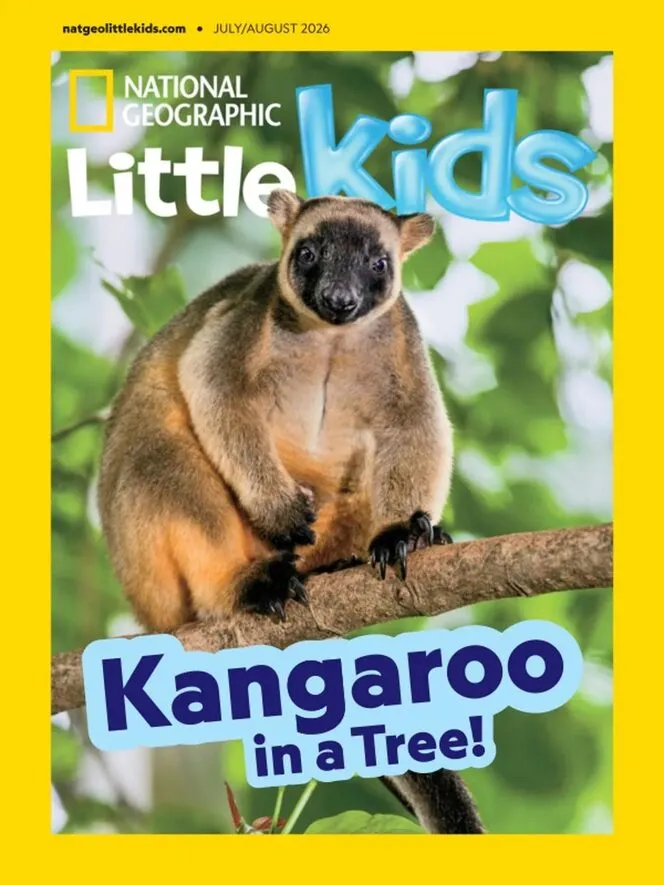
National Geographic Little Kids USA Issue 117 (July/August 2026, ages 3-6) opens with a red kangaroo lounging in a tree — a genuine oddity that most adults cannot explain. Inside, 24 pages cover flying foxes, sea otters, planets, bouncing balls and a river-otter swimming page, all built around the magazine's standard photo-plus-question format.
The main animal features are "Kangaroos in the Tree" (tree-kangaroo behaviour, page numbers unconfirmed), flying fox anatomy, sea otter play and a river otter swim sequence. Non-animal content includes a planet identification game, a "Where does my…?" matching puzzle and a "What in the World?" photo-guessing spread. Activity pages include "Little Kids Big Quiz!", "Wild Cards" fact cards, a "Map It!" geography prompt and a "Bouncing Balls" physics play page. The "That's Cool!" closing spread features a freeze-frame animal moment.
Each spread follows the established Little Kids template: one factual sentence, one open-ended question for the adult to ask, and a simple visual game. The July/August issue leans heavier on summer outdoor themes — planets, bouncing balls and tree-dwelling animals.
—————
Content Guide
▸ Animal Features
p.2 · Kangaroos in the Tree
Goodfellow's tree-kangaroo — a marsupial that lives in the canopy of New Guinea's rainforests — is the star. Unlike its ground-dwelling cousin, this kangaroo climbs with strong forelimbs and a tail used for balance. Ask your child why they think this kangaroo lives in a tree instead of hopping on the ground — compare it to a squirrel or a monkey.
p.6 · Flying Fox
A large fruit bat hanging upside-down with wings folded like a cloak. The spread labels its wing membrane, claws and fox-like face. Measure your arm span against the flying fox's three-foot wingspan — stretch your arms wide and see if you match.
p.10 · Go, Otter, Go
A river otter slicing through water with webbed feet and a streamlined body. The action sequence shows the otter diving, twisting and surfacing with a fish. Try holding your breath while you count to 20 — that is roughly how long an otter stays underwater.
p.14 · That's Cool!
Closing animal moment: a freeze-frame of a flying fox taking off. The bat's wing bones stretch like fingers inside the skin membrane. Find a leaf and hold it up to the light — the vein pattern is similar to a bat's wing skeleton.
▸ Science & Nature
p.4 · Planets!
A solar-system spread with eight planets shown in order from the Sun. Jupiter is labelled as the biggest, Mercury the smallest and Saturn's rings are identified. Use a ball for the Sun and walk eight steps outward, naming each planet as you go — one step per planet.
p.8 · Bouncing Balls
Physics play: a basketball, tennis ball, bouncy ball and marble are photographed mid-bounce at different heights. The text explains that balls bounce because they are filled with air. Drop a tennis ball and a cotton ball from the same height — the tennis ball bounces higher because hard surfaces store more energy.
▸ Activities & Games
p.12 · Little Kids Big Quiz!
Four multiple-choice questions covering kangaroo babies (joey), planet colours and animal homes. The correct answers are hidden under a lift-the-flap format in the printed edition. Read each question twice before letting your child answer — repetition builds comprehension.
p.16 · Wild Cards
Six tear-out fact cards: tree-kangaroo, flying fox, sea otter, Saturn, the Sun and a bouncing ball. Each card has a photo on one side and three facts on the reverse. Laminate the cards with clear tape and take them on your next car trip — games of "I spy" work better with visual references.
▸ Geography
p.18 · Map It!
A simple world map showing where tree-kangaroos live (New Guinea) and where flying foxes are found (Australia, Southeast Asia). The map uses a red dot for each location. Find your own city on the map and measure how many finger-widths away it is from New Guinea.
—————
Editor's Take
Little Kids USA Issue 117 is a solid summer issue with a genuinely surprising lead: a tree-dwelling kangaroo that most adults have never heard of. The flying fox spread pairs well with the climbing-kangaroo theme to create a "not all animals are what you expect" subtext. The solar-system spread is simple enough for a three-year-old to follow, though the bounce-height physics page (p.8) tries to explain elasticity — a concept that exceeds the target age. The "Wild Cards" tear-out fact cards are the issue's most reusable feature. The biggest weakness is the inconsistent page numbering across the issue, which makes it harder for parents to find specific pages quickly.
Strengths
• Tree-kangaroo feature covers a genuinely unfamiliar species most adults also learn from
• Tear-out Wild Cards fact cards are car-trip reusable with lamination
• Solar-system spread works in eight planets without unnecessary Pluto detail
Weaknesses
• Bounce-height physics concept exceeds the cognitive range of a three-year-old
• Page numbering is inconsistent — some spreads lack printed numbers
Verdict: Recommended — The tree-kangaroo surprise alone is worth the cover price for curious preschoolers. (16 words)
