
Your Horse – March 2026
Summary
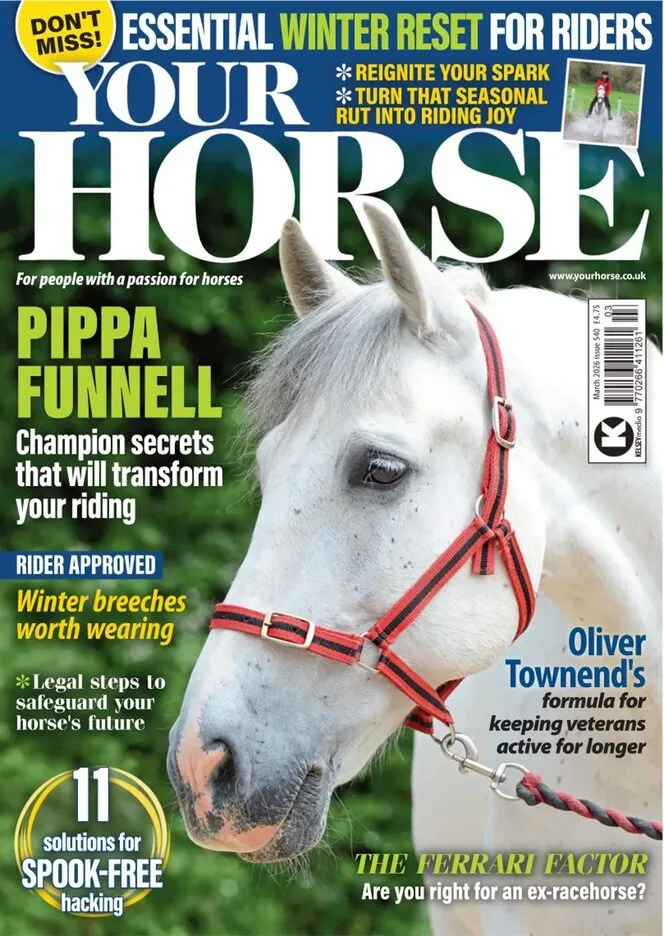
Your Horse issue 540 (March 2026, £4.75) leads with Pippa Funnell recalling the horses who carried her to the 2003 Rolex Grand Slam, while Oliver Townend reveals the routine keeping 19-year-old Ballaghmor Class winning at five-star — a winter-reset edition offering six issues for £15 in its New Year sale.
Your Horse issue 540 (March 2026, £4.75) bills itself as an essential winter reset and delivers with two champion features: Pippa Funnell traces the horses who built her career, from a scruffy first pony called Pepsi to the 2003 Rolex Grand Slam with Supreme Rock and Primmore's Pride, while Oliver Townend details the routine keeping 19-year-old Ballaghmor Class — double Burghley winner and Tokyo team-gold medallist — competing at the top. Both turn memoir into method.
The training section stays practical. Behaviour consultant Trudi Dempsey reframes spooking as pain or fear rather than naughtiness, five-star eventer Georgie Goss fixes transitions with a forward-thinking downward aid, and Emma Massingale answers three real readers' bond problems. A New Beginnings charity feature explains why ex-racehorses need three to six months of downtime before retraining, and coach Niki Otterburn opens a gymnastic pole-work series for frozen-arena days.
Care coverage runs from pasture diversity and safer vet visits to solicitor-grade succession planning, plus five equine weight-loss stories — Ted the cob shed 160kg and beat laminitis. Gear includes a winter breeches group test won by LeMieux's Drytex at £109.95, and Take Five closes with Ted Lasso actor Annette Badland on her Brooke ambassadorship.
—————
Content Guide
▸ Cover Story
p.10 · Pippa Funnell: 'The horses who made me'
Funnell recounts the equines who shaped her, from Pepsi the scruffy first pony through Sir Barnaby — who took her to her first Badminton — to Supreme Rock and Primmore's Pride and the 2003 Rolex Grand Slam worth US$250,000. Her five essentials are directly usable: self-discipline means riding a 10m circle as a 10m circle, consistency means practising transitions out hacking, and trust takes years to build but seconds to break. Her core rule: if you want a good friend, be a good friend.
▸ Training
p.14 · It's not naughty — it's a spook.
Equine behaviour consultant Trudi Dempsey reframes spooking as a welfare signal, not misbehaviour. Pain comes first — one client's horse, already treated for ulcers, needed a second vet workup that revealed kissing spines — then past experience and stacking triggers. Actionables: check tack fit, desensitise with a wheelie bin before bin day, allow minutes for dark-to-light eye adjustment at woodland exits, and dismount to lead past genuinely frightening objects. Her verdict: relaxed riders rarely have spooky horses.
p.24 · Beyond the finish line
Kevin and Pam Atkinson of New Beginnings charity explain why 'difficult' ex-racehorses are usually misunderstood: give them three to six months to just be horses, reintroduce turnout over the fence in small paddocks, and reteach mounting-block manners from scratch — jockeys vault on, so standing still is a new skill. Claire Howie's unseen purchase Skeaping became Retraining of Racehorses National Champion in their first year. Note this feature runs in partnership with British Horse Feeds.
p.30 · Remember, your why
Mindset coach Tijen Sheircliff argues that 'finding motivation' is a January myth: extrinsic drivers like results and qualifiers collapse in winter, while intrinsic ones — the bond, small improvements, curiosity — survive. Try her shifts: replace 'have to' with 'get to', plan each ride before tacking up so cold evenings require no decisions, and judge yourself by identity rather than achievement. Winter is a season, not a verdict on your commitment.
p.34 · Adjust a little, improve a lot
Five-star eventer Georgie Goss fixes transitions with one idea: a downward transition must still be forward. Take the rein forward with the hand instead of pulling, put the outside leg back to activate the outside hind, and skip draw reins — horses just lean on them. Ride transitions on circles or through corners rather than straight lines, use walk-trot reps to wake up a lazy horse, and never halt before a fence; a forward downward transition refocuses better.
p.38 · Fix it… Peace, not pressure
Emma Massingale answers three bond problems with cheap, immediate changes. For an uncatchable horse, add variety — bareback rides, new hacks, sessions with friends. For a grooming-hater, hunt the itchy spots (neck, chest, between the front legs) with a massage brush and spend 10 minutes asking nothing in return; those scratch spots later double as rewards in training. Finally, take your coffee break at the fence with your horse grazing beside you instead of in the tack room.
p.40 · Conditioning with a gym-tastic twist
Coach Niki Otterburn opens a gymnastic-exercise series built for winter's dark evenings, frozen ground and soggy arenas. Four budget setups — raised poles ridden one-handed, rein back over a pole, and trotting through weaving poles among them — target fitness, coordination and suppleness without jumping. Each exercise comes with how-to steps, rider-position guidance and training tips, so a couple of poles is all the kit you need to restart a stalled schooling plan.
▸ Health & Care
p.48 · Why green isn't always good
A grass-only field raises laminitis, EMS and ulcer risk, and this feature lists mostly free fixes: swap fly sprays for masks and rugs to protect pollinators, drop herbicides, keep medicated horses' manure off grazing (wormers act as soil pollutants, says vet Paul Martynski), and mulch with leftover species-rich hay. Legumes like sainfoin, red clover and bird's-foot trefoil supply protein for topline, and varied swards encourage the 18-hours-a-day movement horses need.
p.54 · Risky business
Dr Holly Lenaghan of the University of Surrey quotes the statistic that an equine vet sustains seven to eight career injuries, then shows how learning theory makes visits safer. Clicker training cured one pony's needle phobia — the most common issue vets face, since sedation itself requires an injection. Practical tips: use Likit-style treats because the horse keeps its head still for jabs, and ask vets visiting other horses on the yard to spend a few quiet minutes with yours.
p.58 · Life after you
Solicitor Francesca Hayward sets out five legal steps every owner should take: document ownership in writing (especially for shares and syndicates), consider a trust so the horse can't be sold against your wishes, review mortality and loss-of-use insurance, put loan and competition agreements on paper, and name the horse in your will so non-horsey family aren't left guessing. Her framing sticks: whether your horse is worth £300 or £300,000, the principle is the same.
p.60 · Lightening the load
Five weight-loss case studies anchor a feature on obesity as a welfare issue. Ted, a 27-year-old cob, arrived at Oxfordshire Retirement Livery at 652kg with laminitis and lost 160kg on soaked Timothy hay mixed with oat straw at 1.5% bodyweight dry matter, split across four or five small-hole nets daily — with no laminitis since. Shetland Diamond shed 30kg. The message: fat veterans can regain soundness through measured forage, not starvation.
p.68 · Training for longevity
Oliver Townend credits routine for Ballaghmor Class still thriving at 19: the same stable for 15 years, an unchanged work routine for nine, daily walking on the walker while stables are mucked out, and shorter winter breaks — too long off and seniors 'come in looking like an old horse'. He criticises horses trained quickly without core strength and advises returning to basic training whenever something needs fixing. His one-line system: if it works, don't change it.
▸ Gear & Regulars
p.94 · Winter breeches put through their paces
Reader-testers rate waterproof winter breeches on fit, performance and value. LeMieux's Drytex full-seat breeches (RRP £109.95) took the Your Horse Winner badge with a 15/15 score — warm, waterproof enough to replace overtrousers, true to size. Pikeur's £217.95 recycled-cork Corsheell pair lost points on a short gusset, while Twin Oaks' £119 Mount Rainier trekking breeches earned praise for durability and pockets. Real prices and honest fit notes guide a winter purchase.
p.98 · Take Five with Annette Badland
The Ted Lasso and Midsomer Murders actor, now Brooke's first women's ambassador, explains why equine welfare is a gender issue: an estimated 400 million livestock keepers in developing countries are women, so losing an animal hits them hardest. She taught herself to ride in her twenties, recalls an Icelandic horse called Lofti causing trouble in the Ardennes, and voiced the award-winning Brooke at 90 film. A short, warm read with a real call to action at brooke.org.
—————
Editor's Take
The strongest thing here is the pairing of two champions who actually teach: Funnell's memoir distils into five usable rules, and Townend's Ballaghmor Class piece is a genuine management masterclass — same stable 15 years, walker work daily, shorter winter breaks. The case studies respect the reader too: Ted the cob losing 160kg on measured forage beats vague 'feed less' advice. The weakness is commercial blur — the ex-racehorse feature is partnered with British Horse Feeds, weight loss runs with Dengie, and a Spillers Super Seniors' Club promo sits inside the Townend article — so the care section occasionally reads as extended advertising. News pages are thin for a monthly. This issue suits UK leisure riders and veteran owners who want principle-driven coaching over quick fixes; hardcore competitors get the two star interviews and little else.
Strengths
• Funnell and Townend features pair star stories with directly applicable principles
• Weight-loss and spooking features use real numbers and named case studies
• Winter breeches group test with transparent 15-point ratings and prices
Weaknesses
• Three care features are commercially partnered, softening editorial independence
• Horse Talk news section is thin and lightweight for a monthly
Verdict: Recommended — Champion insight and numbers-backed practical coaching outweigh the sponsored-content creep.
