
Horse Hound – 12 February 2026
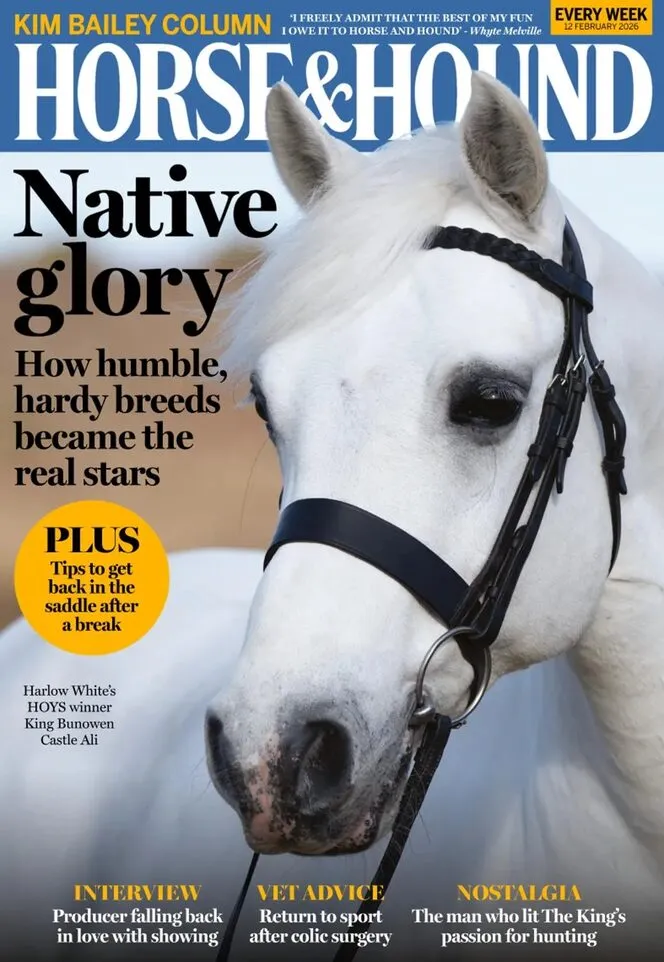
Summary
Simon Charlesworth tells Horse & Hound (12 February 2026) how a £200 ex-Shadwell "impulse buy" called Sicknote revived his love of showing, while Kim Bailey celebrates hurdle-winner Aamilah Aswat and Tim Mair's vet clinic shows 68–78% of showjumpers return to competition after colic surgery.
The news section leads with the Government's pledge to consult on mandatory licensing for rescue centres, a move World Horse Welfare's Kim Ayling backs only if properly enforced, plus the clarification that British Eventing will not follow British Dressage in permitting voice use in dressage this year. Louise Bell pays an emotional farewell to Into The Blue, the Royal International working hunter who rose to grand prix dressage and the Aachen Nations Cup, while Carmen Edwards argues a 1.30m knockout league could rescue showjumping from elitism.
Four cover stories anchor the issue. Simon Charlesworth tells Bethan Simons how he nearly quit showing after losing horses including Pearly King II, then rebuilt a 15-strong string around the £200 Shadwell reject Sicknote, now stepping up to opens. Tim Mair FRCVS dismantles the myth that colic surgery ends careers, citing studies where 76–78% of showjumpers and racehorses returned to competition. Kelly Johnstone maps the surge in demand for native breeds, and Catherine Waterfall meets Trevor Breen, back from three spinal fractures to lead at HOYS.
The reports cover Isobel Hudson's winning comeback from eight broken ribs aboard Cooley Iron Man at Hartpury and Newbury's Cheltenham trials day, where Haiti Couleurs took the Denman Chase, Lulamba the Game Spirit and Paul Nicholls' Tutti Quanti the William Hill Hurdle. Alastair Jackson remembers Beaufort huntsman Brian Gupwell, who gave King Charles his first day's hunting in 1975, and Kiera Boyle weighs whether today's mega trailers now beat horseboxes on living space.
—————
Content Guide
▸ News
p.4 · Licensing for rescues could be on the cards
MPs debated a petition signed by almost 110,000 people on 26 January, and Defra minister Angela Eagle confirmed a consultation on licensing rescue and rehoming centres will come "in due course". World Horse Welfare's Kim Ayling backs the principle but warns it only improves welfare if enforced. Rescue operators should start preparing records and facilities for inspection-style oversight now, and follow the Defra consultation timeline.
p.5 · Use of voice still banned for eventing dressage
British Eventing will not follow British Dressage's 2026 rule allowing discreet voice aids, to avoid confusion for competitors and officials. The rule changes also clarify that riders who pull up for genuine safety reasons, such as loose dogs, may receive time adjustments, and open the door for the British open championships at Hartpury to run at four-star. Eventers must stay silent in the dressage phase this season; check the full changes at horseandhound.co.uk.
p.6 · Heartbroken farewell to star of two disciplines
Into The Blue, the horse bred by John Whitaker who stood working hunter champion at the Royal International and then took Louise Bell to grand prix dressage, died on 2 February aged 20 after complications from a displaced colon, just a week after his retirement was announced. Bell credits an H&H discipline swap challenge in 2011 with the career change that led to Aachen Nations Cup selection and fourth in the Wellington freestyle. A template for giving a show horse a second career.
▸ Cover Story
p.16 · 'The struggle is immense'
Kim Bailey reports on Newbury and Warwick beating the wet weather, then explains why he retires horses such as 13-year-old Two For Gold (11 wins, Grand National and Festival runner) under a non-racing agreement and never sells a retiree, keeping control of their future. He also hails Aamilah Aswat, who became the first female Black jockey to ride a winner over hurdles at Kempton on Guchen after four years on his yard. His non-racing agreement template is worth copying at any yard.
p.18 · Simon Charlesworth
The producer, 42, tells Bethan Simons how losing horses including HOYS hack star Pearly King II nearly ended his ridden career, until the late Leona Sanders reignited it. Last term he collected his 48th HOYS in-hand finalist ticket and steered Heniarth Derring-Do to the Welsh section B championship at the Royal Welsh. He details his family-owned riddens policy, 12-year-old son Jac's ride Greenbarrow Miss Saigon, and Sicknote, the £200 Shadwell reject who screened "riding horse" and steps up to opens this season. His advice: watch today's professionals and "be a sponge".
p.24 · Improving odds
Tim Mair FRCVS replaces colic-surgery folklore with data: 80–90% of colic cases resolve medically, around 10% need surgery, and the surgical window in severe cases can be just hours. Survival to discharge runs at 60–80%, post-operative reflux is the complication to fear, wound healing takes about eight weeks of box rest, and 60–85% of horses return to their former performance level, with US and Italian studies showing 68–78% of showjumpers competing again. Owners should treat suspected colic as a same-hour phone call, not a wait-and-see.
p.32 · Native advantage
Kelly Johnstone explains why demand for mountain and moorland ponies has shifted from quiet popularity to deliberate choice: buyers want soundness, temperament, longevity and barefoot capability. Breeders Sue Arrowsmith (performance Shetlands), Kiera Billington (Welsh blood, via European double-gold medallist Machno Carwyn) and Libby Robinson of the Fell Pony Heritage Trust report rising orders for ridden ponies aged four and over. Meg Elphick's home-bred Connemaras qualify for Badminton grassroots; Highland Brownbread Easter Rabbit took the Endurance GB veteran title at 20. Pony shoppers: judge conformation and feet before movement.
p.36 · Time off — game on
Catherine Waterfall tackles returning to the saddle after a break. Trevor Breen, who fractured his neck and lower back at Hamburg in 2024 and was told he might never ride again, went back to Highland President within three months, used a sport psychologist before St Gallen, and finished 2025 as leading showjumper of the year at HOYS. Dressage trainer Debbie Moore rebuilds riders on a simulator; mind coach Samantha Shanks-Husbands taught eventer Heidi Maskelyne meditative visualisation after broken ribs. If you are nervy, book a school lesson on a steady horse before you compete.
▸ Opinion
p.14 · 'Innovation can enhance the sport'
Carmen Edwards praises the new JCL Insurance Brokers premier league class at Aintree, a 1.30m knockout format that drew 1,500 spectators on a January Saturday, and argues it should become a league replacing some existing formats rather than sitting alongside them. He also notes Scott Brash's three consecutive five-star wins deserve mainstream coverage, and calls on equestrians to "act like the farmers" and push for barcode-style reform of horse transport paperwork at Dover. Show organisers: this format is the one to copy.
▸ Hunting
p.42 · 'A memorable character and a great showman'
Alastair Jackson's series on great foxhunters he knew turns to Brian Gupwell, huntsman of the Beaufort for 22 years, who handled the hounds when King Charles, then Prince of Wales, first went hunting at Badminton in 1975 on a day with a five-mile point. The piece traces Gupwell from a 2/6d-a-week racing apprenticeship through the Navy, Brocklesby under Ron Harvey, and the Eridge, where Eridge Freedom 60 won the Peterborough bitch championship in 1964. Hunt historians get a primary-source portrait built from a 1989 interview.
▸ Sport Reports
p.52 · Hudson strikes while Iron Man is hot
Isobel Hudson won the Blue Chip Dynamic B&C qualifier at Hartpury on Cooley Iron Man in her first competitive outing since November, when a fall on the road broke eight ribs and punctured a lung. The ex-eventer has racked up 800 points in 18 months and aims at Foxhunter second rounds. Rachael Shubotham logged a first win with the slow-maturing Keeva Klara at Kelsall Hill, and Tom Dunn, back after a 14-year family break, now targets the Hickstead Derby with No Doubt About It II. Proof that comebacks work at every level.
p.54 · Haiti Couleurs and Sean Bowen deliver a win
The Newbury report covers a Cheltenham-themed card on very testing ground. Haiti Couleurs won the Denman Chase from the front under Sean Bowen, Lulamba powered clear late in the Game Spirit and now heads for the Arkle, with better ground expected to suit, and Paul Nicholls' Tutti Quanti made all under top weight in the William Hill Hurdle to enter the Champion Hurdle conversation. Anyone doing ante-post Cheltenham research should read this before placing a bet.
▸ Regulars
p.22 · Liberty rider and trainer
The All in a Day's Work column profiles Mia Rodley, a self-taught liberty trainer who studied under Pat Parelli before going solo. She describes consent-based handling — offer your hand and let the horse close the distance — undemanding field time to build the bond horses form over 18 hours of grazing together, and rehabilitating a traumatised five-year-old others had written off. She plans the UK's first fully insured bridleless dressage and showjumping competition in April. Try her hand-offer routine the next time you greet a strange horse.
p.58 · The best is behind you
Kiera Boyle tests whether the latest mega trailers now rival horseboxes. Böckmann's Tierney Clutterbuck reports owners transitioning away from lorries because trailers cost less, park easier and can carry genuine living quarters. The piece benchmarks the current generation — Ifor Williams HBX511, Bateson Deauville, Cheval Liberté and Equi-Trek models — against lorry spec on amenities, towing vehicles and the "looking the part" factor. Before you buy transport this season, price a customised trailer against the lorry you assumed you needed.
—————
Editor's Take
This issue runs on one theme — comebacks — and mostly earns it. Simon Charlesworth's interview is the best thing here: candid about nearly quitting, precise about horses (a £200 Shadwell reject, a 48th HOYS in-hand ticket), free of producer platitudes. Tim Mair's vet clinic deserves keeping: it replaces colic-surgery folklore with survival percentages and recovery timelines. Kim Bailey's column effectively gives Newbury two pages for the price of one. The weakness is the back half — from page 58 the issue collapses into trailer advertorials, horsebox classifieds and equo marketplace filler occupying a large share of the run. The hunting coverage, led by Alastair Jackson's Gupwell portrait, reads beautifully but assumes you already know why it matters. Buy it for the showing interview and the vet feature; skim the rest.
Strengths
• Charlesworth interview pairs career candour with specific, checkable showing detail
• Vet clinic cites real study percentages instead of reassurance clichés
• Kim Bailey column doubles the value of the Newbury report
Weaknesses
• Final third of the issue is trailers, classifieds and marketplace filler
• Hunting section presumes prior knowledge with no entry point for newcomers
Verdict: Recommended — Four strong cover stories and a standout vet feature outweigh an ad-heavy back half.
