
Horse Rider USA – Spring 2026
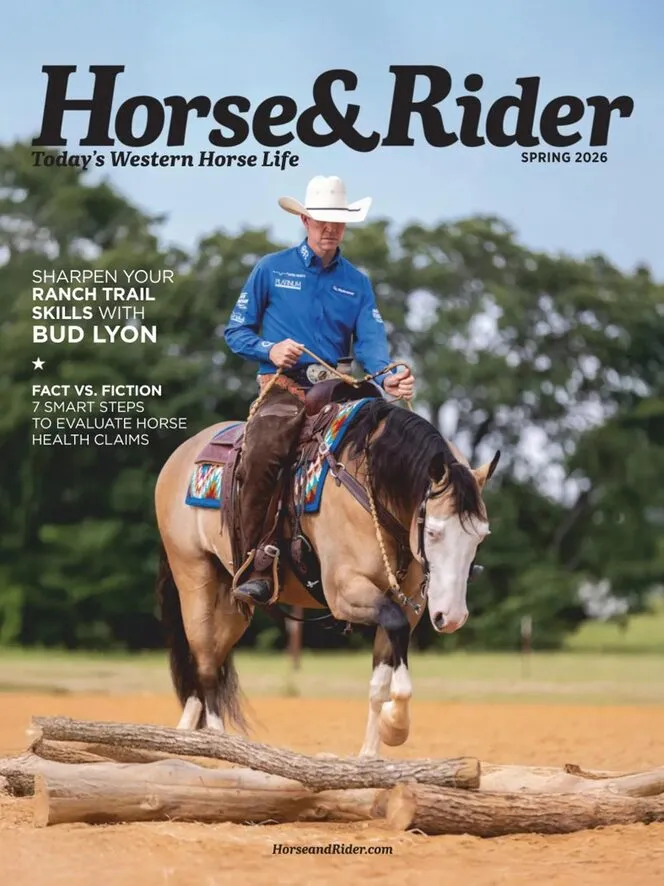
Summary
Horse&Rider's Spring 2026 issue (Vol. LXV, No. 1) walks Bud Lyon of Whitesboro, Texas, through a hinged ranch-trail gate, hands Dr. Barb Crabbe a seven-step test for supplement claims, and explains why that $3,000 kill-pen bailout for a horse named Chief funds a cycle, not a rescue.
Two cover-billed pieces carry the issue. Bud Lyon, the reining and ranch riding clinician from Whitesboro, Texas, spends seven numbered steps on the hinged gate – the one ranch trail obstacle you can count on, and the one that costs five points per judge in AQHA competition if you lose control of it. Then Dr. Barb Crabbe turns an olive-oil infomercial she watched from a dentist's chair into seven rules for judging any equine health claim.
Spring handling dominates the front of the book. "Tick-Borne Diseases on the Rise" walks through Lyme disease, anaplasmosis, and equine piroplasmosis, then lists six steps for pulling a tick without twisting it. The water-source checklist counts the one gallon per 100 pounds of body weight a horse drinks daily, warns that manure-contaminated ponds grow toxic blue-green algae, and suggests goldfish or koi as tank cleaners.
Trainers fill the middle. Al Dunning, 50-plus years in cutting and cow horse, explains what a square-headed cow versus a thin, long-headed one tells you. Leslie Lange rebuilds the stop from the knee up. Shyanne Smith gives young riders two posture drills. Closer to the back, "Support Horses, Not the Cycle" takes apart a $3,000 kill-pen bailout ask and asks where the money actually goes.
—————
Content Guide
▸ Cover Story
p.11 · Ranch Trail Gate
Bud Lyon works a right-handed hinged gate in seven numbered steps, from approaching wide and parallel to relatching without leaning off his saddle. He rides romal reins, so the tail moves to his left hand before he touches the latch, and the horse rocks back off the rider's feet rather than a hand. Lyon flags the judges' read: leaning sideways to reach the latch tells them your horse does not guide or stands too far off the obstacle. Losing hold of the gate costs five points per judge in AQHA. Takeaway: practice both hands, and rattle a metal gate at home until a tense horse stops flinching.
p.26 · Fact, Fiction, or Somewhere in Between
Crabbe, a contributing vet editor, watched an olive-oil infomercial and built seven steps out of it: push pause, be skeptical, consider the source, find the primary references, analyze the data, check the experts, look for backup. Her red flags do the work – a study cited with no reference, research funded by the company selling the product, a trial built on two groups of three horses. She points readers to Google Scholar and to papers indexed in PubMed Central, NLM, or NCBI. Takeaway: ask who paid for the study before you read the testimonial.
▸ Features
p.32 · Are You Really Listening to Your Horse?
Jaycox, writing with Linda Parelli, argues most strained horse-human relationships are emotional breakdowns, not training failures. Her markers are small: a horse that walks off when he sees the halter, holds his jaw tight to the curry, rushes the gate the moment a ride ends. She names learned helplessness, the pressure to perform that leaves a horse hitting his marks with no curiosity left, and closes on four roles every owner has to fill – leader, friend, protector, teacher. Takeaway: audit which of those four you actually filled this week.
p.38 · Support Horses, Not the Cycle
Jennifer Paulson follows a familiar social-media plea – raise $3,000 to keep a horse named Chief off the trailer – and prices it out. A kill-pen buyer might get $300 for him; the rest pays a broker, transport, and quarantine, with nobody tracking the crowdfunded total. Tinia Creamer of Heart of Phoenix Equine Rescue describes bailed-out horses arriving with nowhere to go, and Paulson lays out five facts, including how bailouts drain rescues that never see the money. Takeaway: send donations to established nonprofits, not individual bailout pages.
▸ HorseLife
p.5 · Travel: NCHA Super Stakes
The travel page sends readers to Fort Worth, Texas, for the NCHA Super Stakes, running March 18 through April 13, 2026, at the Will Rogers Memorial Center, a show whose 2025 edition paid out $4.5 million. Between sets, the recommendations are the Amon Carter Museum of American Art, Beau Galyean Stallion Station to see Stevie Rey Von and Breykin Bad, Woodhouse Spa about ten minutes south of the coliseum, and Flower Child for lunch. Takeaway: book the stallion-station visit early and keep your show days free.
p.6 · Tick-Borne Diseases on the Rise
The health page explains why tick-borne disease keeps climbing – warmer climate plus owners moving into tick habitat – and separates the three that matter. Lyme disease and anaplasmosis both arrive on black-legged or deer ticks and show up as fever, lethargy, appetite loss, intermittent lameness, and joint swelling. Equine piroplasmosis comes on southern cattle and tropical horse ticks, destroys red blood cells, and brings jaundice, colic, and stocking up. The removal sequence runs six steps and ends with steady even pressure, never a twist. Takeaway: check ears, girth, mane, tail dock, and legs after every trail ride.
p.8 · Spring Water-Source Checklist
A horse drinks roughly one gallon per 100 pounds of body weight daily, and this checklist treats that figure as the season's maintenance baseline. It covers scrubbing troughs and automatic waterers after winter, sloping and gravelling the footing so horses are not standing in mud, keeping the trough heater plugged in on cold nights, and moving the manure pile away from the drinking area. It also flags the two failures owners miss: natural water gone sandy or murky and possibly carrying Leptospira, and stagnant manure-fed ponds that grow toxic blue-green algae. Takeaway: test any pond the moment its color, odor, or taste changes.
▸ Ride & Train
p.14 · Learn to Read Cattle
Al Dunning, who has spent 50-plus years in cutting and cow horse, gives three tips for reading cattle before you enter a boxing or sorting class. He says the fastest education is being around cows in a pasture or catch pen, then watching herd helpers settle a herd – an average 20 minutes that shows you which cattle will honor a horse. He still uses the anecdotal tells: a full-bellied, fuzzy-coated cow tends to be slower, a thin, slick-coated one has more go. Takeaway: walk your horse through a pasture of cattle this month.
p.16 · Mastering The Whoa
Leslie Lange argues the stop is the foundation of subtle cueing, and she does not care whether you ride a clinician-style one-rein stop or a traditional two-rein stop – clear and consistent matters more than style. Her diagnostic is the knee: riders who squeeze with knee and thigh, as many learned in English disciplines, pop themselves out of the saddle and give a go signal while asking for a halt. Release your feet, stay upright or slightly back, open the hip, soften the knee. Takeaway: start every stop session at a walk or slow jog before adding speed.
p.20 · Get It Straight
Shyanne Smith, who teaches beginners in Central Texas and rode on Baylor University's equestrian team, targets the collapsed posture that muddles young riders' cues. Her first drill has the child raise the off hand straight overhead at a walk, which lifts the shoulders, straightens the spine, and puts the head between the hips. The second has him hold an arm forward at chest height and study his own fingertips so he stops staring down. Kids ride one-handed with a loop or romal rein, in an arena or round pen. Takeaway: add ten to fifteen seconds of hold time weekly, then try both drills over poles.
p.23 · 3-Year-Old Quarter Horse Geldings
Louis A. Hufnagel, carded as a judge in 1971 and based in Tulsa, Oklahoma, places three 3-year-old Quarter Horse geldings across balance, structural correctness, breed and sex characteristics, and muscling. He explains reasons rather than ranking: the roan Gelding C wins on balance and levelness despite a long middle section, Gelding A owns the best neck but the weakest topline, and Gelding B's short back is undone by an extremely steep shoulder that limits reach. Takeaway: compare his critique against your own placings and note the fault you missed.
▸ In Every Issue
p.2 · When News Starts Moving Fast
Editor Nichole Chirico opens with the EHV-1 outbreak that had barn members texting screenshots and refreshing phones, and makes the case for pausing before you repost. She describes her own mare's multiple colic surgeries and colon resection, plus the well-meaning supplement advice that followed – she took it to her vet rather than the feed store. The magazine publishes confirmed reports through EDCC Health Watch on HorseandRider.com, sourced from the Equine Disease Communication Center. Takeaway: verify an outbreak report at the EDCC before forwarding it to your barn's group chat.
p.40 · Final Thoughts
The back page is a single quote, and it lands. Tuli Dowers describes how one show redirected her riding when her father let her cool out one of his bridle horses; she begged to ride him constantly afterward, and he became the first horse she ever showed. The line comes from The Ride, Horse&Rider's podcast, in a conversation about moving into cow horse events after riding a horse belonging to NRCHA Million Dollar Rider Nick Dower. Takeaway: queue that episode if you are weighing a switch into cow horse.
—————
Editor's Take
Buy this issue for Crabbe's seven steps and Dunning's cattle tips, not for the photography, which is serviceable stock and arena snapshots. The Parelli feature leans long on empathy language – "toxic relationships," "learned helplessness" – and lands the same four-roles idea three times; a page less sermon would hit harder. Where the issue earns its keep is the unglamorous middle: the tick-removal sequence, the water checklist, and the bailout breakdown that names a $3,000 ask against a $300 kill-pen price. That is a working amateur owner's magazine, and its best pages assume you have mud, a pasture gate, and a friend forwarding you supplement links.
Strengths
• Crabbe's seven steps give a repeatable test, not just a warning about misinformation.
• Dunning and Hufnagel explain their reasoning move by move, which suits amateur competitors.
• The bailout story names the money trail: brokers, quarantine fees, untraceable crowdfunding totals.
Weaknesses
• The Parelli feature repeats its four-roles thesis and reads longer than its content.
• Ad load is heavy: Dechra drug pages, Chewy, UltraShield, and TW Saddlery cut into the training sections.
Verdict: Recommended — Two strong how-to features and honest health reporting outweigh a padded listening essay and heavy advertising.
