
Science News – October 2026
Summary
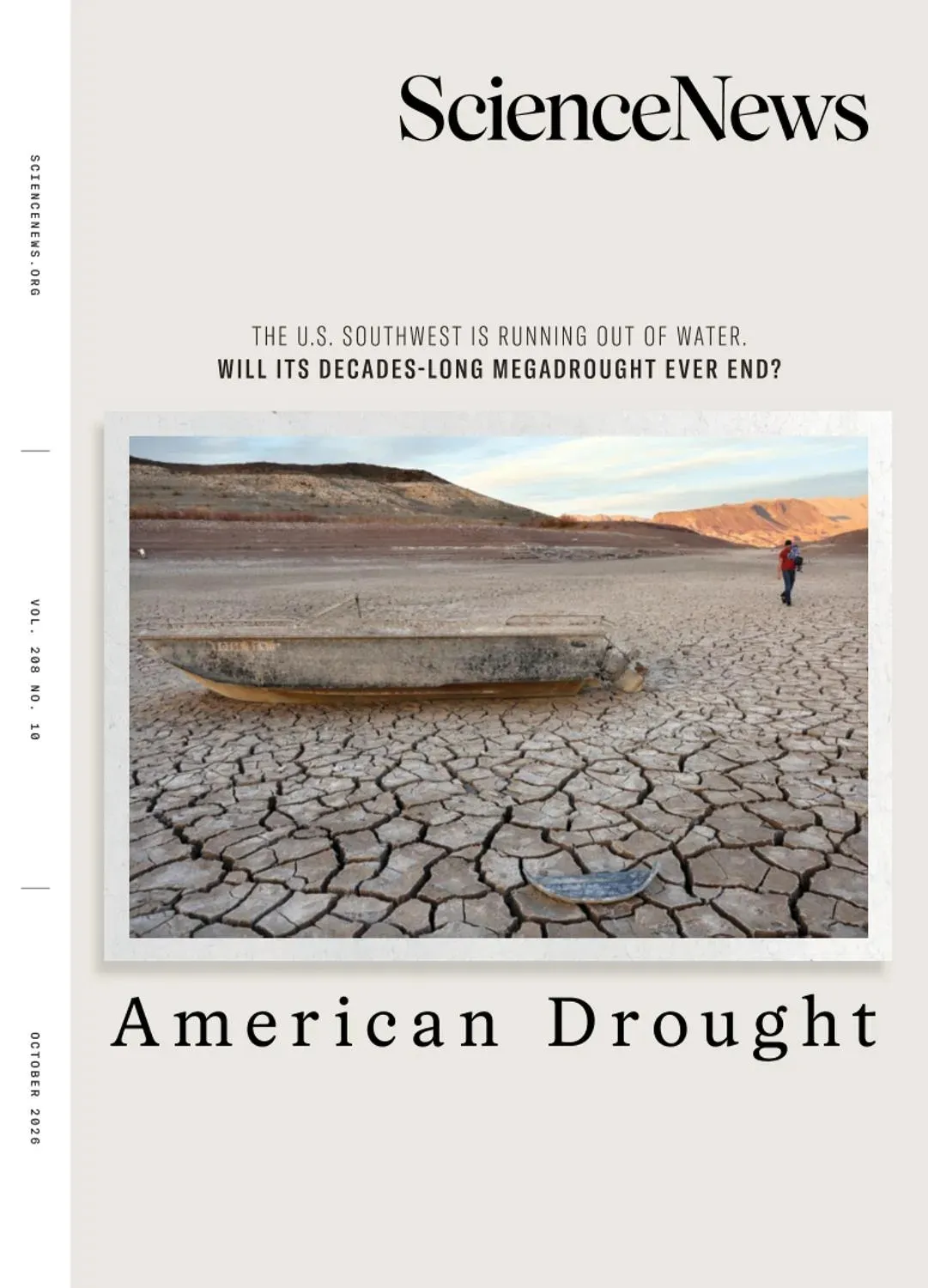
Science News' October 2026 issue (Vol. 208 No. 10) opens with the American Southwest's 27-year megadrought on the cover — Lake Mead's retreat reveals a sunken boat in Mario Tama's Getty photograph. Nikk Ogasa reports on a controversial new hypothesis that the drought may not end, with the town of Kearny, Arizona losing 87 percent of its Gila River water allocation this year. Katarina Zimmer documents how physiologists are testing hot baths to heat-proof older bodies before summer heatwaves arrive.
Ogasa's feature on page 32 positions the megadrought as a structural shift rather than a weather event, citing tree-ring data extending back to 800 CE to argue that the current dry period is without precedent in the last 1,200 years. Zimmer on page 40 reports on trials where older volunteers sit in 40-degree-Celsius baths for 20 minutes to induce heat acclimation before temperatures spike. Lisa Grossman on page 46 investigates the FCC-approved plan by Reflect Orbital to launch thousands of mirrors into orbit to redirect sunlight to Earth.
The News section covers the first mRNA flu shot approval, a fossil revealing snakes' underground origins, Betelgeuse's likely companion star, and the discovery that cave walls preserve ancient human DNA. Mourners find comfort in AI-generated "ghosts" of lost loved ones despite the technology's frequent errors.
—————
Content Guide
▸ Cover Story / Climate Adaptation / Geoengineering / Health / Advances
p.12 · What You Need to Know About the First mRNA Flu Shot
The FDA has approved the first mRNA-based influenza vaccine targeting four flu strains simultaneously. Early trial data shows 85 percent efficacy against H3N2, the strain that typically drives winter hospitalisations. The shot requires a single dose, unlike the current two-strain standard.
p.22 · Cave Walls Preserve DNA From Ancient Humans
Sediment from cave floors in Siberia and Spain has yielded mitochondrial DNA from Neanderthals and Denisovans without requiring bone or tooth samples. The technique allows archaeologists to identify species presence even in caves with no visible remains.
p.32 · Will This Drought Ever End?
Nikk Ogasa reports that tree-ring reconstructions from the Colorado River basin show the current 27-year megadrought is the driest 27-year period since 800 CE. The Gila River, a Colorado tributary, cut Kearny's allocation by 87 percent this year. Residents now operate under a strict 50-gallon-per-person-per-day budget.
p.40 · How the Body Adapts to Extreme Heat
Katarina Zimmer follows physiologists who place older volunteers in 40-degree-Celsius baths for 20 minutes over 10 consecutive days. The subjects showed a 15 percent increase in sweat rate and a 1-degree-Celsius lower core temperature during subsequent heat-exposure tests. Start pre-acclimation at least two weeks before a forecasted heatwave.
p.46 · The Dark Side of Light
Lisa Grossman investigates Reflect Orbital, an LA-based company that received FCC permission to launch a prototype mirror in July, with plans for thousands more. Astronomers calculate that a full array would increase night-sky brightness by 10 percent across the visible spectrum, making professional survey telescopes less sensitive.
p.57 · Reviews: Books and Culture
The reviews section covers two books — one on climate migration, one on the history of light pollution — and a documentary about water rights in the Colorado River basin. The light-pollution book pairs directly with Grossman's feature for a full evening read.
—————
Editor's Take
Three features, all urgent, all well-reported, and all connected by the theme of environmental limits — this is the most thematically coherent Science News issue in recent memory. Ogasa's drought reporting is the standout: he keeps the science rigorous while letting Kearny's 50-gallon water budget speak for itself. Zimmer's hot-bath trial is an ingenious angle on heat adaptation. Grossman's mirror piece is the most sceptical, and rightly so — the FCC's approval process for Reflect Orbital gets deserved scrutiny. Weakness: the News section feels compressed, especially the single-paragraph Betelgeuse item that deserved a feature of its own.
Strengths
• Three-feature environmental thread is editorially coherent
• Kearny water-budget figure makes the drought visceral
• Hot-bath acclimation protocol is immediately actionable
Weaknesses
• Betelgeuse companion story buried at one paragraph
• No full-length Advances story despite strong candidates
Verdict: Essential — The drought feature alone is the best climate reporting in any science magazine this month.
