
Parrots – April 2026
Summary
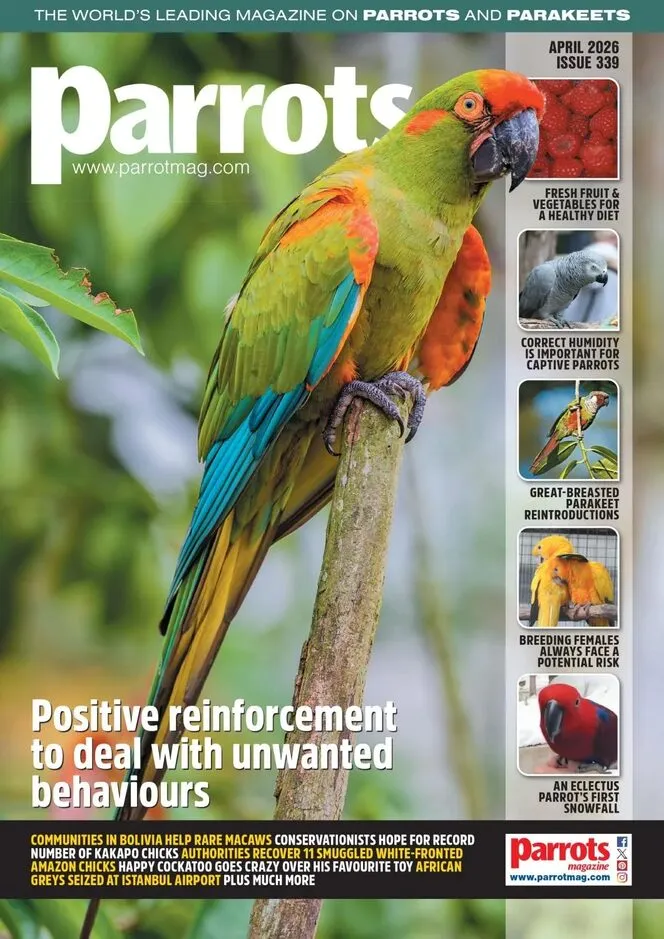
April 2026's Issue 339 leads with Bolivia's Red-fronted Macaw ecotourism boom and the Grey-breasted Parakeet reintroduction that pushed one Brazilian population past 1,500 birds. Then Rosemary Low on breeding females, Sonny Stollenmaier on punishment, Eb Cravens on humidity, Leslie Moran on vitamin A.
April 2026, Issue 339 of Parrots magazine runs across three regions. Brianna Randall walks the Mizque River with her nine-year-old son to watch Red-fronted Macaws return to Bolivia's largest breeding colony, now protected by a 50-hectare community reserve and a 14-bed ecolodge that earned Quechua families $25,000 in 2023. Aquasis and Loro Parque Fundacion report 803 Grey-breasted Parakeet fledglings in 2025 alone.
Three keepers' columns carry the practical weight. Rosemary Low answers nine questions breeders should ask before pairing a female, from egg-binding to egg peritonitis. Sonny Stollenmaier argues punishment fails whenever the behaviour continues, and shows how two-minute time-outs taught a young African Grey named Chiku to stop dive-bombing guests. Eb Cravens separates arid-zone species from rainforest birds when setting humidity.
Parrot News covers Mark Bittner's death at 74, 20 African Greys seized at Istanbul Airport, 11 White-fronted Amazon chicks returned at Ciudad Juarez, a record Kakapo season after a rimu berry crop, and Heidi Fleiss defending her Las Vegas macaws. Postbag mourns Great Western Exotics' closure; Calendar Dates runs to December.
—————
Content Guide
▸ Cover Story
p.19 · Birding in Bolivia: A reason for communities to save rare macaws
Brianna Randall watches a dozen Red-fronted Macaw pairs enter cliff nests above the Mizque River, 200 km southeast of Cochabamba. Since 2006 Armonia has paid Quechua communities to guide birders instead of selling chicks; a 50-hectare reserve and 14-guest ecolodge now protect 23 breeding pairs, roughly 13 per cent of the species' reproductive population. Natura adds water tanks and barn roofs for forest protection, and 60 beehives reached 30 families in 2023.
p.32 · Grey-breasted Parakeet reintroductions – expand and meet with success
David Waugh details how Aquasis rebuilt a species once down to fewer than 100 birds in Ceara's Baturite Mountains. In the 2025 Baturite season, 175 artificial nests held 1,447 eggs, 1,132 chicks hatched and 802 fledged; the census reached 1,500 individuals. Translocations to Aratanha and Almas, zinc-plated tree bands against opossums and tree boas, and deltamethrin collars against wasps and Africanised bees are all covered.
▸ Behaviour & Husbandry
p.20 · Punishment for parrots
Sonny Stollenmaier's argument is blunt: if the behaviour continues, it was never punished. Hitting, spraying and cage-covering all fail that test, and some reward the bird instead, since screaming Greys often enjoy shouting because it mimics their own noise. He walks through the trust cost, cites Irene Pepperberg's finding that parrots reason like two-year-olds, and gives the workable alternative he used on a dive-bombing young Grey called Chiku.
p.24 · Take extra care of your females!
A nine-question checklist for anyone about to hang a nest-box. Rosemary Low asks whether the female has been ill since last season, had egg-laying trouble, is underweight at the breastbone, too obese to fly, or too old by declining clutch size. She caps a female at two clutches a season, prescribes calcium plus Vitamin D3 before laying, explains why a second exit hole stops a male trapping his mate inside, and describes the heat that buys time against egg-binding.
p.30 · Humidity in our parrots' environments
Eb Cravens opens with a Princess of Wales Parakeet that plucked under the wings because a humidifier and shared mist baths suited her sneezing Eclectus neighbour, not her. Humidity has to match the species' origin: Rock Pebblers and cockatiels sicken in year-round damp, while Amazons, lories, Eclectus and King parrots react to dry air with feather dryness, sinus irritation and sneezing. He also warns that incubation eggs in arid rooms lose too much moisture.
▸ Nutrition & Breeding
p.12 · The Holistic Parrot: Spinach, red bell peppers, apples and raspberries
Leslie Moran dismantles the vitamin A myth. Parrots cannot use the beta-carotene they eat efficiently; they convert xanthophylls instead, and spinach lutein absorbs 45 to 55 per cent better than beta-carotene. Lutein and zeaxanthin sit highest in raw spinach and red sweet bell peppers, the two foods she wants fed daily. She lists deficiency signs including choanal plaques, nasal discharge and feather picking, and notes cockatiels are unusually sensitive to vitamin A toxicity.
p.10 · Preparation for fertility – the beginning
Loro Parque Fundacion's scientific director Rafael Zamora Padron puts the Canary Islands' January and February at the centre of the breeding calendar. Pairs should be bonded months ahead to expose character clashes; birds need a low-stimulation rest diet before a controlled protein rise, otherwise obese Amazons breed late or produce infertile eggs. Perches with bark, one mobile perch, morning showers and nest-boxes opened only when both birds are ready all feed the fertility rate.
▸ News & Rescue
p.6 · Parrot News from around the world
The section spans five countries. Mark Bittner, whose Telegraph Hill flock became The Wild Parrots of Telegraph Hill, died of a heart attack on 1st March at 74. Twenty African Greys without documentation were seized from passenger luggage at Istanbul Airport; 11 White-fronted Amazon chicks were returned at Ciudad Juarez; Heidi Fleiss defends two free-flying Las Vegas macaws; and New Zealand's Kakapo, up from 50 birds to more than 200, faces a record season.
p.28 · News from Feathers Together
Catalina Tate's Tyne & Wear charity took in 61 zebra finches, five Bengalese finches and a canary from one overgrown aviary, plus bonded pairs of Peach-faced Lovebirds, Red-rumped Parakeets, Ring-necked Parakeets and budgies. Henry and Hannah, a bonded African Grey pair whose young owner died suddenly, needed an urgent home. Parrot, a 40-year-old Blue-fronted Amazon, is transitioning off monkey nuts onto pellets and vegetables.
▸ Regulars
p.42 · Calendar Dates
Twelve months of diary entries. May 31st is World Parrot Day; the Think Parrots show runs Sunday 7th June at Kempton Park Racecourse with Sophie Barnett, Isabelle Brinan and Hildegard Niemann on the masterclass bill. The Parrot Society Summer Show and National Exhibition return to Stafford, the Tropical Bird Show lands in South Shields on 16th August, AFA holds its 52nd conference in St. Louis, and Tenerife hosts the XI International Parrot Convention in September.
p.43 · Postbag
Amelia Thompson opens the letters with the closure of Great Western Exotics, the referral exotic practice she credits with saving several of her birds, and asks why a busy service shut. She notes how few avian specialists the UK holds and how far owners already travel. The page carries the magazine's standing note that contributor views are not necessarily the editor's.
—————
Editor's Take
April's strongest pages are the ones carrying numbers. David Waugh's Grey-breasted Parakeet report gives 175 nests, 1,447 eggs and 803 fledglings for a single season, and Brianna Randall shows the money that keeps a colony alive, $25,000 to Quechua communities from one ecolodge. Set against that, Stollenmaier's punishment piece is sound but retreads ground the magazine has covered for years, and the news pages lean hard on viral parrot clips. Buy it for the conservation file. Rosemary Low's female checklist is the page most breeders will photocopy.
Strengths
• Grey-breasted Parakeet data is backed by ten years of nest-box totals.
• Rosemary Low's nine-question female checklist is usable before pairing.
• Bolivia feature names the communities, reserves and cash figures behind macaw protection.
Weaknesses
• Sonny Stollenmaier's positive-reinforcement case repeats earlier issues.
• News pages lean on social-media parrot clips with thin sourcing.
Verdict: Recommended — Buy for the two conservation features and Low's breeding checklist; behaviour and news add little new.
