
History of War Defining Battles of the First World War – 7th Edition – 13 August 2026
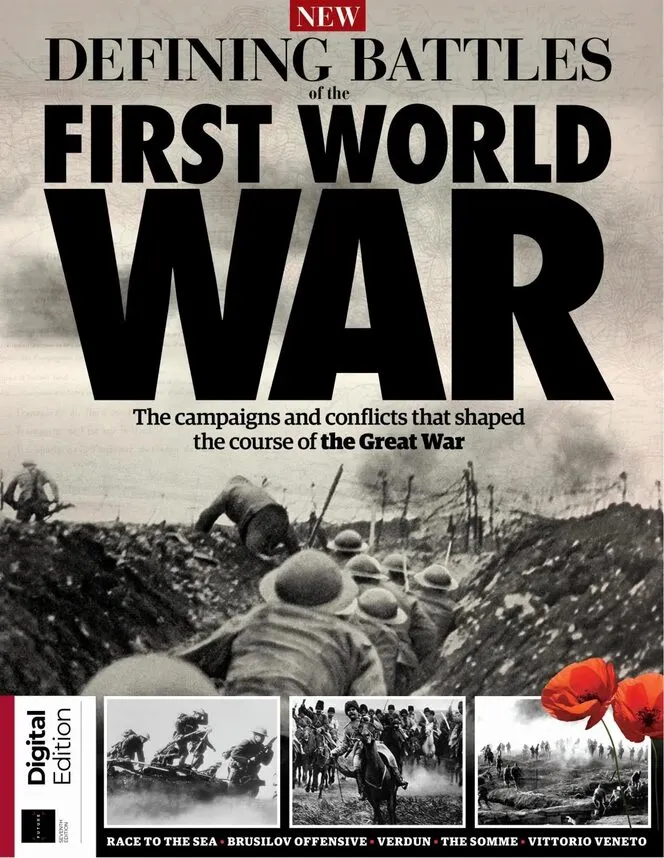
Summary
The Marne the Somme Gallipoli Megiddo and the Hundred Days Offensive—five battle clusters that decided the First World War are unpacked in this 7th Edition special from History of War. Defining Battles of the First World War runs from the 1914 German Schlieffen Plan through the Armistice with the Austrian ultimatum to Serbia on 23 July 1914 as the trigger point.
The collection covers the Battle of Artois where the French attempted to capture Vimy Ridge two years before the Canadian triumph. The Battle of Loos is examined as Britain's largest offensive of the war to that point including the first British use of poison gas and a casualty rate that would be matched only by the Somme. The 10-month Verdun battle with 600,000 dead is given a dedicated chapter. The Gallipoli campaign's strategic failures and the Hundred Days Offensive that ended the bloodshed are each treated as standalone analyses.
The special edition opens with the fragile alliance system that turned a local crisis into a continental war—Austria's declaration on 28 July Russia's mobilisation on 30 July Germany's Schlieffen Plan on 2 August and Britain's entry over Belgian neutrality.
—————
Content Guide
▸ The Great Battles
The Battle of the Marne
Germany's Schlieffen Plan required rapid defeat of France before turning on Russia. The French and British counter-attack along the Marne River halted the German advance. The taxicab army anecdote is contextualised within actual troop movement data.
The Battle of the Somme
The bloodiest battle in British military history is analysed through casualty figures and strategic objectives. The first day's losses are stated and the tactical lessons that emerged from the attrition are identified.
The Battle of Verdun
Lasting ten months with 600,000 dead this monstrous battle produced a loss etched into the collective psyche. The German plan to bleed France white is explained through specific casualty ratios. The forts of Douaumont and Vaux anchor the geographical narrative.
▸ Campaigns
Gallipoli 1915
The amphibious campaign that shaped the war's Mediterranean theatre. The landings at Anzac Cove and Cape Helles are described with troop numbers and beach conditions. The evacuation is presented as the campaign's only tactical success.
The Battle of Artois
The forgotten French battle to capture Vimy Ridge two years before the famous Canadian triumph. The French Army's tactical doctrine and the cost in lives are both quantified.
The Battle of Loos
The largest British offensive of the war so far brought terrible records: the bloodening of the 1914 volunteers Britain's first use of poison gas and a horrific casualty rate. The specific gas deployment and its effect on the troops are detailed.
▸ The Final Year
The Hundred Days Offensive
The Allied series of offensives that ended the war. The coordinated use of tanks infantry and air power is analysed as the model for modern combined-arms warfare. The specific dates of each offensive phase are mapped.
Megiddo 1918
General Allenby's Palestine campaign ended with a decisive cavalry breakthrough. The article names the Ottoman units destroyed and the territorial gains that followed.
—————
Editor's Take
This 7th Edition succeeds as a single-volume reference for WWI's key battlefields. The inclusion of the lesser-covered Artois battle adds value for readers who know only the Canadian Vimy story. The casualty figures are presented without sensationalism. The special edition lacks any coverage of the Eastern Front or the Italian theatre which limits its usefulness as a complete guide. This title suits the WWI enthusiast building a reference library rather than the casual reader.
Strengths
• Artois and Loos coverage adds depth beyond standard Somme-Verdun focus
• 600,000 dead at Verdun and casualty data are well-sourced
• Schlieffen Plan trigger sequence from 23 July to 4 August is clearly laid out
Weaknesses
• Eastern Front and Italian theatre completely absent
• No annotated maps for any of the featured battles
Verdict: Recommended — solid battle reference let down by incomplete theatre coverage.
