
National Wildlife – Spring 2026
Summary
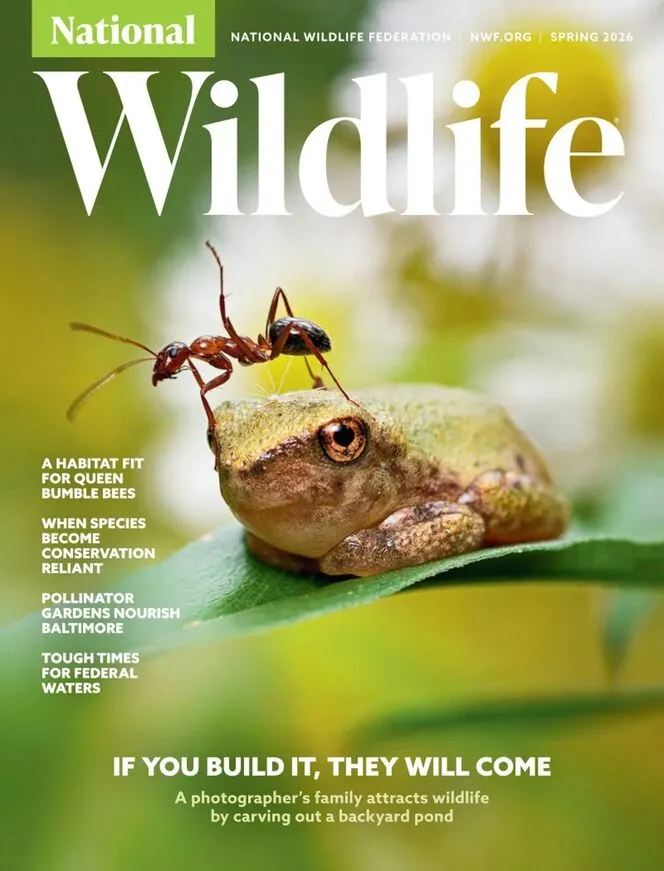
A tiny gray treefrog with an ant crawling over its head sits on the cover of National Wildlife Spring 2026 (Volume 64, Number 2), photographed by Steven David Johnson at his backyard pond in Virginia. Milkweed is the only host plant for monarch caterpillars.
Editors Jennifer Wehunt and Laura Tangley build the annual gardening-for-wildlife issue around people who do the work: a Wisconsin couple supporting queen bumble bees at p24, Baltimore farmers planting pollinator gardens alongside produce at p42, and young sisters who built a native plant app at p10. The monarch's 3,000-mile migration anchors the issue's call to plant native milkweed.
Life Support at p30 asks whether conservation-reliant species can ever stand alone, and Testing the Waters at p48 covers federal protected waters under policy rollbacks. Members pay a $15 minimum, of which $5 covers a one-year subscription, and renewal brings a free NWF garden apron with 6 to 8 weeks for delivery.
—————
Content Guide
▸ Gardening for Wildlife
p.24 · FIT FOR A QUEEN
Anne Readel writes and photographs how one Wisconsin couple turned their yard into a haven for vulnerable queen bumble bees. Readel, a full-time lawyer who began photography in 2019, proposed the story after realising people do not focus nearly enough on queen bumble bees despite their being the foundation of the colony. She hopes it convinces readers that small changes to their yards can have huge impacts on pollinators. Leave one undisturbed corner of your garden for queen bees this spring.
p.42 · SPREADING THE JOY
Nicole J. Caruth reports on planting pollinator gardens on Baltimore urban farms, nourishing the community and the entire food web. Urban farms carry more weight per square metre than most gardens. Ask whether a farm near you plants for insects as well as people.
p.16 · GARDEN FOR WILDLIFE — Why you should test soil before planting
The garden column explains why testing soil comes before planting. Soil decides what will actually grow, not what the label promises. Test one bed's soil before you buy any plant this spring.
p.14 · POLICY MATTERS — Legalizing the right to grow native
This department covers the legal right to grow native plants. Sara Green, executive director of SCWF, says South Carolina is one of the fastest-growing states, so replacing habitat removed when new neighbourhoods are built matters more than ever, and replacing it with native gardens benefits songbirds and native pollinators; other NWF affiliates have asked how to change their local landscaping rules. Ask your own council what its landscaping rules allow.
▸ Species and Science
p.12 · BEHAVIOR WATCH — Captive rearing poses risks to monarchs
Behaviour Watch reports that captive rearing poses risks to monarchs, alongside the issue's guidance on assisting them. Milkweed is the only host plant for monarch caterpillars, and monarch decline is inextricably linked to milkweed decline, since without it they cannot complete their life cycles and populations plummet. NWF encourages planting native milkweed to help a species on its 3,000-mile migration, with a swamp milkweed, Asclepias incarnata, caterpillar pictured. Plant one native milkweed species this spring rather than raising caterpillars indoors.
p.30 · LIFE SUPPORT
Stephenie Livingston reports that a growing number of imperiled species rely indefinitely on labor-intensive and expensive human intervention to survive. Mike Leahy, senior director of wildlife, hunting and fishing policy at NWF, says the biggest story with the Mexican wolf is that they are conservation reliant for far longer than they should be because of human intolerance. Ask what your state spends keeping one species alive before assuming recovery.
p.18 · CASE STUDY — Helping red-legged frogs cross the road
The case study covers helping red-legged frogs cross the road. Road crossings kill amphibians by the thousand and rarely make news. Check whether a local crossing has a volunteer rota you could join.
▸ Places and People
p.36 · ON MAGGIE'S POND
Steven David Johnson writes and photographs how a daughter's school project became a family affair, bringing biodiversity to a barren Virginia backyard. Around the pond the family planted button-bush, joe-pye weed and pickerelweed, later adding white water lilies for amphibian shelter, and had the garden designated a Certified Wildlife Habitat by NWF. Just a few weeks after the pond was filled the first American toads found it, and the project went from an occasional wandering toad to a fully functioning ecosystem. Fill one small pond or sink a shallow dish this spring and wait.
p.10 · NEXT GENERATION — Young sisters raise a native plant app
The Next Generation column follows young sisters who built a native plant app. Young people build the tools older gardeners then use. Download one native plant app before you choose what to sow.
p.20 · COMMUNAL HABITAT — Expert tips on preventing bird strikes
Experts give tips on preventing bird strikes. Window strikes kill more birds than most predators do. Put one marker on your largest window this week.
▸ Departments
p.5 · EDITOR'S NOTEBOOK — The rites of spring
Jennifer Wehunt, editorial director, writes that spring takes patience, moving from snow to hints of chartreuse and signs of buds before the explosion of colour, then rolls up her sleeves and hits the garden. She notes the issue features visionaries from Wisconsin to Baltimore to Virginia. Read her note before the features, since it maps the whole issue.
p.6 · PRESIDENT'S VIEW — Healing our nation by getting outside
The president's view argues for getting outside, noting that excluding work and school adults average seven hours a day online while many teenagers spend nearly nine hours on screens, as the nation marks its 250th anniversary. Conservation consistently transcends the partisan divide. Track your own screen hours for one day before judging the figure.
p.22 · NATURE'S WITNESS — Whoo-whoo-whose photos won?
The photo contest winners run here, with reader Kay Knight of Wellington, Ohio praising the 54th National Wildlife Photo Contest, naming a turkey sheltering her brood, a mother Arctic fox and a frost-covered bison. Contest pages are the most-read part of any wildlife magazine. Enter next year's contest with an image taken without bait.
—————
Editor's Take
The gardening-for-wildlife focus gives National Wildlife Spring 2026 a purpose most general wildlife magazines lack, and Anne Readel's queen bumble bees, the Baltimore urban farms and Maggie's Pond all show readers work they can copy. The 3,000-mile monarch migration and the fact that milkweed is the only host plant make the BEHAVIOR WATCH page the most useful in the issue. Weakest is the cover: a gray treefrog with an ant on its head is a fine photograph, but it advertises the gentlest story in an issue that also covers conservation-reliant species and federal water rollbacks. The magazine later disqualified one photo contest winner as a composite, which the Summer issue reports honestly. Buy this if you garden for wildlife; readers wanting hard conservation reporting get two features.
Strengths
• Gardening pages give work readers can copy
• Monarch page gives 3,000 miles and milkweed fact
• Life Support names Mexican wolf reliance
• Maggie's Pond lists plants and toad arrival
Weaknesses
• Cover treefrog undersells the harder features
• Several departments are tips over reporting
Verdict: Recommended — the gardening issue delivers for anyone planting for wildlife.
