
ArtReview Asia – Summer 2026
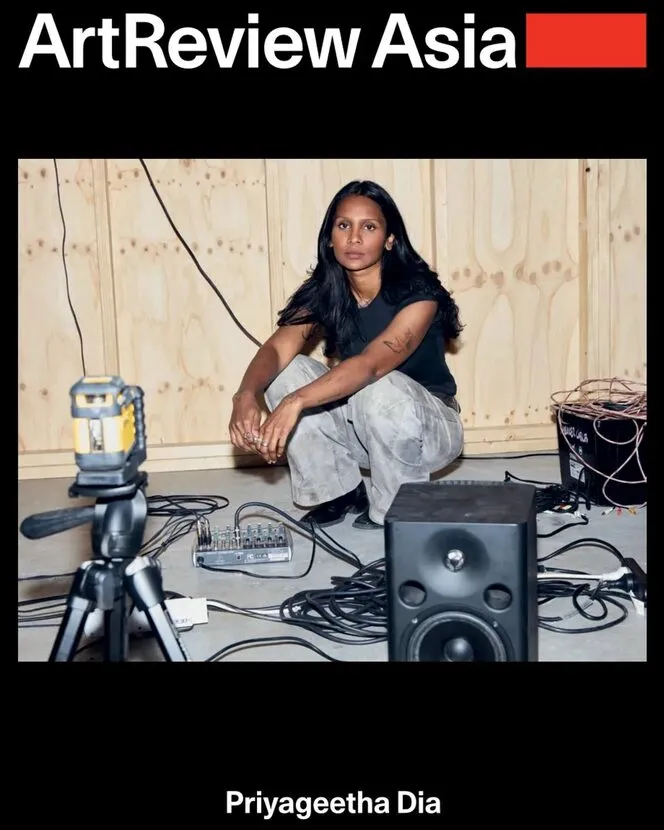
Summary
Shahrnush Parsipur and Shirin Neshat discuss Women Without Men, political metaphor and the second-class status of Iranian women in ArtReview Asia Summer 2026 (Vol 14 No 2) — "women in Iran are the second sex, not the first sex, and that has not changed."
ArtReview Asia Summer 2026 opens with a cover focused on the Next Prize, profiling Payal Kapadia, Pol Taburet, Ayoun Kim, Pan Daijing, Marco da Silva Ferreira, Andrea Pena, Emeka Ogboh, Alvaro Urbano, Ambrose Akinmusire and Barbara Sanchez-Kane. The Interview features Shahrnush Parsipur and Shirin Neshat in conversation about their novel-to-film adaptation, censorship and the political power of storytelling. Art Previewed covers Gallery Weekend Beijing, India in Venice, and Cambodia's shifting sands. Art Featured includes Piryageetha Dia, Saodat Ismailova, Against Venice by Regis Debray, The Way of Water by Shaunak Mahbubani, and Shuruq Harb by Stephanie Bailey. Exhibitions reviews cover Spectrosynthesis Seoul, Park Chan-kyong, the 61st Venice Biennale, and more. Books reviewed include Brutalist Korea and Paul Morley's Yoko Ono biography.
—————
Content Guide
The Interview
p.14 · Shahrnush Parsipur and Shirin Neshat — Publish and be Banned
The Iranian novelist and filmmaker discuss their collaboration adapting Women Without Men, the political metaphor at its core, and conditions for women artists under Iranian state censorship. Neshat states: "Women in Iran are the second sex, not the first sex, and that has not changed." The lesson for any artist working under censorship: metaphor is not weakness — it is the only language power understands.
Art Previewed
p.25 · Gallery Weekend Beijing
Yiyi You reports on the Chinese capital's annual gallery weekend, covering the galleries that participated and the sales trends that indicate market direction.
p.28 · India in Venice
Pallavi Surana on India's national pavilion at the Venice Biennale, covering the selected artists and the curatorial theme.
p.30 · Cambodia's Shifting Sands
Max Crosbie-Jones on how Cambodia's contemporary art scene is navigating political constraints and international funding dependencies.
Art Featured
p.34 · Piryageetha Dia
Adeline Chia profiles the Sri Lankan artist whose textile works address colonial遗产 and feminist memory.
p.42 · The Way of Water
Shaunak Mahbubani on artists using water as both material and metaphor in South and Southeast Asian contemporary practice.
p.50 · Saodat Ismailova
Fi Churchman profiles the Uzbek filmmaker and visual artist whose work bridges Central Asian spiritual traditions and contemporary installation.
p.58 · Shuruq Harb
Stephanie Bailey on the Palestinian artist whose work maps the invisible borders of everyday life under occupation.
Exhibitions & Books
p.76 · Exhibitions
Reviews of Spectrosynthesis Seoul, Park Chan-kyong, Ju Young Kim, Kawita Vatanajayankur, Hung Hsien, Cian Dayrit, the 61st Venice Biennale, and more.
Books include Brutalist Korea by Paul Tulett, Paul Morley's Yoko Ono biography Love Magic Power Danger Bliss, and Megha Majumdar's A Guardian and a Thief.
—————
Editor's Take
The Parsipur/Neshat interview is the strongest feature — it covers censorship, gender politics and artistic adaptation with specificity that most art magazines avoid. The Against Venice essay (Regis Debray, annotated by Chris Fite-Wassilak) is a smart counterpoint to the Venice-heavy issue. The Next Prize profiles give useful context on emerging artists. Weaknesses: the exhibition reviews section runs over 20 entries but several are so short they function as listings rather than criticism. The Cambodia's Shifting Sands piece raises important questions about funding dependencies but does not name specific figures. Several preview entries (Gallery Weekend Beijing, India in Venice) provide scene reports without critical edge.
Strengths
• Parsipur/Neshat interview addresses censorship with direct political language
• Against Venice essay provides necessary biennale critique
• Next Prize profiles cover genuinely emerging international artists
Weaknesses
• Exhibition reviews are too short to offer real critical engagement
• Scene reports lack critical edge
Verdict: Recommended — Buy for the Parsipur/Neshat conversation and Against Venice; skip if you prefer criticism over scene reporting.
