
The Strad – August 2026
Summary
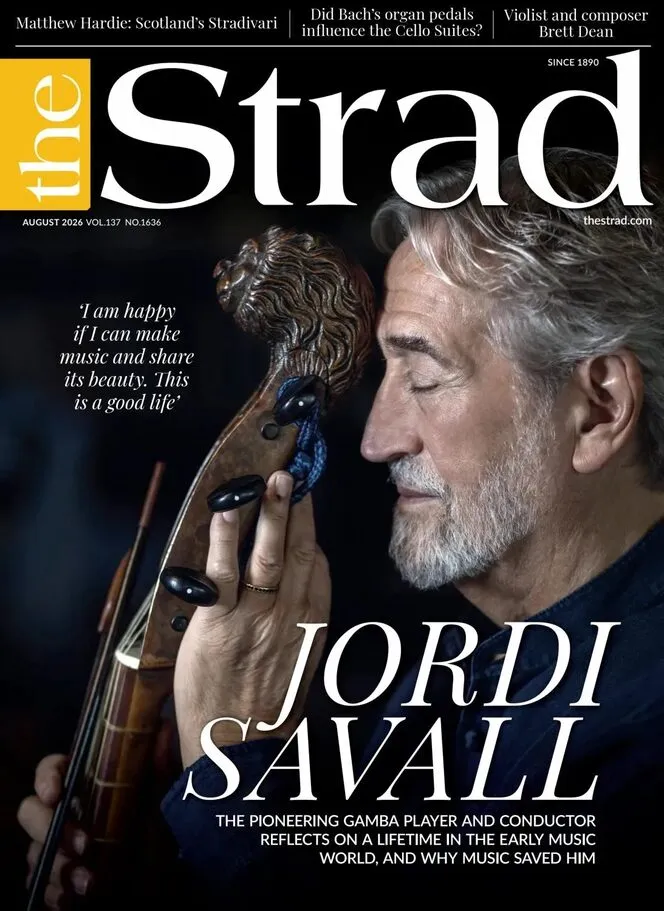
Jordi Savall turns 85 on 1 August, and The Strad August 2026, Vol.137 No.1636, marks it with a cover interview by Michael White in which the Catalan gamba player and conductor explains why music saved him, five decades into an early-music career that has just brought the Ernst von Siemens Music Prize.
The rest of the issue is unusually strong on scholarship. Florent Boyer opens a two-part study of how 18th-century Parisian instruments began showing Stradivari's influence, David Rattray reassesses Jedburgh-born luthier Matthew Hardie two centuries after his death, and Markus Rathey argues that Bach's cello works owe something to his organ pedal technique.
Players get equal weight. Jessica Duchen interviews Brett Dean, former Berlin Philharmonic violist turned composer-in-residence, and Alban Gerhardt on pairing the Elgar and Dvořák concertos. Esther Yoo teaches the first movement of Grieg's Violin Sonata no.3, Edith Salzmann addresses 19th-century cello technique, and Jennifer Halenar explains setting up a five-string violin.
—————
Content Guide
▸ Cover Story
p.24 · JORDI SAVALL
Michael White interviews the Catalan viola da gamba player and conductor as he approaches his 85th birthday on 1 August, and as the Ernst von Siemens Music Prize arrives. Savall talks about more than five decades in early music and why the repertoire mattered to him personally, not just professionally. He also brings his ensembles to the Edinburgh International Festival, which anchors the piece in a present season. Read it before the festival broadcasts and his programming choices make far more sense.
▸ Scholarship And Making
p.30 · FRENCH TRANSITIONAL PERIOD – PART ONE
Florent Boyer begins a two-part study of how instruments made in 18th-century Paris began to show the influence of Antonio Stradivari. Boyer writes with shop credentials: he graduated from the Jean-Jacques Pagès School of Violin Making in Mirecourt in 2006 and has been an accredited expert under the Court of Paris since 2019. The argument is built on observed construction changes rather than labels. Read part one now, because September's issue carries the second half.
p.42 · MATTHEW HARDIE
David Rattray examines the Jedburgh-born luthier known as the Scottish Stradivari, two hundred years after his death, with particular attention to his violas. Rattray treats a regional reputation as something to be tested against surviving instruments. The anniversary peg is handled without hagiography. Makers working on Scottish instruments will want this for the attribution detail.
p.57 · IN FOCUS
The instrument examined is an unusual mute violin made in 1776 by the Neapolitan luthier Nicolò Gagliano. The write-up describes what makes it atypical and how that affects its value and use. Mute and silent violins are rarely documented properly, which gives the page real reference worth. Check the features listed here against any Gagliano attribution you encounter.
p.60 · TRADE SECRETS
Jennifer Halenar sets out the method for setting up a five-string violin, drawing on her work as a Nashville-based physician and luthier specialising in set-up and five-string instruments. The dual career is not decoration: her approach to measurement and repeatability shows in the sequence. It is bench-usable, not a survey. Follow her order of operations on the next five-string that comes through your shop.
p.66 · MAKING MATTERS
The column examines the amount of air in the soundboxes of 23 Cremonese violins, treating internal air volume as a measurable quantity rather than a myth. The sample size is stated, which makes the findings checkable. It is the kind of empirical work that separates this magazine from glossy instrument titles. Compare the figure for your own instrument before accepting any received rule.
▸ Players And Teaching
p.36 · BRETT DEAN
Jessica Duchen interviews the Australian violist and composer, a former member of the Berlin Philharmonic viola section who has returned as composer-in-residence. Dean speaks from both sides of the stand, which gives the conversation an unusual balance of practical and compositional detail. Players who programme contemporary music get the most from it. Look at his viola writing with this interview in hand.
p.48 · SESSION REPORT
German cellist Alban Gerhardt tells Jessica Duchen about his latest album, which pairs the cello concertos of Elgar and Dvořák. The conversation covers why those two works sit together and how the recording was approached. Coupling decisions are usually marketing; here they are musical. Programme the two concertos back to back and judge the pairing yourself.
p.50 · BACH CELLO SUITES
Markus Rathey investigates the evidence that Bach's works for cello were influenced by his virtuosity as an organist, specifically his pedal technique. The claim is narrow and documented, which makes it persuasive rather than speculative. It changes how you hear the part-writing in the suites. Play the pedal lines yourself and the polyphonic thinking becomes obvious.
p.68 · MASTERCLASS
Esther Yoo works through the first movement of Grieg's Violin Sonata no.3, passage by passage. She writes as a performer with a specific interpretive view rather than as a neutral editor. The focus on one movement keeps the advice concrete. Bring the score and her fingerings to your next lesson.
p.78 · TECHNIQUE
Cellist Edith Salzmann offers hints and tips on 19th-century cello technique, a period usually left to specialists. She connects historical setup and bow to what players can actually adopt today. The column is short but dense. Try one of her suggestions in a Romantic work this week and listen for the change in articulation.
▸ Departments
p.20 · LIFE LESSONS
Scott Pingel, principal bassist of the San Francisco Symphony, reflects on the lessons that shaped his playing and career. An orchestral principal's perspective is rarer in these pages than a soloist's, and Pingel is specific about section work. It is short enough to read in one sitting. Take his point about listening down into your next rehearsal.
p.21 · OPINION
Carmen Lasceski-Custers, a Toronto-based educator and violinist, argues that theatre improvisation can offer inspiration for music teachers. The argument is practical: what improvisatory exercises train that scale books do not. Teachers get a usable idea rather than a manifesto. Try one exercise from it in your next studio class.
p.22 · POSTCARD FROM CALIFORNIA
Thomas May reports from the 2026 Ojai Music Festival. The report covers programming rather than celebrity, in keeping with that festival's character. It works as a guide to what American festivals are commissioning. Check the Ojai programme online before the next edition.
p.98 · SENTIMENTAL WORK
Cellist Maja Bogdanović writes about her love for Saint-Saëns's Cello Concerto no.1, closing the issue on a player's attachment to a specific work. Her account is personal but grounded in passages. It is a good final page. Revisit the concerto with her reading in mind.
—————
Editor's Take
The August issue is the strongest of the year so far because it refuses to choose between scholarship and playing. Boyer's Paris-Stradivari argument, Rattray on Matthew Hardie and Rathey's organ-pedal reading of the Bach suites are three genuine contributions, and Halenar's five-string set-up and the 23 Cremonese soundbox measurements give makers hard data. Savall at 85 is a worthy cover because Michael White gets him talking about why music mattered rather than listing prizes. The weakness is the back half: Reviews spread across concerts, recordings and books with the PENTATONE release listings reading like a label bulletin, and Products at page 19 is filler. Best for luthiers, teachers and serious students rather than casual listeners.
Strengths
• Boyer documents Parisian Stradivari influence with verifiable workshop credentials since 2019
• 23 Cremonese soundboxes measured, giving makers data instead of inherited rules
• Savall interview ties a lifetime in early music to a current Edinburgh Festival season
Weaknesses
• Reviews section leans on PENTATONE release listings that read like a label bulletin
• Products at page 19 adds nothing between the scholarship and the player features
Verdict: Essential — three pieces of real scholarship plus bench-usable maker data make this the year's best issue.
