
History Extra Collection – Issue 162 2026
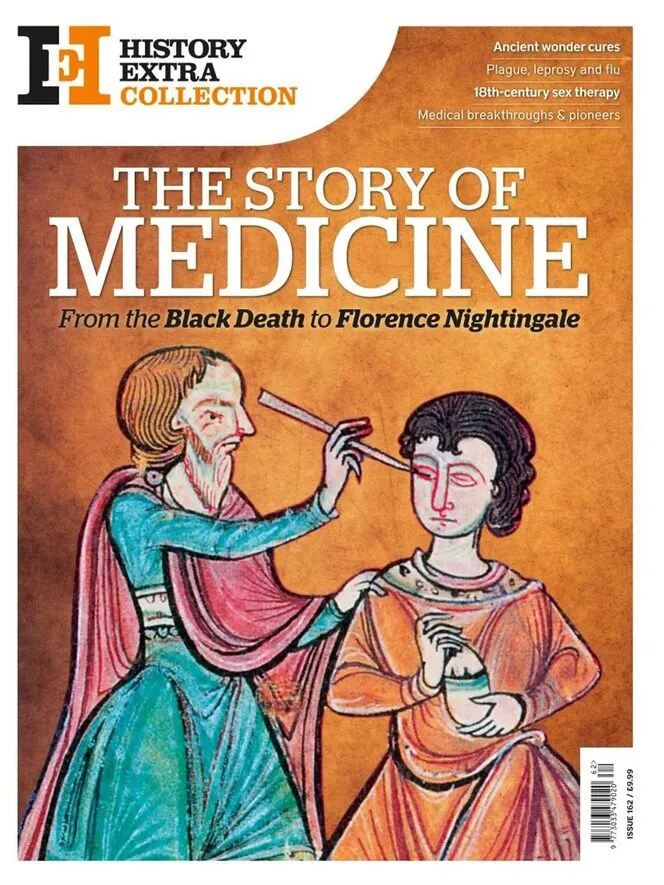
Summary
From the Black Death to Florence Nightingale the History Extra Collection Issue 162 traces the story of medicine across centuries of breakthroughs and failures. The collection covers ancient Egyptian treatments Roman midwifery medieval plague sites and the Spanish flu of 1918-19 then moves through sex therapy penicillin Marie Curie and the birth of the NHS.
Caroline Rance traces key moments in medical history across a timeline and contributes two features of surprising historical medical facts. Elma Brenner traces changing attitudes to leprosy through the ages. Mark Ormrod maps nine British sites affected by the 14th-century Black Death outbreak. Four experts answer big questions about the medieval pestilence. Laura Spinney covers the 1918 Spanish flu epidemic. Janet Weston examines how HIV-Aids changed Britain. The pioneers section profiles John Snow Louis Pasteur Edward Jenner and Marie Curie. Dominic Sandbrook recounts Alexander Fleming's discovery of penicillin. Martin Gorsky traces the NHS from Aneurin Bevan's vision to the present.
—————
Content Guide
▸ Death and Disease
p.16 · Health and Healing in Ancient Egypt
Carole Reeves explores diseases diagnoses and treatments from the pharaonic era. The article identifies the specific remedies recorded in the Ebers Papyrus. The surgical instruments found in tomb excavations are described.
p.26 · Marked by Plague
Mark Ormrod maps nine British sites affected by the 14th-century Black Death outbreak. Each location is named with its plague mortality rate. The archaeological evidence for mass burial pits is documented.
p.32 · The Black Death The Historians' View
Four experts answer big questions about the medieval pestilence. The mortality rate of 30 to 60 per cent of Europe's population is stated. The debate over whether the disease was bubonic or pneumonic plague is presented.
p.46 · The Fatal Flu That Gripped the Globe
Laura Spinney on the Spanish flu epidemic of 1918-19. The article estimates the death toll at 50 to 100 million worldwide. The specific public health failures that worsened the outbreak are identified.
p.50 · HIV-Aids The Epidemic That Changed Britain
Janet Weston examines how a new virus challenged and transformed attitudes towards sexuality. The article names the first UK cases and the government response. The role of activist groups in shaping treatment policy is documented.
▸ Diagnosis and Treatment
p.64 · Taking the Sex Cure
Lydia Syson introduces the world's first sex therapist. The article identifies the specific treatments prescribed for sexual dysfunction in the 18th century. The social context that made these treatments controversial is explained.
p.68 · Sickness Salves and Skillets
Elaine Leong delves into an 18th-century medicine cabinet. The specific remedies ingredients and their claimed properties are catalogued. The household medical guidebooks that circulated among the middle class are named.
p.72 · The Ladies With the Lamps
Mark Bostridge discusses Florence Nightingale and the genesis of modern nursing. The article identifies the specific reforms Nightingale implemented at Scutari. Her statistical methods for tracking mortality are described.
p.76 · Under the Knife in the 18th Century
Daniel Hahn examines surgery in the pre-anaesthesia era. The article names the common procedures and their survival rates. The specific tools used and the speed required of surgeons are described.
▸ Breakthroughs and Pioneers
p.94 · NHS Britain's Healthcare Revolution
Martin Gorsky traces the history from Aneurin Bevan's vision to the present. The article identifies the political opposition to the NHS's founding in 1948. The specific services included in the original Act are listed.
p.106 · Penicillin When Mould Made Medical History
Dominic Sandbrook recounts Alexander Fleming's antibiotic advance in 1928. The article identifies the specific mould strain Penicillium notatum. The delay between discovery and mass production during WWII is explained.
p.112 · Medicine's Big Bang
Adrian Washbourne explores ten 19th-century innovations in medicine. The article identifies anaesthesia germ theory and the stethoscope among the breakthroughs. The specific inventors and their dates of discovery are named.
—————
Editor's Take
Issue 162 of the History Extra Collection delivers the most coherent thematic volume in the series with a logical structure that progresses from ancient disease through treatment to modern breakthroughs. The Spanish flu and HIV-Aids chapters carry contemporary relevance. The pioneers sidebars break up the dense medical history effectively. The British focus of the NHS chapter is inevitable for the target audience but limits the collection's global value. This title suits the medical history enthusiast and the general reader alike.
Strengths
• Thematic structure from ancient to modern creates a coherent narrative arc
• HIV-Aids and Spanish flu chapters add contemporary relevance
• Pioneers sidebars provide useful quick-reference biographical data
Weaknesses
• NHS chapter too UK-centric for a global medical history
• No dedicated coverage of Chinese or Islamic medical traditions
Verdict: Recommended — the most tightly edited collection in the series.
