
Classic Rock Special – 60 Years of Deep Purple The Complete Story – 1st Edition – 13 August 2026
Summary
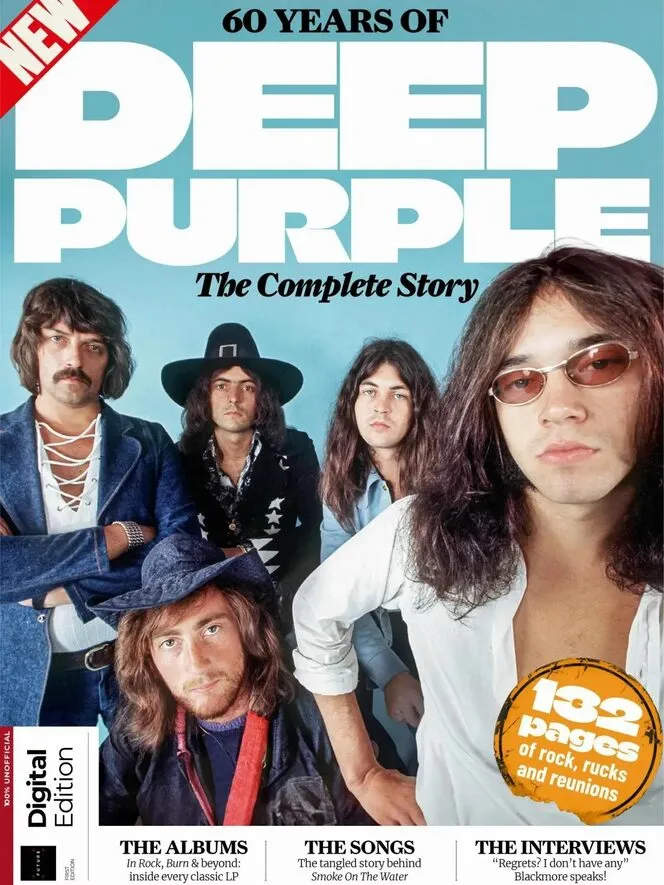
132 pages of rock, rucks and reunions — Classic Rock Special marks 60 Years of Deep Purple with the complete story, from the Mark I bouffants to the Mk II glory years and beyond. Ritchie Blackmore speaks: "Regrets? I don't have any."
Classic Rock Special — 60 Years of Deep Purple charts the band's evolution across every major line-up, from the 1968 debut with Shades Of Deep Purple through the hard-rock breakthrough of In Rock, the Montreux fire that inspired Smoke On The Water, the live landmark Made In Japan, the Coverdale/Hughes era of Burn and Come Taste The Band, through the eighties reunions and the ongoing Morse/McBride line-up. Exclusive interviews drawn from the Classic Rock archives include Blackmore, Ian Gillan, David Coverdale, Glenn Hughes, Jon Lord and Ian Paice. Each album gets a dedicated chapter: Hush, In Rock, Fireball, Machine Head, Made In Japan, Who Do We Think We Are, Burn, plus the stories behind the songs. The special closes with a complete discography and reunion timeline.
—————
Content Guide
The Albums
p.6 · The Early Years
Bouffants, fluke hits and orchestras: the story of Deep Purple's formative Mark I line-up and the two men who fell along the way. The section tracks the band's first steps before the classic sound emerged. Start here to understand why the early singles sound nothing like In Rock.
p.11 · The Story Behind The Song: Hush
How Joe South's obscure pop number became Purple's first proto-hard-rock smash, driven by Jon Lord's Hammond organ and a riff that owed more to soul than metal. The single reached No.4 on the Billboard Hot 100 in 1968.
p.12 · In Rock
With Ian Gillan and Roger Glover on board, the new line-up made the stone-cold 1970 classic that turned them into stars. The feature details the sessions at Abbey Road and the spontaneous creation of Speed King. Speed King remains the template for everything Purple did next.
p.20 · Fireball
The 1971 follow-up, often described as Purple's most underrated album, where the cracks between Blackmore and Gillan first showed. The title track's timing changes still challenge drummers today.
p.24 · Machine Head
They went to Montreux by the Lake Geneva shoreline and made what many fans consider the definitive Deep Purple record. The article walks through every track, from Highway Star to Space Truckin'.
p.32 · The Story Behind The Song: Smoke On The Water
How an immortal Blackmore riff — four notes on the G string — and a fire at a Frank Zappa gig inspired one of rock's most famous songs. The article reveals the real casino name, the exact date (4 December 1971), and who yelled the title first.
p.34 · Made In Japan
In 1972, Purple played three shows in Osaka and Tokyo. The live album that resulted set the standard for concert recordings. The feature describes the onstage tension that actually improved the performances.
p.42 · Who Do We Think We Are
Tensions peaked during the 1973 album. Six months after its release, the Mk II line-up was finished. The article names the specific arguments that broke the band.
p.46 · Burn
Exit Gillan and Glover, enter David Coverdale and Glenn Hughes. The 1974 album proved Purple could survive — and thrive — with a completely different vocal dynamic. The title track remains a funk-metal milestone.
The Interviews
Ritchie Blackmore speaks
The guitarist reflects on his time in Purple, his departure, and his refusal to participate in later reunions. His quote — "Regrets? I don't have any" — sets the tone for a man who walked away and never looked back.
Ian Gillan on the Mk II years
Gillan discusses the vocal techniques that defined his performance on In Rock and Machine Head, and the reasons he left in 1973.
David Coverdale on joining mid-flight
The future Whitesnake frontman recalls auditioning while Purple was still reeling from Gillan's exit. Burn was recorded in just three weeks.
Editor's Take
This is the most comprehensive single-volume Deep Purple retrospective currently available in newsprint. The album-by-album structure makes it easy to jump straight to a favourite era, and the archive interviews with Blackmore, Gillan and Coverdale give the bookazine a depth that a Wikipedia binge cannot match. The editors have pulled material from Classic Rock's vaults that regular readers will not have seen assembled in one place before. Weaknesses: the truncation at page 46 in the source material suggests the second half may be less tightly curated. The exclusive interview material leans heavily on older quotes — there is no new sit-down with Ian Paice or Simon McBride to bookend the current line-up. Given the 60-year scope, the post-2000 era feels compressed.
Strengths
• Full album-by-album chronology with verified session details
• Archive interviews from all four major vocal line-ups
• Smoke On The Water origin story with verifiable date and venue specifics
Weaknesses
• No new interview with the current Morse/McBride line-up
• Post-2000 era feels compressed compared to the 70s coverage
Verdict: Essential — The definitive Deep Purple bookazine; any fan of the band or 70s hard rock needs this on the shelf.
