
Vintage Rock Presents – Buddy Holly, 2026
Summary
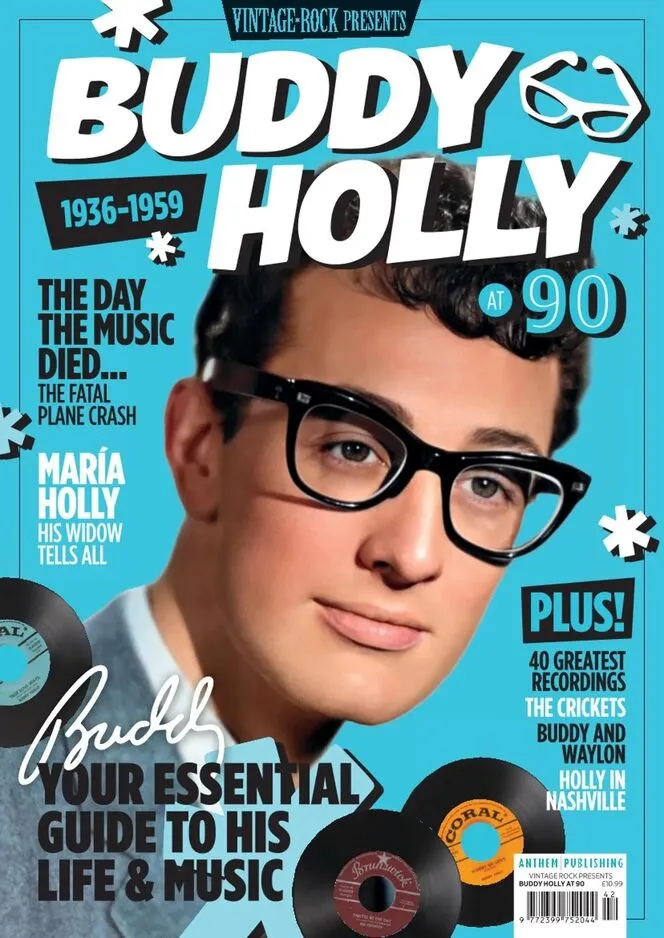
Charles Hardin Holley was 13 and already playing Hank Williams songs in Lubbock, Texas, when the story told by Vintage Rock Presents: Buddy Holly 1936-1959 begins, a 2026 Anthem Publishing special that runs from JT Hutchinson Junior High to the midnight flight and Maria Elena Holly's own account.
Johnny Sharp opens at page 6 with the Lubbock years: guitar lessons from eldest brother Larry, the Buddy and Bob show on KDAV, and the 1955 bill where Elvis Presley ranked above the pair. Sonny Curtis and Sonny West speak from the archives, George Tomsco explains The Fireballs' link to Holly, and Maria Elena Holly gives a 2018 interview at page 88. The 40 Greatest Recordings countdown and a full account of the crash close the run.
Regulars reach past nostalgia. The magazine walks round the Buddy Holly Center in Lubbock, examines Buddy's personal singles collection held there, and uses That'll Be The Tone to explain how those Fender Stratocaster sounds can be rebuilt today. The Classic Album slot takes the 1974 LP Legend, Greetings From Nashville weighs Music City against Holly's instincts, and Coda revisits the apartment tapes cut in his Greenwich Village flat.
—————
Content Guide
▸ Cover Story
p.6 · IT'S A CRAZY FEELING
Johnny Sharp traces Charles Hardin Holley from the household of Odell and Ella Holley to the guitar his eldest brother Larry taught him. Sharp dates the serious start to age 11 at JT Hutchinson Junior High, with Hank Williams songs in the repertoire by 13. He follows the partnership with Jack Neal, the 1952 audition that became Buddy and Jack's Sunday Party, and the switch to Bob Montgomery at the end of 1954. Read it to see how a KDAV slot turned two schoolboys into a paid working act.
p.102 · THE DAY THE MUSIC DIED
The feature reconstructs the midnight flight that killed three of rock and roll's brightest performers, and states plainly that the causes remain controversial. Rather than settling on one theory, the magazine lays out the competing accounts around that night. Readers who only know the shorthand phrase get the sequence of events and the disputes attached to it. Use it as the factual base before arguing about the crash with anyone at the record fair.
▸ Interviews And Archive
p.88 · TRUE LOVE STAYS
Buddy's widow Maria Elena Holly speaks to Vintage Rock in an exclusive interview first published in 2018. Her account covers the marriage and what she carried afterwards, and it is the closest thing the issue has to primary testimony. Reprinting it in the At 90 special puts her voice alongside the band members rather than behind them. Read this one before the crash feature; her perspective changes how the later pages land.
p.28 · BEST FRIEND OF MINE
Waylon Jennings emerges here as a protege rather than a peer, with Holly cast as mentor as much as fellow music obsessive. The piece follows that relationship through the tour circuit that later defined Jennings's own myth. It also explains why Jennings spoke about Holly for the rest of his career. Play the early Jennings singles after reading it and the debt is audible.
p.34 · BREAKING ROCKS
Sonny Curtis, Cricket, songwriter and sideman, talks about working alongside Buddy Holly in an interview pulled from the Vintage Rock archives. Curtis is specific about the mechanics of the group rather than the legend. The piece matters because Curtis outlasted the band and kept writing hits. Pair it with the 40 Greatest Recordings list to hear which sides he shaped.
p.72 · ALL THE RAVE: SONNY WEST
This archive interview from 2016 has Sonny West discussing his work with Holly, and it is flagged on the contents page with the At 90 marker. West's songs entered the Holly canon through other hands, which makes his account of the writing process valuable. He is candid about how material moved between Lubbock musicians. Read it, then check the writer credits on your own copies.
p.78 · FAMOUS FLAMES: THE FIREBALLS
George Tomsco of The Fireballs tells Vintage Rock how his band's path crossed Holly's, a connection that outlived Holly himself through posthumous overdub sessions. Tomsco talks as a working guitarist from the same Southwestern circuit. The interview fills in the regional scene that made Holly possible. Follow it up with The Fireballs' instrumental singles to hear the shared vocabulary.
▸ The Music
p.18 · THE SPECIAL ONE
The magazine gives That'll Be The Day a feature of its own, treating the song as one of Holly's greatest hits rather than just his breakthrough. The piece stays with the record itself: how it came together and why it still opens doors for new listeners. It is the natural entry point for anyone starting a Holly collection. Cue the single first, then read.
p.40 · 40 GREATEST RECORDINGS
Vintage Rock picks its 40 favourites from a recorded legacy built in barely two years, and the choices run well past the obvious singles. The list is the issue's best argument that Holly's catalogue rewards deep listening. Entries explain what each record contributed rather than simply ranking them. Build a playlist straight from the 40 and you have an evening sorted.
p.96 · CLASSIC ALBUM: LEGEND
The Classic Album slot takes Legend, the 1974 LP that introduced a whole generation to Holly long after his death. The piece treats the compilation as a historical object: what it collected, and how it shaped which songs became standards. It is a useful reminder that reissues, not originals, made most fans. Check which Legend tracks you still default to before reading.
p.84 · THAT'LL BE THE TONE
Holly's brief career produced a string of instantly identifiable sounds, and this feature explains how those tones can be reproduced now. The Fender Stratocaster he carried to the UK sits at the centre of the discussion. Written for players rather than collectors, it connects specific records to specific sounds. Guitarists can take it straight to a rehearsal and test the settings.
p.50 · GREETINGS FROM NASHVILLE
The piece asks whether Music City's hit machine was ready for Holly, and the answer is not flattering to Nashville. It follows the sessions and the friction between a studio system and a performer who wrote his own material. Read it as the counterpart to the Lubbock story that opens the issue. It explains why Holly went back to working with his own band.
▸ Places And Artefacts
p.58 · PILGRIMAGE TO THE BH CENTRE
Vintage Rock travels to Lubbock, Texas to the Buddy Holly Center, described as a fixture on every Holly fan's list. The report covers what is actually held and displayed there rather than the gift shop. It works as practical planning material for anyone routing a trip through West Texas. Note the location details if Lubbock is anywhere near your itinerary.
p.64 · BUDDY'S PRIZED 45'S
The Buddy Holly Center holds Holly's personal singles collection, and this feature goes through it to see what his own listening reveals. Records he chose say more about his influences than any interview. The article uses the collection as evidence rather than memorabilia. Cross-check the titles against your own shelves and the family tree of his sound gets clearer.
—————
Editor's Take
The strongest material here is first-hand: Maria Elena Holly from 2018, Sonny West from 2016, Sonny Curtis and George Tomsco all speaking as participants, plus Johnny Sharp's tightly dated Lubbock chronology built on named schools, stations and bandmates. The weakest element is the reliance on reprinted archive interviews rather than new reporting for an At 90 special, and the photo gallery at page 56 leans on Getty library shots rather than fresh discoveries. Production slips too: the contents page lists page 118 ahead of page 114, and a subscription plug at page 100 interrupts the closing run. This suits collectors who want the biography and the testimony in one volume, not readers hunting unpublished revelations.
Strengths
• Named sources throughout: Larry Holley, Jack Neal, Bob Montgomery, Pappy Dave Stone, Hi Pockets Duncan
• That'll Be The Tone turns the mythology into usable guitar and amp information
• Buddy's own 45s collection at the Buddy Holly Center gives genuinely new listening evidence
Weaknesses
• Key interviews are reprints from 2016 and 2018, not new commissions
• Contents page misorders pages 114 and 118, and the gallery adds little
Verdict: Recommended — the Lubbock chronology and María Elena Holly's testimony justify the price, even with recycled archive material.
