
ArtReview – September 2026
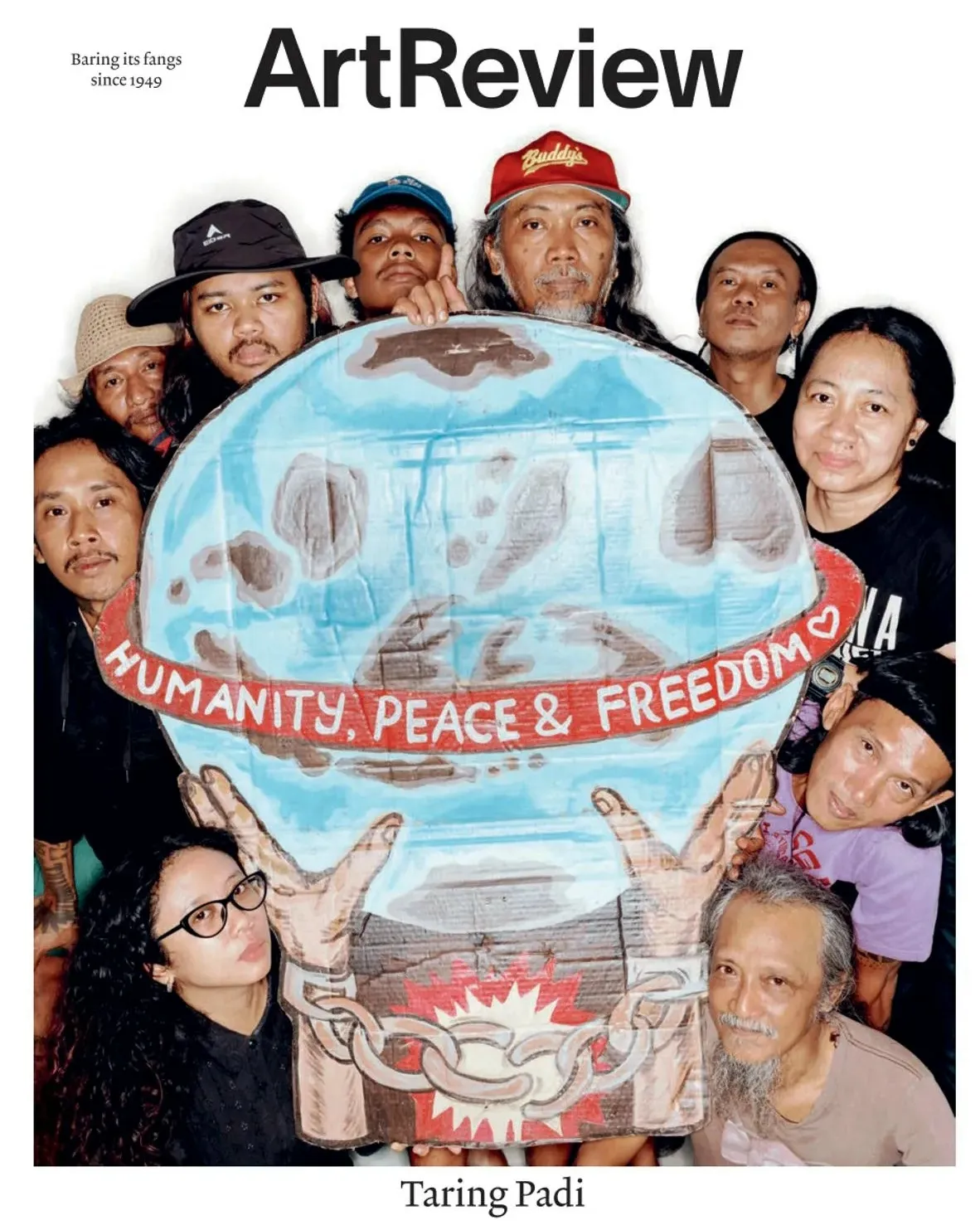
Summary
Clive Chijioke Nwonka on Roots & Regeneration, Taring Padi's politically charged printmaking, and Ana Maria Caballero on AI, ritual and playing the art market — ArtReview September 2026 (Vol 78 No 5) asks what art is for and whether it still has the agency to intervene.
ArtReview September 2026 opens with an editor's letter questioning art's functionality in a world demanding results. Taring Padi, the Indonesian collective, gets the cover treatment with Adeline Chia's feature on their activist print tradition. Clive Chijioke Nwonka examines Roots & Regeneration through the lens of diaspora and visual culture. Alexandra Symons-Sutcliffe profiles Terminal Piece as a meditation on endings. Martin Herbert revisits Jasper Johns at the current moment. Sophie Becker is profiled by Nicole Kaack. The Waning of the Middle Ages features Johan Huizinga's text annotated by Mark Rappolt. Ana Maria Caballero discusses poetry, NFTs, and putting herself where people would not expect to find a poet. The Sight & Sound column by Zoe Hopkins and Jenny Wu's Fitting In and Dirty Work columns round out the front. Exhibitions reviews cover Manifesta 16 Ruhr, Annette Messager, Eric Baudelaire, Sim Chi Yin, Candace Hill-Montgomery, and more than 20 other shows. Book reviews include Simon Reynolds' Still in a Dream and Catherine Liu's Traumatized.
—————
Content Guide
Features
p.38 · Taring Padi
Adeline Chia on the Indonesian collective whose woodcut and screen-print posters have documented political protest since 1998. The feature traces their visual language from the fall of Suharto through contemporary activism. Printmakers should study their layering technique for political messaging.
p.46 · Roots & Regeneration
Clive Chijioke Nwonka examines how diaspora artists use botanical and agricultural metaphors to talk about displacement and belonging. The article cites specific installations and their material choices.
p.50 · Terminal Piece
Alexandra Symons-Sutcliffe on an artwork that stages its own ending, questioning whether an artwork can complete itself. The piece names the specific durational performance and its intended close date.
p.54 · Jasper Johns
Martin Herbert revisits Johns's flag paintings and target motifs through the lens of the current political moment. The article argues that Johns's work has become more relevant, not less, with age.
p.62 · Sophie Becker
Nicole Kaack profiles the emerging artist whose practice combines textile and installation. Becker names the specific woven technique that anchors her current series.
The Interview
p.20 · Ana Maria Caballero
The poet discusses what art is when it exists as code, the importance of ritual, playing the NFT market strategically, and whether AI is going to screw us all. She describes a specific auction outcome and what it taught her about valuation. Artists navigating Web3 should read her strategy notes.
Columns
p.27 · Sight & Sound
Zoë Hopkins on a recent exhibition where sound functioned as the primary spatial organiser rather than a supplement to visual work.
p.28 · Fitting In
Jenny Wu on the pressure for artists to assimilate into institutional expectations.
p.31 · Maxxin & Relaxxin
Michelle Santiago Cortes on the aesthetic economy of self-care commodification.
Exhibitions
p.76 · Exhibitions & Books
Twenty-four exhibition reviews including Manifesta 16 Ruhr, Annette Messager at her Paris retrospective, Sim Chi Yin's photographic investigation, and Gray Wielebinski at the ICA. Each review runs 100-200 words with a clear verdict.
Books reviewed include Simon Reynolds' Still in a Dream (shoegaze history), Catherine Liu's Traumatized, and Courttia Newland's The Art of Opposition.
—————
Editor's Take
This issue coheres better than most because the editor's question — what is art for? — threads through every major feature without feeling forced. Taring Padi's profile is the standout: it grounds the political urgency in specific printmaking decisions rather than vague rhetoric. The Ana Maria Caballero interview is the most pragmatic piece for any artist working with digital media because she names specific financial outcomes. Weaknesses: the Johan Huizinga annotation piece is an academic exercise that most readers will skip — it breaks the issue's rhythm. The exhibitions section runs 24 reviews, which is impressive breadth but a handful of the entries (particularly the lesser-known Korean and Southeast Asian shows) get only four lines that read more like catalogue notes than criticism. The Waning of the Middle Ages insertion feels like a reprint filler.
Strengths
• Taring Padi profile grounds political art in concrete techniques
• Ana Maria Caballero interview offers actionable Web3 strategy
• Editor's thematic question holds 100 pages together
Weaknesses
• Huizinga annotation piece reads as academic filler
• Several exhibition reviews are too short to offer real critical value
Verdict: Recommended — Buy for the Taring Padi feature and Caballero interview; skip if short exhibition reviews frustrate you.
