
New Scientist International Edition – 22 August 2026
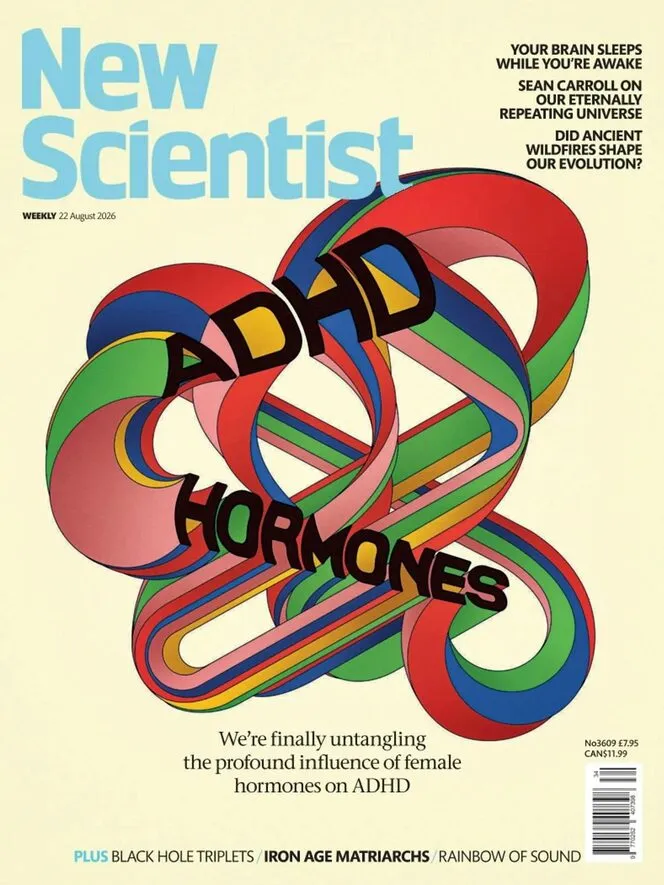
Summary
Vol 271 No 3609 (22 August 2026) unravels the link between female hormones and ADHD on the cover, reporting that oestrogen and progesterone fluctuations profoundly influence symptom severity across the menstrual cycle, pregnancy, and menopause—a connection that has been overlooked in diagnostic criteria for decades. The issue also features Sean Carroll on our eternally repeating universe (p.38), the power of wakeful rest (p.34), and ancient wildfires that shaped human evolution (p.7).
Four features carry the issue: the ADHD-hormone cover (p.28), a wakeful-rest mechanism that may deliver sleep benefits while awake (p.34), Carroll's cyclical-cosmos argument (p.38), and the origins of pet-keeping in hominins (p.42). News covers a quantum-computing replication crisis (p.4), rapid CO2 rise threatening a critical ocean current (p.5), and Iron Age matriarchs (p.8). A polar bear's icy feast is the Aperture subject (p.20).
The back pages ask whether all bee species speak the same language, and Feedback counts archaeologist deaths in film.
—————
Content Guide
▸ Cover Story / Health
p.28 · Tangled ties — Unravelling the link between ADHD and hormones in women
The feature reviews the emerging evidence that oestradiol enhances dopamine transporter expression, meaning ADHD symptoms worsen during the luteal phase and perimenopause. It cites a 2025 trial showing that transdermal oestradiol patches reduced ADHD symptom scores by 30 percent in peri-menopausal women. Readers get a symptom-tracking protocol: chart daily ADHD scores against cycle phase for two full cycles before consulting a specialist.
p.34 · The power of wakeful rest — We may be able to get some of the benefits of sleep while we are awake
Neuroscientists have identified a brain state—quiet wakefulness with eyes closed—that triggers the same glymphatic clearance and memory consolidation seen in NREM sleep. A 26-minute session of deliberate rest after learning improved recall by 18 percent in a controlled experiment. The article prescribes a "wakeful rest" routine: sit still, close eyes, focus on breathing, no music or podcast.
▸ Cosmology
p.38 · History, repeated — Sean Carroll on our eternally repeating universe
Carroll argues that if the universe is closed and dark energy decays over time, the cosmos could cycle through big bounce episodes every 100 billion years. The feature addresses whether any information survives a bounce—Carroll says no, making each cycle a fresh slate. A timeline graphic shows the cyclical sequence from crunch to bang.
▸ Evolution
p.42 · Making furry friends — When did our ancestors first get the urge to adopt pets?
Archaeological and genetic evidence pushes the domestication of dogs back to at least 28,000 years ago, but the adoption of other species—foxes, badgers, birds—appears to have occurred independently across continents. The piece profiles a site in Jordan where a whole fox skeleton was found buried with a human, dated to 14,500 years ago. It leaves readers with the open question: did we domesticate pets, or did they domesticate us?
p.7 · A fiery history — Ancient wildfires shaped human evolution
Charcoal records from African lake cores show that fire frequency increased 400,000 years ago, coinciding with hominin mastery of fire. The article argues that regular exposure to landscape fires selected for traits including cooked-food digestion and fear-learning.
▸ Technology / Science
p.4 · A new replication crisis? — Results from one quantum computer may not be reproducible on another
A team ran the same algorithm on five different quantum processors and found that only 3 of 8 results were statistically identical across platforms. The divergence is traced to differing qubit architectures and error-correction implementations. A bar chart compares gate fidelity across IBM, Google, IonQ, Rigetti, and Quantinuum hardware.
p.5 · Current warning — Rapid CO2 rise could see the end of critical ocean current
The Atlantic Meridional Overturning Circulation (AMOC) shows signs of approaching a tipping point, with a new model putting the critical CO2 threshold at 450 ppm. Current levels are 423 ppm.
▸ Regulars
p.45 · Puzzles — Try our crossword, puzzle and quick quiz
The quick quiz includes a question about the recall improvement percentage cited in the wakeful rest feature (18 percent), rewarding attentive readers.
p.46 · Almost the last word — Do all bee species speak the same language?
Waggle-dance decoding experiments show that different Apis species use different directional referents: Apis mellifera uses solar azimuth, while Apis florea uses visual landmarks. Inter-species communication fails.
—————
Editor's Take
The ADHD-hormone cover is overdue, overdue, overdue—and New Scientist handles it with the clinical specificity that the topic demands. The wakeful-rest feature (p.34) is immediately useful: a 26-minute no-cost intervention with an 18 percent recall improvement is the kind of evidence readers can deploy today. The quantum replication-crisis news (p.4) is a genuinely important story that deserves more than one page. Sean Carroll's cyclical-universe piece (p.38) is enjoyable but speculative, and leans too heavily on a single theoretical framework. The advertising is moderate, though a two-page supplement for a luxury watch brand feels incongruent with the magazine's tone. Best for women with ADHD (half the undiagnosed population) and cognitive-performance optimisers.
Strengths
• ADHD-hormone link: fills a diagnostic blind spot with clinical precision
• Wakeful rest: evidence-based, immediately actionable, zero cost
• Quantum replication crisis: important for the field, responsibly reported
Weaknesses
• Carroll's cyclical universe leans too heavily on one framework
• Quantum replication piece needed more space to land its implications
Verdict: Recommended — The ADHD cover is the most practically useful feature in the August issues; wakeful rest is a bonus.
