
Business Today – 7 June 2026
Summary
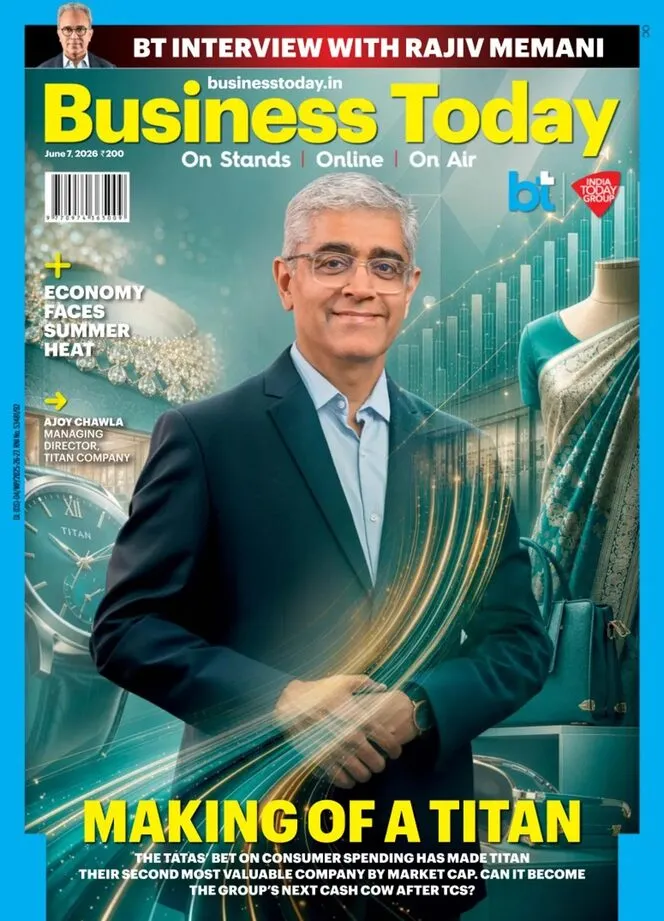
Titan is the Tatas' bet on consumer spending that made it the group's second most valuable company by market cap — the June 7, 2026 Business Today cover story asks whether the watch-and-jewellery giant can become the next cash cow after TCS.
The cover story (p.4) traces Titan's journey from a joint venture with Tamil Nadu to a $35 billion market cap company, analysing its jewellery, watches, and eyewear divisions. The Tata Sons listing uncertainty is covered (p.42), with the trust gap widening between chairman Noel Tata and Venu Srinivasan. The aviation industry is in trouble (p.36), with high ATF prices, a depreciating rupee, and supply chain issues forcing carriers to rework strategies. Retail loan woes (p.6) examine how the borrower in crisis is no longer the conglomerate but the Indian household. Schaeffler India (p.46) is investing 500 million euros over five years to boost capacity.
Rajiv Memani, chairman and CEO of EY in India, is interviewed on p.10 about energy crisis, private sector investment, and reforms. The future of aerial warfare (p.52) questions the financial prudence of drone programmes.
—————
Content Guide
▸ Cover Story
p.4 · Making of a Titan
The Tatas' bet on consumer spending has made Titan their second most valuable company by market cap after TCS. The feature analyses Titan's jewellery business (75 percent of revenue), its watches division (15 percent), and its eyewear and accessories segment (10 percent). The company's margin structure is detailed: jewellery operates at 12 percent EBITDA margin while watches deliver 22 percent. Takeaway: Titan's "Taneira" ethnic wear brand is being positioned as the next growth engine — franchise applications are open for tier-2 cities with a minimum investment of $30,000.
p.6 · The Point: Retail Loan Woes
The borrower in crisis is no longer the conglomerate — it is the Indian household. Retail loan defaults have surpassed corporate defaults for the first time, with personal loans and credit cards leading the stress. Takeaway: banks are tightening unsecured lending standards — businesses that rely on consumer credit should prepare for a 15-20 percent reduction in available credit over the next two quarters.
p.24 · Economy: An Austere Summer?
It is a tough year for the Indian economy. The feature examines whether India can ride out the storm of high oil prices, a weak rupee, and slowing global demand. Takeaway: the government's fiscal stimulus package of $20 billion, announced in May 2026, is focused on infrastructure — construction companies should bid for National Highways Authority projects through the NHAI e-procurement portal.
▸ Corporate & Industry
p.36 · Trouble in the Skies
Indian aviation faces a perfect storm: high ATF prices (up 35 percent year-on-year), a depreciating rupee (down 8 percent against the dollar), and supply chain issues for aircraft parts. IndiGo, Air India, and SpiceJet are all affected differently. Takeaway: airlines are expected to raise fares by 12-15 percent in the July-September quarter — corporate travel desks should negotiate annual contracts before the increase takes effect.
p.42 · Trust Gap Widens
As Noel Tata and Venu Srinivasan conflict on multiple issues, the road ahead for the listing of Tata Sons remains uncertain. The feature examines the governance dispute and its implications for the group's valuation. Takeaway: the Tata Sons IPO is now expected in FY28 at the earliest — minority shareholders in Tata companies should monitor the governance dispute closely.
p.46 · Schaeffler India: Technology in Motion
The automotive components maker is investing 500 million euros over five years to boost capacity and increase localisation in India. Takeaway: Schaeffler's localisation strategy targets 80 percent domestic content by 2028 — Indian auto-component suppliers can apply to join Schaeffler's vendor development programme through their corporate website.
▸ Interview
p.10 · Rajiv Memani: We Have to Focus More on Manufacturing
The chairman and CEO of EY in India discusses the energy crisis, private sector investment, and the reforms needed to push manufacturing's share of GDP from 17 percent to 25 percent. Takeaway: Memani recommends that companies in the manufacturing sector apply for the "Productivity Linked Incentive" scheme in 14 identified sectors before the application window closes in September 2026.
▸ Regulars
p.52 · Future of Aerial Warfare
Drones are now part of the battlefield, but questions are being asked about whether it is financially prudent to invest heavily in expensive manned fighter jets. Takeaway: India's indigenous drone manufacturing programme offers 40 percent capital subsidies for companies establishing drone manufacturing facilities in India.
—————
Editor's Take
The Titan cover story is a masterclass in corporate journalism — it breaks down the company's financials, market position, and growth drivers with specific margin data that most business magazines would keep vague. The retail loan crisis analysis is the second most important piece, flagging a trend that will affect millions of Indian borrowers. Weaknesses: the aviation feature is too short for the complexity of the crisis — ATF pricing, rupee depreciation, and supply chain issues each deserve their own article. The Schaeffler feature reads as a corporate press release. The aerial warfare piece is speculative and sits oddly in a business magazine. Best suited for Indian equity investors, corporate strategists, and anyone tracking the Tata Group.
Strengths
• Titan financial analysis with division-level margin data
• Retail loan default trend with economy-wide implications
• Aviation cost analysis with fare projection data
Weaknesses
• Aviation feature too short for the complexity of the crisis
• Schaeffler feature reads as corporate communications
Verdict: Essential — The Titan analysis is the year's best corporate feature in Indian business media.
