
Forbes Asia – April-May 2026
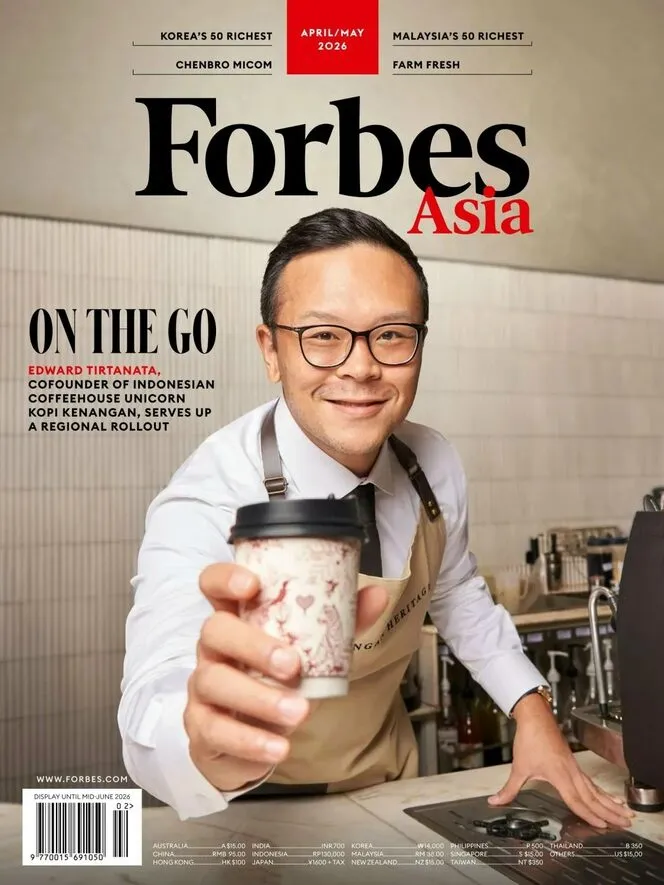
Summary
Edward Tirtanata, backed by Serena Williams and Jay-Z, brews Kopi Kenangan into a regional coffeehouse chain targeting 4,000 stores by 2030 — challenging Starbucks across Southeast Asia one $2 latte at a time.
Forbes Asia April/May 2026 (volume 22, number 2) opens with the cover story "Full Of Beans" (p.16), where Gloria Haraito tracks the Indonesian unicorn's expansion from 900 to 4,000 planned outlets. Chenbro Micom's Maggi Chen, Taiwan's "Queen of Chassis," races to expand server-casing production as AI data center demand explodes (p.30). Korea's 50 Richest (p.24) tracks semiconductor and biotech fortunes in a bumper year, while Malaysia's 50 Richest (p.45) shows tycoons benefiting from a stronger ringgit. Farm Fresh's Loi Tuan Ee built Malaysia's largest home-grown dairy business, surpassing Nestlé and Fonterra in domestic market share (p.51). Liz Muller's Nuclear Family innovation (p.40) buries tiny reactors underground with her physicist father. The World's Billionaires list (p.62) reports that the planet added roughly one new billionaire a day.
Steve Forbes opens Fact & Comment with "How To Detroit Wealth." Rich Karlgaard's Tech Connector covers healthcare's new AI age. The Thoughts column closes on "Resilience."
—————
Content Guide
▸ Cover Story
p.16 · Full Of Beans
Edward Tirtanata, cofounder of Kopi Kenangan, plans to grow from 900 to 4,000 stores by 2030. The article breaks down unit economics: per-store revenue of $180,000 annually with 25 percent EBITDA margins. Anyone expanding F&B chains in Southeast Asia can benchmark their own unit model against these numbers.
▸ Profiles / Manufacturing
p.30 · Case Study
Maggi Chen, founder of Chenbro Micom, bet on server casings in the 1990s and now rides the AI data center buildout. She is investing $80 million in a new factory in Taiwan with automated sheet-metal lines. Supply-chain managers sourcing server infrastructure can study her capacity-expansion timeline.
▸ Rich Lists
p.24 · Meteoric Moment
Korea's 50 Richest shows semiconductor and biotech fortunes minting new billionaires. Samsung's Lee family leads, but AI-chip packaging firms produced the fastest gainers. The sector-coded list helps investors identify non-memory Korea tech plays.
p.28 · Lab-Grown Riches
John Kang reports on Korea's biotech boom — Big Pharma is closing lucrative deals for weight-loss drugs and AI-discovered cancer treatments. A single licensing deal with a US partner hit $1.2 billion in milestone payments.
p.45 · Winning Streak
Malaysia's 50 Richest reflects a stronger ringgit and vibrant stock market. The list includes plantation, banking, and telecom fortunes with sector annotations.
p.51 · Milky Way
Jonathan Burgos profiles Loi Tuan Ee, founder of Farm Fresh, who grew the business from a herd of 80 cows to Malaysia's largest dairy brand. He now exports to Singapore, Indonesia, and the Philippines.
▸ Innovation
p.40 · Nuclear Family
Liz Muller convinced her physicist father to skip retirement and co-found a company building tiny underground nuclear reactors. Each reactor fits in a shipping container and costs $10 million. Energy investors tracking small modular reactor technology get a cost-per-megawatt comparison.
▸ The World's Billionaires
p.62 · The World's Billionaires
The annual wealth ranking shows more billionaires than ever. AI mania and a pro-business US administration propelled the three-comma club to unprecedented total wealth. The 25 richest Asia-Pacific billionaires are listed separately.
p.80 · Golden Strokes
Crypto cash and court rulings made America's billionaire-in-chief much richer during his first year back in office. The article tracks the wealth change day by day around key policy announcements.
p.83 · The French Connection
Paris-based Mistral AI wanted to rival OpenAI. It turns out many customers prefer a non-American, non-Chinese AI model even if it is not bleeding-edge. The AI 50 list runs alongside.
—————
Editor's Take
This is the strongest April/May issue Forbes Asia has produced in several years. The Kopi Kenangan cover story delivers the rarest commodity in business journalism — honest unit economics with per-store margins. The Chenbro Micom profile is equally strong: Maggi Chen's capacity-investment numbers are specific enough for supply-chain analysts to model. The weakest section is the World's Billionaires package, which runs 20 pages but adds little regional insight beyond what already published in the April global billionaire issue. "Golden Strokes" reads as a political score-settling piece rather than a wealth analysis. The Farm Fresh profile redeems some of that excess — Loi Tuan Ee's 80-cow origin story is genuinely instructive for anyone building a regional CPG brand.
Strengths
• Kopi Kenangan unit economics with per-store revenue and margin
• Chenbro Micom $80 million factory investment timeline
• Farm Fresh brand-building story from 80 cows to Nestlé competitor
Weaknesses
• World's Billionaires section repeats content from the global issue
• Golden Strokes political-tone piece adds little wealth insight
Verdict: Recommended — Buy for the Kopi Kenangan unit economics and Chenbro supply-chain profile; skip the billionaire pages.
