
Rock Gem – September 2026
Summary
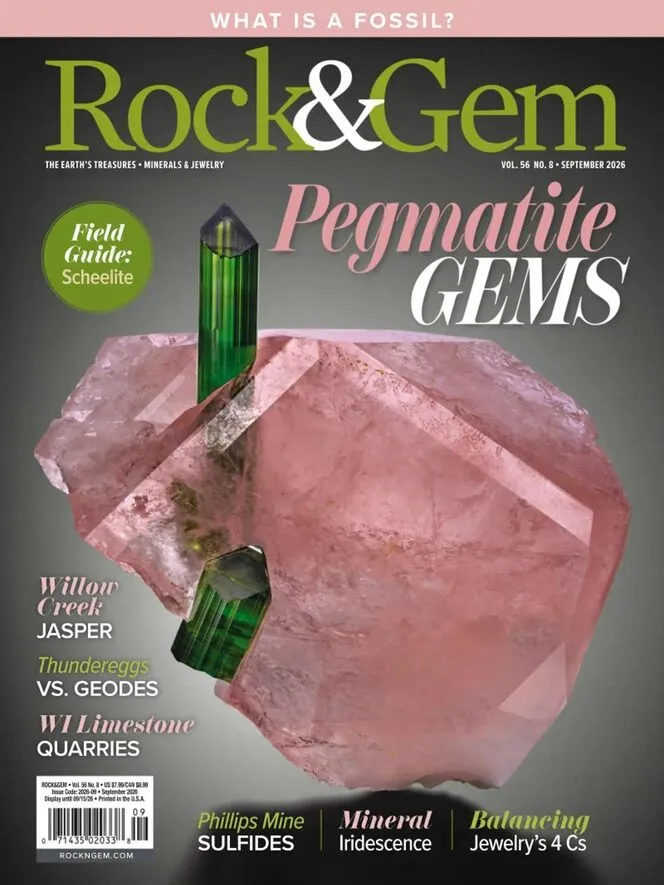
A 12-centimetre tourmaline and morganite "Sword in the Stone" from Brazil's Pederneira Mine fronts Rock & Gem September 2026, and Vol. 56 No. 8 backs that cover with nine features, from Willow Creek jasper at page 12 to Bob Jones on spinel at 64.
Rock & Gem magazine September 2026 (Vol. 56 No. 8) opens its feature well with Willow Creek jasper by Bruce McKay at page 12 and In Praise of Pegmatites by Steve Voynick at 18, before Mark Oros returns twice, on cutting colored gemstones for maximum value at 26 and on using social media for promotion at 50. Robert Beard covers Philips Mine sulfides at 32, Dr. Stuart Mills and Pam Freeman build a scheelite field guide at 42, L.A. Berry separates geodes from thundereggs at 52, and Sue Eyre works through Wisconsin limestone at 58.
The regulars carry the practical load: Earth Science News at 4, R&G Kids at 38, What to Cut at 46, Show Dates at 70, Rock Science at 74 and Parting Shot at 80. Editor's Letter sits on page 1. For collectors, the issue's value is that the field guide, the cutting advice and the show calendar all arrive in one delivery, so a trip planned from Show Dates can be prepped with the scheelite guide in hand.
—————
Content Guide
▸ Cover Story
p.26 · CUTTING COLORED GEMSTONES FOR MAXIMUM VALUE
Mark Oros takes the cutting question head-on in Rock & Gem September 2026, arguing that value is decided at the wheel before the stone ever reaches a setting. He works through orientation, proportion and the trade-offs a cutter faces when a rough piece could yield either one large stone or several smaller ones. Map your rough on paper and mark two cutting options before you put it on the lap.
▸ Features
p.12 · WILLOW CREEK JASPER
Bruce McKay opens the issue on Willow Creek jasper, tracing the material to its source ground and describing the patterns that make it identifiable. He names the colour bands and the conditions the material forms in, so readers know what to look for in a rough batch. Carry a hand lens and check for the banding before you buy a slab labelled Willow Creek.
p.18 · IN PRAISE OF PEGMATITES
Steve Voynick makes the case for pegmatites at page 18, explaining why these coarse-grained rocks produce so many of the collector specimens people actually want. He ties mineral species to the pegmatite pockets that host them rather than treating the rock as background. Sort your pegmatite rough by pocket habit, not by colour alone.
p.32 · PHILIPS MINE SULFIDES
Robert Beard documents the Philips Mine sulfides, giving the locality its due with the species and specimen forms it has produced. The piece stays with named minerals and the mine's own history instead of general locality praise. Verify any Philips Mine label against the species list before you pay a premium.
p.42 · FIELD GUIDE: SCHEELITE
Dr. Stuart Mills and Pam Freeman build a working scheelite field guide at 42, covering the tests and traits that separate it from look-alikes in the field. The guide is structured for use outdoors, with the diagnostics a collector can run without a lab. Pack a shortwave UV light, because scheelite's fluorescence is the fastest field test.
p.52 · GEODE OR THUNDEREGG?
L.A. Berry settles the geode-versus-thunderegg question at page 52, giving the structural differences that decide which name applies. The piece is built on formation, so readers leave able to defend their own classification. Cut one specimen in half and read the fill pattern before calling it either.
p.58 · WISCONSIN LIMESTONE
Sue Eyre takes the issue to Wisconsin limestone at 58, describing the beds and the fossil material that makes the state's limestone worth collecting. She keeps the focus on accessible sites and what the rock yields there. Check land access rules before you collect, because much of the state's limestone sits on private ground.
▸ Regulars
p.4 · EARTH SCIENCE NEWS
Earth Science News at page 4 gathers the month's research items, naming the institutions and findings behind each one. It is the fastest way to find out which new paper matters to a collector or a field trip. Skim it before the features, since several items connect to later articles.
p.38 · R&G KIDS
R&G Kids at 38 runs a page aimed at young collectors, with activities built around rocks and minerals rather than text alone. It gives parents something concrete to do with a beginner. Set up one sorting tray with labelled compartments for a child's first collection.
p.46 · WHAT TO CUT
What to Cut at 46 picks rough with cutting potential and explains the yield a lapidary should expect. The column names material and expected results, so it reads as a buying shortlist. Buy one piece of the rough it names and cut it before the next issue arrives.
p.64 · RETRO ROCKS: SPINEL
Bob Jones closes the feature run on spinel at 64, using the Retro Rocks frame to look back at how the mineral has been understood and mislabelled. He names historical confusions and the specimens behind them. Re-check any old "ruby" label in your cabinet, because spinel hides under that name.
p.70 · SHOW DATES
Show Dates at 70 lists upcoming gem and mineral shows with their locations and dates, which is the issue's most-used page for anyone who travels to buy. The listing is organised so a trip can be planned directly from it. Circle the two nearest shows now and book accommodation before the dealers take the rooms.
—————
Editor's Take
Rock & Gem Vol. 56 No. 8 is at its best when it stays in the field and the workshop: In Praise of Pegmatites at 18 and the scheelite field guide at 42 are the two pieces a collector will actually carry, and Mark Oros's cutting feature at 26 makes a real argument rather than admiring finished stones. The weakest link is the middle stretch, where Wisconsin limestone at 58 and the sulfides piece at 32 are competent but thin, and the issue leans on the same small group of names across four bylines. The cover is the strongest asset in the whole package: the Pederneira tourmaline and morganite "Sword in the Stone", shot by Laszlo Kupi from the Robert Lavinsky collection, is a specimen worth the newsstand price on its own. This issue suits working collectors and lapidaries far more than armchair readers, and the Show Dates page alone justifies a subscription.
Strengths
• Pederneira tourmaline cover shot by Laszlo Kupi
• Scheelite field guide built for outdoor use
• Oros cutting feature argues a real position
Weaknesses
• Four bylines recur across the feature well
• Limestone and sulfide pieces stay thin
Verdict: Recommended — Field and workshop content is strong; the middle features are merely competent.
