
Bloomberg Businessweek USA – January 2026
Summary
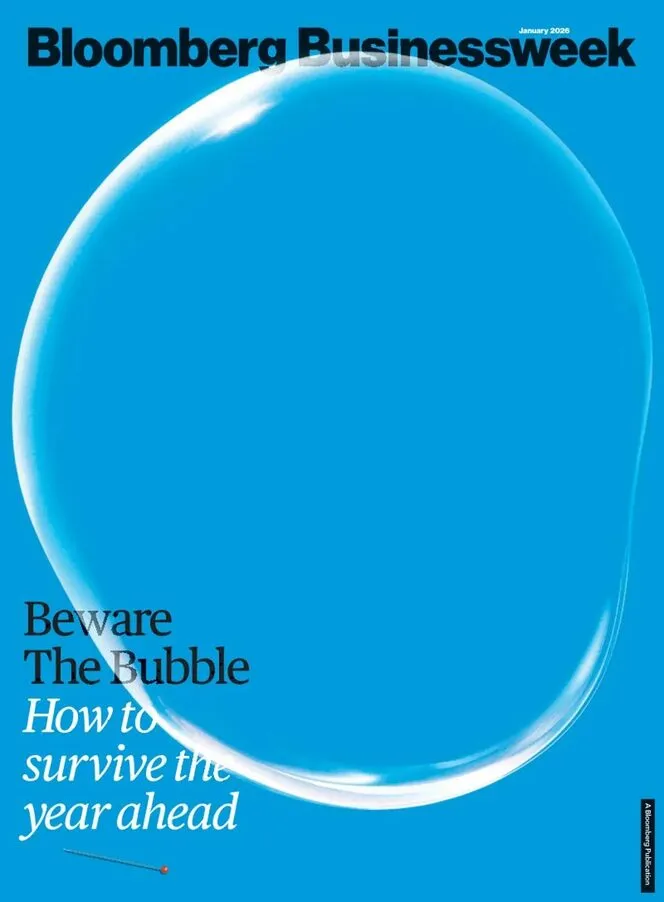
"Beware The Bubble" — Bloomberg Businessweek's January 2026 issue opens with a sensible guide to surviving the year ahead, set against a cover image of a tiger safari in India's Bandhavgarh National Park. Brad Stone's opening essay warns that AI infrastructure spending, private credit and memecoin speculation are all exhibiting bubble characteristics simultaneously.
The 92-page issue features "The Year Ahead" section from P7 to P26: topics include "AI Can't Produce a Whole Movie… Yet" (P11), "Fast-Casual Chains Have a Big Salad Problem" (P13), "Luxury in 2026 Means Finding a Secondhand Steal" (P22), and "These Are the 50 Companies to Watch" (P26). The In Context section covers America's rare-earth mining pipe dream, Malaysian boycotts boosting local brands, and Trump's Golden Dome missile-defence cost. The Pursuits section is a travel-focused guide to 2026 destinations from Texas road trips to African tiger tours. The Oracle AI infrastructure story (P46) and Target turnaround piece (P54) anchor the middle of the book.
—————
Content Guide
▸ The Year Ahead / Cover Package
P7 · Dial Down the Hype
Brad Stone opens with the 1929 Babson Break and draws a line to today's AI, gold and private-credit bubbles. Omdia data shows tech companies will spend nearly USD 1.6 trillion annually on data centres by 2030. Bitcoin's total market cap gained USD 636 billion from January to October, then gave it all back. The $TRUMP and $MELANIA coins are down 88% and 99% respectively since inauguration. Any investor sitting through 2026 should treat Stone's bubble taxonomy as a checklist.
P11 · AI Can't Produce a Whole Movie… Yet
The gap between AI video-generation tools and theatrical-release quality is still wide. Entertainment-company strategists should use the timeline estimates here to plan their AI adoption roadmaps.
P13 · Fast-Casual Chains Have a Big Salad Problem
Rising avocado and chicken costs, labour shortages and the perception of salad as overpriced are squeezing a once-hot category. Restaurant investors should compare the margin data here with their own portfolios.
P22 · Luxury in 2026 Means Finding a Secondhand Steal
Resale platforms are attracting first-time luxury buyers while cannibalising full-price sales. Brand managers must decide which channel to protect.
P26 · These Are the 50 Companies to Watch
Curated list of companies across AI, energy, consumer goods and finance that Businessweek editors believe will define 2026.
▸ In Context
P37 · America's Rare-Earth Mining Pipe Dream
The US wants to break China's rare-earth monopoly, but domestic mining projects face permitting timelines of a decade or more.
P39 · Malaysian Boycotts of Global Brands Boost Local Rivals
Consumer boycotts tied to geopolitical sentiment are permanently reshaping market share in Southeast Asia.
P42 · What Trump's Golden Dome Would Cost
A missile-defence system of the scale proposed would rival the Manhattan Project in expense and engineering complexity.
▸ Features
P46 · Oracle Has a Lot Riding on AI Infrastructure
Larry Ellison's bet on AI data centres is massive — the article notes his Florida drive-through safari cost less than a single server cluster.
P54 · Can New Leadership Make Target Chic Again?
Jaewon Kang and Devin Leonard report from Minnesota on Target's attempt to regain the cultural and commercial relevance it lost over the past three years.
P62 · How Trump Forged a Memecoin Fortune
The inside story of how the Trump family launched $TRUMP and $MELANIA days before the inauguration, generating hundreds of millions in trading fees.
▸ Pursuits / Travel Guide
P73 · Pack Your Bags: Here's Where to Go in 2026
A 20-page travel guide covering Texas road trips, desert-flat sailing, five uncrowded European destinations, Taiwan's dining scene, Guyana's ecotourism boom, and a tiger tour in India.
P88 · Earn Your Stripes on a Tiger Tour in India
A practical guide to Bandhavgarh National Park and the Bengal tiger safari experience.
P92 · Exit Strategy: Star-Powered Collabs That Are Too Good to Be True
The closing column examines the economics of celebrity-branded collaborations and why most fail within three years.
—————
Editor's Take
The Year Ahead section is disciplined and useful — Brad Stone's bubble essay is the best opening Remarks of any 2026 issue so far, and the 50 Companies to Watch list is a genuine resource. The travel section consumes 20 pages that could have gone to deeper business analysis; it is well-produced but feels like a supplement rather than an integrated part of the issue. The Target story is solid but not revelatory. The memecoin piece is the most entertaining article in the issue. Best for investors who want a sober 2026 outlook and anyone who enjoys watching bubble narratives get punctured.
Strengths
• Stone's bubble essay is the most honest macroeconomic take in business media this month
• 50 Companies to Watch list is a practical reference
• Memecoin story is well-reported and genuinely entertaining
Weaknesses
• 20-page travel section is excessive for a 92-page issue
• Target story lacks the access needed for a definitive turnaround profile
Verdict: Essential — The bubble essay alone is worth the cover price.
