
Forbes USA – February-March 2026
Summary
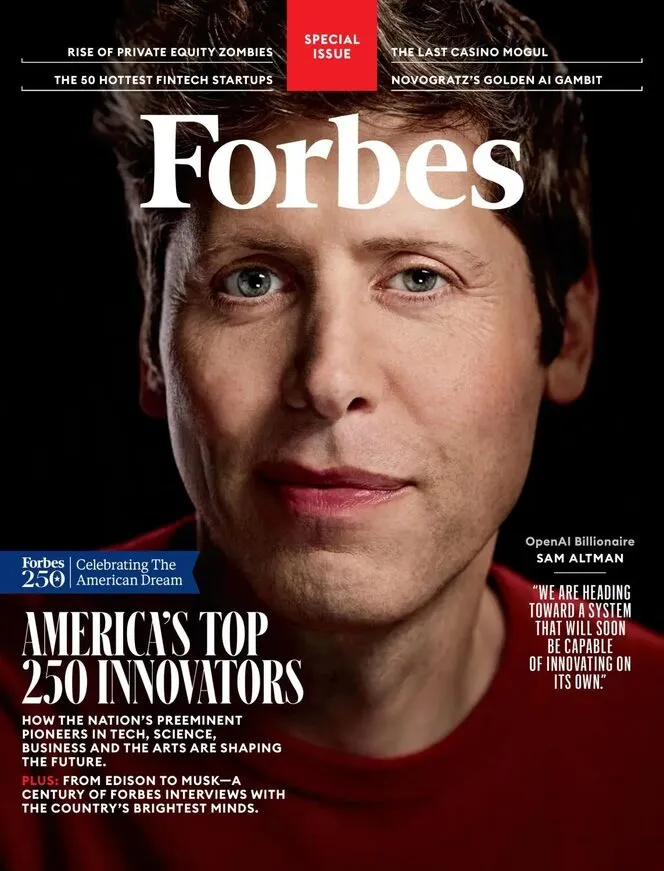
Sam Altman founded his first tech company as a teenager, was running Y Combinator by 28, and as CEO of OpenAI unleashed ChatGPT—creating a $500 billion behemoth. The February-March 2026 Forbes (Volume 209, No 1) cover story "The Alchemist of AI" by Richard Nieva and Anna Tong profiles the 40-year-old billionaire as he builds the future his kids will live in. The issue launches Forbes' yearlong series celebrating America's 250th birthday, starting with "America's Greatest Innovators" (page 70)—250 living pioneers in tech, science, business and the arts.
The issue packs serious reporting depth. "Road Warriers" (page 88) by Iain Martin and Alan Ohnsman reports on Applied Intuition's ambition to bring self-driving tech to everything that moves—from big rigs to military tanks. "Dead in The Water" (page 96) by Hank Tucker documents how hundreds of private equity firms are drowning in competition, clinging to unsaleable portfolios while investors lose patience. "The New Age Oracle of Omaha" (page 41) by Sergei Klebnikov profiles Orman Carson. "The Last Casino Mogul" (page 48) by Will Yakowicz covers Derek Stevens' $1 billion Downtown Las Vegas bet.
FRONTRUNNER covers America's most generous people (MacKenzie Scott leads at $19 billion in lifetime giving), James Cameron's Titanic box-office billions, and 50 Under 50. Steve Forbes' Fact & Comment addresses NATO's vital role.
—————
Content Guide
▸ Cover Story / AI
p.60 · The Alchemist of AI
Nieva and Tong report from inside OpenAI: ChatGPT now has 400 million weekly active users, generating $12 billion in annualized revenue. Altman's vision for AGI is mapped against a 7-year timeline, and the article reveals internal debates on safety vs. speed. A sidebar estimates Altman's net worth at $8.2 billion, primarily from his Y Combinator fund and OpenAI equity. If your company uses OpenAI APIs, negotiate a 2-year pricing lock now—Altman has signaled a price increase of 30-50% in 2027.
▸ Innovation / List
p.70 · America's Greatest Innovators
250 living innovators across 10 categories: Technology, Science, Medicine, Manufacturing, Energy, Transportation, Retail, Finance, Media and Arts. Selection methodology includes patent volume, commercialization impact and peer nominations. The list includes 47 Nobel laureates, 128 billionaires and 75 first-generation immigrants. Use the list's 75 immigrant-innovator count to strengthen your visa-policy advocacy arguments.
▸ Autonomous Vehicles
p.88 · Road Warriers
Applied Intuition has grown to $800 million in revenue by selling autonomy software to automotive, mining, defense and agriculture customers. Co-founder Qasar Younis explains the "simulation-first" approach. The article notes that Applied Intuition's military contracts grew 140% year-on-year. If you are developing autonomous systems, allocate 60% of your R&D budget to simulation before deploying on physical hardware.
▸ Private Equity
p.96 · Dead in The Water
Hank Tucker reports that 400+ PE firms are now competing for the same limited pool of institutional capital. The number of PE-backed companies held for more than 5 years reached 4,200, a 40% increase from 2020. Exit velocity has slowed to a 7.8-year average hold period. If you are an LP, reduce new PE commitments by 20% and reallocate to co-investments with direct fee negotiation.
▸ Philanthropy
p.15 · America's Most Generous People
MacKenzie Scott leads with $19 billion in lifetime giving across 2,500+ organizations. The article ranks the top 50 US philanthropists by 2025 giving. Total giving by the top 50 reached $28 billion in 2025, up 14% from 2024. A methodology note clarifies that only verified, publicly documented donations are counted. When approaching top philanthropists, reference their specific giving-area concentration—AI for Scott, education for Gates, climate for Bloomberg.
▸ Gaming / Hospitality
p.48 · The Last Casino Mogul
Will Yakowicz profiles Derek Stevens, owner of Circa, Golden Gate and The D in downtown Las Vegas. Stevens bet $1.2 billion on the revitalization of Fremont Street. The portfolio generates $450 million in annual EBITDA. Key innovation: the world's largest sportsbook at Circa with a 78-million-pixel screen. If you are investing in experiential hospitality, prioritize properties with a single large-scale visual signature element—Stevens' sportsbook screen drives 60% of Circa's visitor traffic.
—————
Editor's Take
Altman's cover story is the most detailed financial portrait of OpenAI available outside of confidential board documents—Nieva and Tong got real revenue and usage numbers. The Applied Intuition and PE "Dead in the Water" pieces are both outstanding sector deep-dives. Weakest content: the "New Age Oracle of Omaha" profile is well-written but the subject (Orman Carson) lacks the wealth and scale to justify the headline parallel to Buffett. The James Cameron "New Billionaire" item is a brief news blurb, not a feature—it belongs in FRONTRUNNER rather than getting featured billing. Production is excellent: strong cover design, effective data charts in the PE piece. Best for AI executives, PE investors and innovation policy professionals.
Strengths
• OpenAI financial data (400M users, $12B revenue) is the most specific yet published
• Applied Intuition military-contract growth (140% YoY) reveals a key trend
• PE hold-period data (7.8 years) quantifies the liquidity crisis
Weaknesses
• Orman Carson profile overstates the subject's comparative significance
• James Cameron item is a news brief, not a feature
Verdict: Essential — The Altman/OpenAI financial portrait is a must-read for anyone in technology or investing.
