
Business Today – 1 March 2026
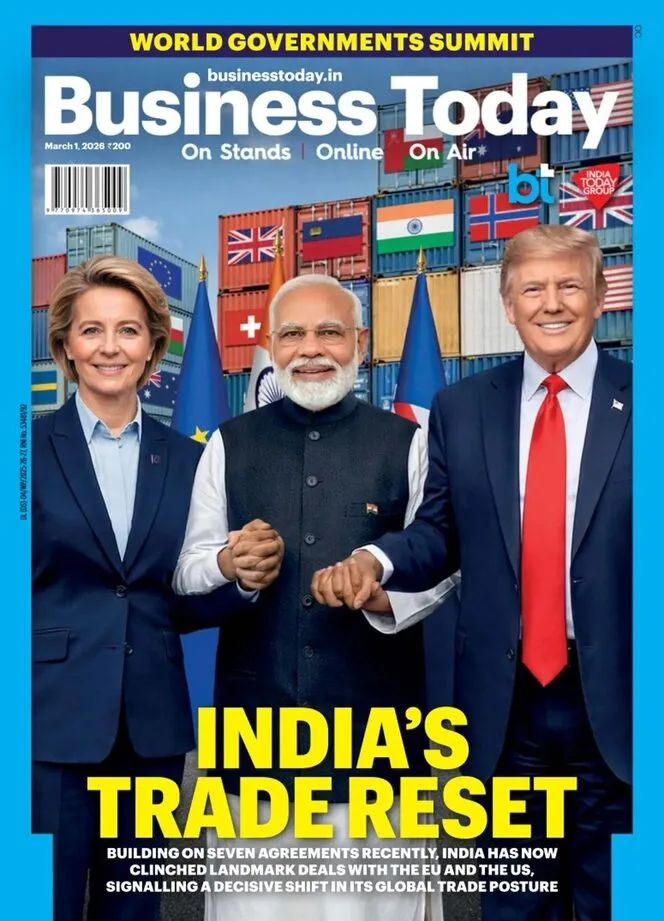
Summary
India signed two trade pacts in two weeks — a free-trade agreement with the EU and a bilateral deal with the US — and Commerce Minister Piyush Goyal tells Business Today's March 1, 2026 issue (Vol 35 No 5) that both are win-wins. The cover story "India's Trade Reset" examines whether the sudden acceleration in trade diplomacy can rewire an economy still reliant on domestic consumption. India's gig economy is projected to employ 90 million workers by 2030, and record silver and copper prices are squeezing solar photovoltaic manufacturers.
The lead essay by Anand Adhikari argues that the EU and US deals signal a fundamental shift in India's global trade posture after years of protectionist hesitation. Goyal's interview covers tariff reductions, intellectual property timelines, and the government's strategy for services export growth in IT and healthcare. The gig economy feature profiles platforms like Urban Company, Zomato, and Swiggy and their evolving worker-protection frameworks.
Regular columns The Point and BT Interview anchor the front half. The Industry section examines the solar manufacturing cost crisis.
—————
Content Guide
▸ Cover Story / Trade Policy
p.24 · India's Trade Reset
Anand Adhikari's lead essay analyses the EU FTA and US bilateral deal as a coordinated pivot away from India's traditionally defensive trade posture. The EU agreement alone covers 90 percent of tariff lines and is projected to boost India's goods exports by 8 billion dollars annually by 2028. The US deal includes a services component that could double Indian IT exports to North America within 3 years. Trade compliance teams should map the tariff phase-down schedule against their current product codes.
▸ Interview / Government
p.18 · US Deal is a Win-Win
Commerce Minister Piyush Goyal confirms that the US agreement includes mutual recognition of professional qualifications for Indian chartered accountants and doctors — a first in any Indian trade deal. He also addresses the auto-component tariff reduction timeline, which gives domestic manufacturers 5 years to adjust. Export promotion councils can use the qualification recognition clause in cross-border recruitment pitches.
▸ Economy / Digital Labour
p.38 · Inside India's Gig Economy
India's gig workforce is projected to reach 90 million by 2030, up from 45 million in 2025. The article profiles 3 platform companies — Urban Company, Zomato, Swiggy — and their contrasting approaches to worker insurance and skill certification. Urban Company's training-to-certification rate of 68 percent is cited as the industry benchmark. HR leaders designing flexible-work models should study the certification metric.
▸ Industry / Renewable Energy
p.52 · Price Shock For Solar
Silver prices hit 1,200 dollars per kilogram in Q1 2026, up 60 percent year-on-year, and copper prices crossed 11,000 dollars per tonne. The article reports that solar PV manufacturing costs have risen 15 percent in 6 months, threatening the viability of 12 gigawatts of awarded projects. Project finance teams should stress-test their solar bids against the current silver and copper spot prices.
▸ Markets / Economy
p.10 · India's Big Corporate Bond Push
The Point column reports that corporate bond issuances reached 8.2 lakh crore in FY2026, up 24 percent year-on-year, driven by infra companies seeking long-term capital. The RBI's proposed framework for a corporate bond repo market could add another 30 percent to volumes. Fixed-income investors should monitor the repo framework timeline.
—————
Editor's Take
The trade reset cover story is well-timed and well-sourced — Piyush Goyal's interview gives the issue a news-making advantage that most fortnightly magazines cannot match. Anand Adhikari's lead essay connects the EU and US deals into a coherent strategy narrative. The gig economy feature is the issue's hidden gem, with platform-level data that daily newspapers do not provide. The solar manufacturing cost piece is a short but essential alert for renewable energy investors. The issue's weakness is its length — at barely 60 pages of editorial, subscribers will finish it in one sitting. A second interview or a longer tech feature would have added heft.
Strengths
• Piyush Goyal interview includes genuinely new trade deal details
• Gig economy workforce projection (90 million) is policy-deck material
• Solar cost data is immediately actionable for project finance
Weaknesses
• Issue feels thin at approximately 60 editorial pages
• No technology or start-up feature in a trade-themed issue
Verdict: Recommended — The trade deal coverage and Goyal interview make this essential for anyone who follows India's trade policy; the gig economy report is a bonus.
