
Forbes Middle East English Edition – September 2026
Summary
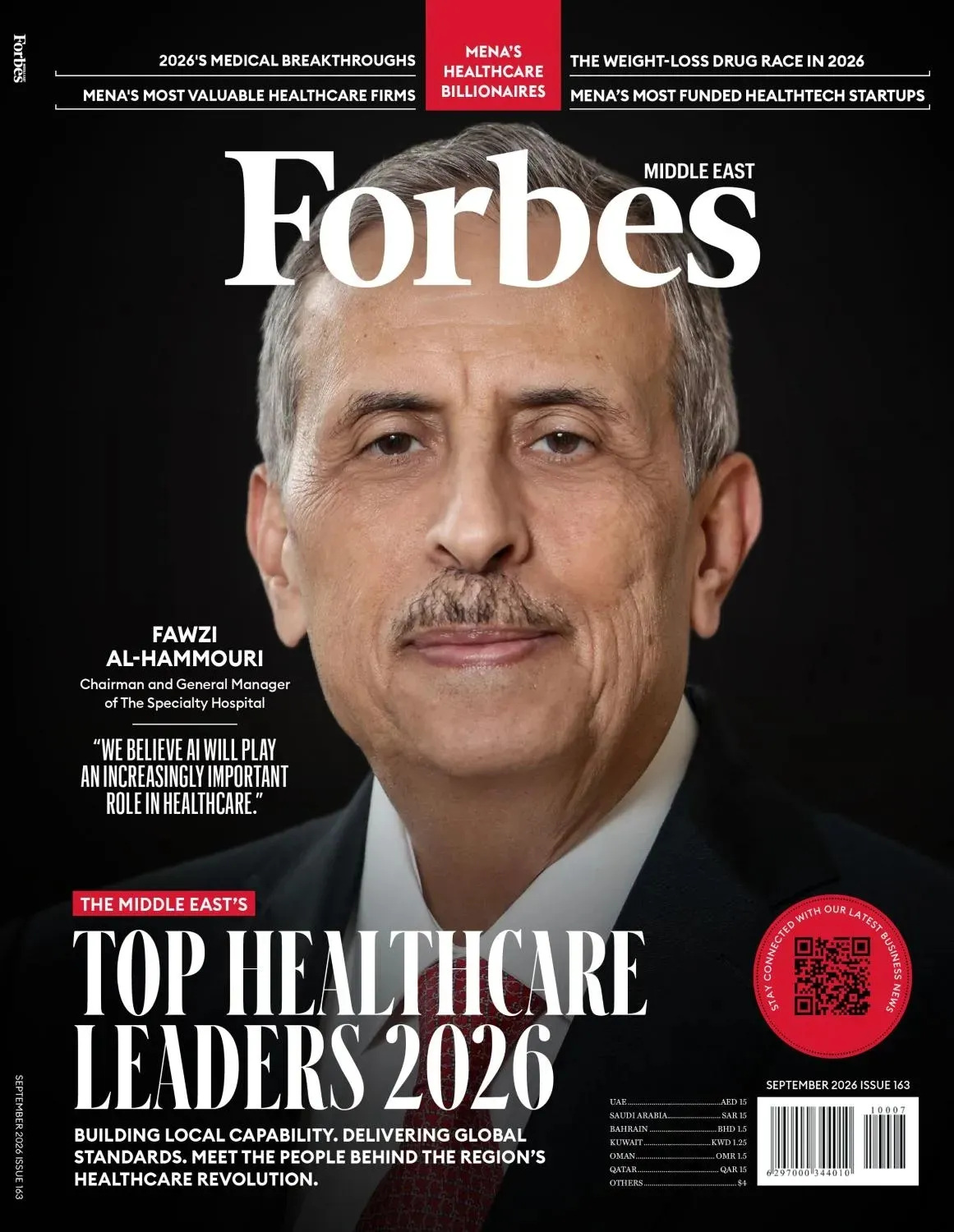
The Middle East's healthcare sector is standing strong—Forbes Middle East September 2026 (Issue 163) leads with "Standing Strong," a cover story featuring Fawzi Al-Hammouri, Chairman and General Manager of The Specialty Hospital. The issue is a dedicated healthcare deep-dive, tracking 16 healthcare billionaires, 61 publicly listed healthcare firms worth $66 billion (Saudi Arabia holding 58% of that value), and 5 most-funded healthtech startups that raised $780 million combined. CEO and Editor-in-Chief Khuloud Al Omian's Sidelines column "Beyond Traditional Healthcare" sets the frame: the region's healthcare IT market is projected to reach $445 billion by 2034.
The data package is dense. "MENA's Healthcare Billionaires" (page 8) profiles the 16 wealthiest individuals in regional healthcare. "MENA's Most Valuable Healthcare Firms" (page 10) by Hagar Omran ranks 61 companies by market cap. "MENA's Most Funded Healthtech Startups" (page 12) by Amr Abdelhamid tracks the venture pipeline. "2026's Medical Breakthroughs" (page 14) by Nermeen Abbas covers gene therapy and GLP-1 advances. "The Weight-Loss Drug Race In 2026" (page 16) by Syed Saadain Gardez analyzes the competitive landscape for semaglutide and newer entrants. ForbesLife covers "Esports Has A New Arena" (page 76).
—————
Content Guide
▸ Cover Story / Healthcare
p.22 · Standing Strong
Rawan Hassan profiles Fawzi Al-Hammouri and The Specialty Hospital's expansion strategy: adding 200 beds, launching a genomics lab and establishing a medical-tourism unit targeting 5,000 international patients annually. The hospital achieved 94% occupancy and $180 million revenue in 2025. If you are investing in Middle East healthcare, prioritize hospitals with established medical-tourism infrastructure—they generate 30% higher EBITDA margins.
▸ Wealth / Industry
p.8 · MENA's Healthcare Billionaires
16 healthcare billionaires from 8 countries, combined net worth of $28 billion. Saudi Arabia leads with 7 billionaires, followed by UAE (4) and Egypt (3). The list includes hospital operators, pharmaceutical manufacturers and medical-device distributors. A methodology note explains that wealth valuations are based on public filings, private-company estimates and real estate holdings. Use the list for partnership prospecting—billionaire-owned hospitals are actively seeking technology partners.
▸ Capital Markets
p.10 · MENA's Most Valuable Healthcare Firms
61 publicly listed healthcare companies worth $66 billion combined. Saudi Arabia's 35 listed firms account for 58% ($38 billion) of total market cap. Top 3: Dr. Sulaiman Al Habib Medical Services Group ($12 billion), Al-Moammar Information Systems ($4.2 billion) and Mouwasat Medical Services ($3.8 billion). The UAE and Qatar add another $18 billion combined. Filter your healthcare investment screen to Saudi-listed firms first—they offer the deepest liquidity.
▸ Technology / Startups
p.12 · MENA's Most Funded Healthtech Startups
5 startups raised $780 million combined: Altibbi ($230 million), Vezeeta ($180 million), Nabta Health ($150 million), Keshif ($120 million) and O7 Therapy ($100 million). Most active investor categories: sovereign wealth funds (42%), corporate VC (28%) and international VC (22%). Telemedicine and AI-diagnostics are the dominant subsectors. If you are a healthtech founder fundraising in MENA, prioritize sovereign wealth funds—they write larger tickets with longer hold periods.
▸ Science / Trends
p.14 · 2026's Medical Breakthroughs
Nermeen Abbas covers 8 breakthrough areas: CRISPR-based therapies for sickle cell (now approved in UAE), mRNA vaccines beyond COVID (RSV and flu), liquid biopsy for early cancer detection, AI-assisted radiology (92% accuracy in lung nodule detection), robotic surgery expansion, wearable continuous monitors, gene therapy for inherited blindness and digital therapeutics for mental health. Monitor CRISPR-therapy regulatory approvals in UAE as a bellwether for broader MENA adoption.
▸ Pharmaceuticals
p.16 · The Weight-Loss Drug Race In 2026
Syed Saadain Gardez analyzes the GLP-1 market: Novo Nordisk's Wegovy ($18 billion global sales), Eli Lilly's Zepbound ($12 billion), and 5 pipeline entrants targeting oral formulations and reduced side effects. The article notes that MENA obesity rates exceed 35% in 6 countries, creating a $4 billion addressable market. A table compares efficacy, pricing and insurance coverage across products. If you are a pharmacy distributor, secure GLP-1 supply agreements before the oral formulations launch in 2027-28.
—————
Editor's Take
This is Forbes Middle East's most data-dense issue of 2026. The three "MENA's Most" lists (Billionaires, Valuable Firms, Funded Startups) together provide the most comprehensive quantitative snapshot of the region's healthcare economy available in a single publication. The Weight-Loss Drug Race piece is well-timed and market-specific. Weakest content: the "Esports Has A New Arena" ForbesLife piece, while well-written, has no connection to the healthcare theme and disrupts the issue's focus. The "Standing Strong" cover story is competent but lacks the financial depth of the lists. Production is cleaner than previous issues—better data visualization in the lists section. Best for healthcare investors, hospital operators and pharma executives covering the MENA region.
Strengths
• Three "MENA's Most" lists provide the region's most comprehensive healthcare data set
• GLP-1 drug race article includes MENA-specific market sizing ($4 billion)
• Healthtech startup funding data names specific companies and amounts
Weaknesses
• Esports ForbesLife piece breaks the issue's healthcare focus
• Cover story lacks the financial depth of the lists sections
Verdict: Recommended — The most comprehensive single-issue data set on MENA healthcare economics available in English.
