
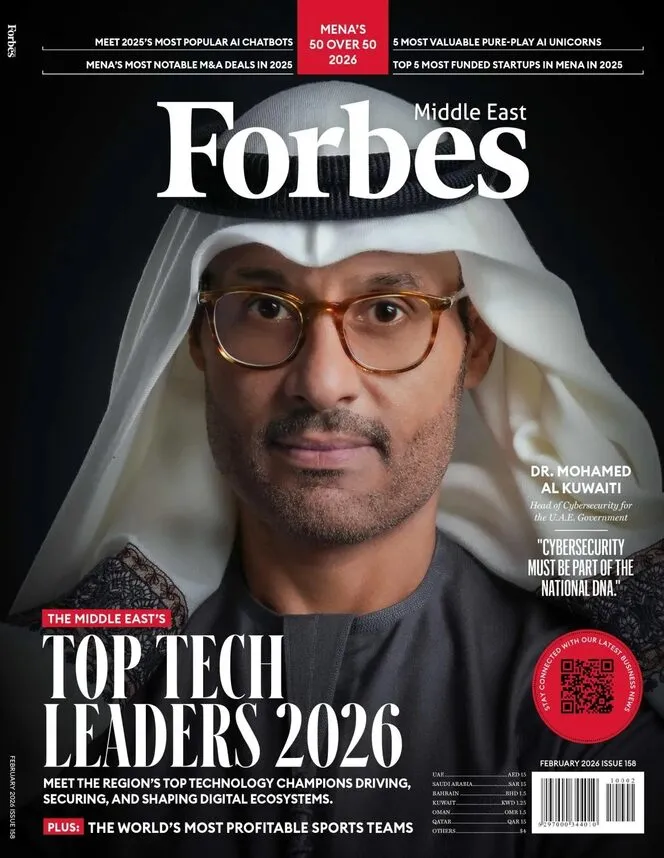
Forbes Middle East English Edition – February 2026
Summary
Dr. Mohamed Al Kuwaiti, head of cybersecurity for the UAE government, argues that security must become part of the national DNA — as Forbes Middle East profiles the region's top tech leaders for 2026.
February 2026 issue 158 opens with the cover story "The UAE's Long Game On Cybersecurity" (p.40) by Jamila Gandhi, tracing how Al Kuwaiti built a national framework that treats every government entity as a node in a single defense grid. The Top Tech Leaders 2026 list runs across the issue, naming CIOs, CTOs, and digital chiefs from Saudi Aramco, e&, and Beyon. The Leaderboard section ranks 2025's most funded MENA startups, the year's most popular AI chatbots, five pure-play AI unicorns, and MENA's largest M&A deals. Sportsmoney adds "The World's Most Profitable Sports Teams 2026" (p.28). The 30 Under 30 feature profiles an engineer building space tech for earthbound application. Adrian Cheng's K11 Middle East playbook closes the leadership section (p.76).
Regular columns include Khuloud Al Omian's Sidelines on tech-driven economies, an economic transformation outlook for 2026, and the UAE passport ranking first globally for power. The issue also debuts the MENA 50 Over 50 list for 2026, recognizing executives aged 50-plus who continue to shape regional business.
—————
Content Guide
▸ Cover Story / Cybersecurity
p.40 · The UAE's Long Game On Cybersecurity
Jamila Gandhi reports how Dr. Mohamed Al Kuwaiti built a federal cybersecurity framework covering 40-plus government entities. The article details the zero-trust architecture roll-out timeline and the mandatory incident-reporting window of 60 minutes. CISOs in Gulf-regulated industries should read this before updating their own reporting protocols.
▸ Top Tech Leaders 2026
p.24 · Meet MENA's 50 Over 50 in 2026
Maggie McGrath compiles 50 regional executives aged 50-plus still active in technology leadership. The list includes C-suite names from Aramco, STC, and Majid Al Futtaim. Headhunters building non-executive board slates will find candidates here.
▸ Leaderboard / Innovation
p.12 · Top 5 Most Funded Startups In MENA In 2025
Amr Abdelhameed ranks the five startups that raised the most venture capital across the region last year. Tabby, Kitopi, and Pure Harvest Smart Farms appear in the top slots. Founders can benchmark their own round sizes against these sector leaders.
p.14 · Meet 2025's Most Popular AI Chatbots
Khadijah Khogeer ranks chatbots by monthly active users across MENA. ChatGPT leads by a wide margin, but regional Arabic-language bots gained share in Q4 2025. Product managers building Arabic AI interfaces can use the feature-comparison table.
p.16 · 5 Most Valuable Pure-Play AI Unicorns
Ashraqat Osama values five AI-native companies that reached billion-dollar valuations without non-AI revenue. The list is dominated by computer-vision and NLP firms. Venture investors screening AI-only deal flow get a clean comp set.
▸ Economy / M&A
p.18 · MENA's Most Notable M&A Deals In 2025
Muhammad Addam tracks the 10 largest disclosed transactions in the region, including Saudi sovereign wealth fund acquisitions and cross-border technology buys. The aggregate deal value exceeds $45 billion. Corporate development teams can use the sector breakdown to identify active buyer pools.
p.20 · MENA 2026 Economic & Transformation Outlook
Syed Saadain Gardezi projects 3.7 percent regional GDP growth with non-oil sectors contributing 68 percent of output for the first time. The forecast table breaks down growth by GCC and Levant sub-regions.
▸ Sportsmoney
p.28 · The World's Most Profitable Sports Teams 2026
Brett Knight and Justin Teitelbaum rank franchises globally by operating income. The Dallas Cowboys, New England Patriots, and Real Madrid top the list. Sports-equity investors can reference the revenue-per-seat metric used in the ranking methodology.
▸ 30 Under 30
p.32 · Engineered For Space, Built For Earth
Amal Abdelwahab profiles a young engineer who developed a satellite-component startup in Dubai and now licenses the tech to agricultural drone operators. The crossover application cut per-acre monitoring cost by 35 percent.
—————
Editor's Take
This is a tightly edited issue that earns its "tech leaders" theme through data density rather than fluff profiles. The Al Kuwaiti cover story delivers genuine policy architecture detail — the zero-trust timeline and 60-minute reporting rule are concrete enough for any CISO to benchmark against. The startup funding and AI unicorn lists give venture investors hard data in under 8 pages total. The weakest element is the Adrian Cheng K11 playbook piece, which reads like a press release for a mall project that hasn't opened yet. The Sportsmoney list is a curiosity but sits oddly between the AI chatbot analysis and the startup funding data. Still, for anyone tracking Gulf technology investment in early 2026, this issue packs more usable data per page than the March or December issues.
Strengths
• UAE cybersecurity framework with concrete policy timelines
• AI chatbot feature-comparison table useful for product teams
• Startup funding list with actual round sizes and sector tags
Weaknesses
• Adrian Cheng K11 piece lacks independent reporting
• Sportsmoney list feels disconnected from the tech-leaders thesis
Verdict: Recommended — The most data-dense issue of the three; buy it for the cybersecurity framework and startup funding tables.
