
Understanding Chemistry – 3rd Edition – 23 July 2026
Summary
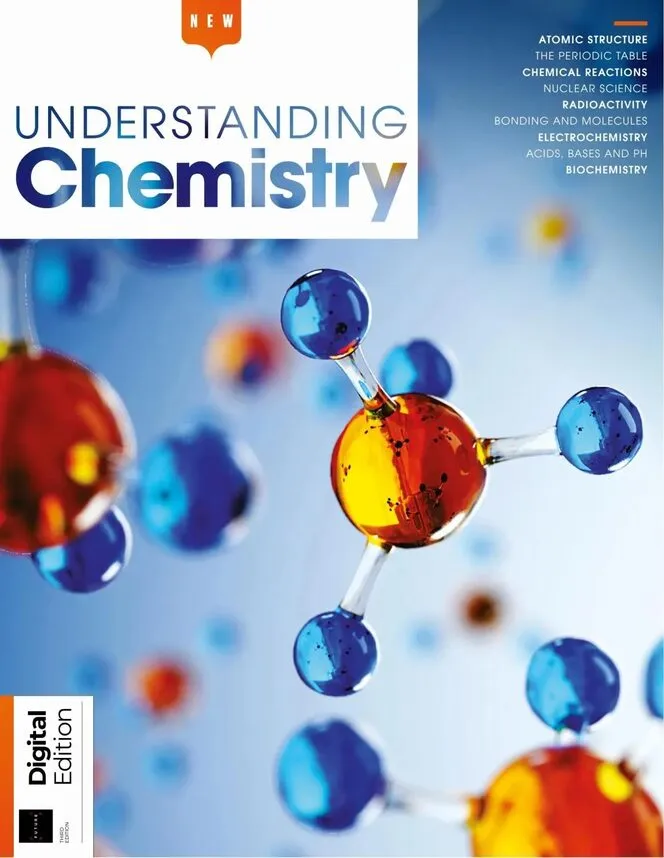
Understanding Chemistry (3rd Edition, Digital Edition, 23 July 2026) is a textbook-style reference organised as a magazine with a full table of contents, covering atom anatomy, chemical bonds, the periodic table, nuclear reactions, and everyday chemistry from baking bread to fireworks. The 3rd Edition updates sections on green chemistry, battery technology, and pharmaceutical synthesis. It functions as a revision guide or a classroom supplement rather than a news-driven periodical.
The Contents page lists 20-plus topics beginning with atom anatomy (page 10), the power of atoms (page 6), what is DNA (page 14), chemical bonds (page 20), how noble gases work (page 22), making fertiliser (page 24), and how fireworks work (page 26). Later sections cover acids and bases, redox reactions, organic chemistry, polymers, and environmental chemistry. Each topic runs two to four pages with diagrams, molecular models, and worked example calculations.
The 3rd Edition adds a new chapter on battery chemistry covering lithium-ion, solid-state, and flow battery technologies, plus a section on computational chemistry methods used for molecular modelling. The revision also expands the green chemistry chapter to include case studies on biodegradable polymers and carbon-capture materials.
—————
Content Guide
▸ Atomic Structure / Chemical Bonds / Reactions / Applied Chemistry / Green Chemistry
p.6 · The Power of Atoms
Atoms contain a nucleus of protons and neutrons surrounded by an electron cloud. The number of protons defines the element — hydrogen has one, uranium has 92. A single gram of matter contains roughly 10^23 atoms.
p.10 · Atom Anatomy
The Bohr model places electrons in fixed shells, but quantum mechanics describes orbitals as probability clouds. The s orbital is spherical; p orbitals are dumbbell-shaped and directional. Carbon's four valence electrons occupy one 2s and three 2p orbitals hybridised as sp3.
p.14 · What Is DNA?
DNA is a polymer of nucleotides, each containing a phosphate group, a deoxyribose sugar, and one of four bases: adenine, thymine, cytosine, guanine. The double-helix structure, discovered by Watson and Crick in 1953, uses hydrogen bonds between base pairs — A-T forms two bonds, C-G forms three.
p.20 · Chemical Bonds
Ionic bonds transfer electrons between metals and non-metals; covalent bonds share electrons between non-metals. The bond energy of C-C single bonds is 348 kJ/mol, while C=C double bonds are stronger at 614 kJ/mol. These values determine reaction energetics.
p.22 · How Noble Gases Work
Helium, neon, argon, krypton, xenon, and radon have full outer electron shells, making them chemically inert under standard conditions. Xenon forms compounds with fluorine — XeF2, XeF4, XeF6 — at high pressure and temperature.
p.24 · Making Fertiliser
The Haber-Bosch process combines nitrogen and hydrogen under 200 atmospheres of pressure and 400 degrees Celsius with an iron catalyst. It produces 150 million tonnes of ammonia annually, supporting half the world's food production.
p.26 · How Fireworks Work
Firework colours come from metal salts: strontium produces red, barium yields green, sodium gives yellow, and copper generates blue. The black powder lift charge is 75 percent potassium nitrate, 15 percent charcoal, and 10 percent sulfur.
p.XX · Battery Chemistry
Lithium-ion batteries operate by shuttling lithium ions between a graphite anode and a metal-oxide cathode. Solid-state batteries replace the liquid electrolyte with a ceramic or polymer layer, enabling higher energy density but requiring new manufacturing processes.
—————
Editor's Take
Understanding Chemistry 3rd Edition is a well-organised educational resource, not a magazine in the conventional sense, and evaluating it as periodical content would be unfair. The diagrams and worked examples are clear, the new battery-chemistry chapter is timely, and the fireworks section provides a satisfying applied-chemistry payoff. Weakness: the DNA chapter is too short for a topic that drives modern biotechnology — two pages cannot cover replication, transcription, and translation. The computational chemistry section assumes familiarity with Python syntax that many high-school readers will not have. Best suited for GCSE and A-level students who need a visual supplement to a standard textbook; university chemistry students will find the treatment too introductory.
Strengths
• Haber-Bosch and fireworks chapters show chemistry's real-world impact
• New battery-chemistry chapter is current and well-illustrated
Weaknesses
• DNA section is compressed to two pages
• Computational chemistry assumes programming skills
Verdict: Selective read — Excellent for secondary-school revision; too basic for undergraduates.
