
Business Spotlight – Nr.5 2026
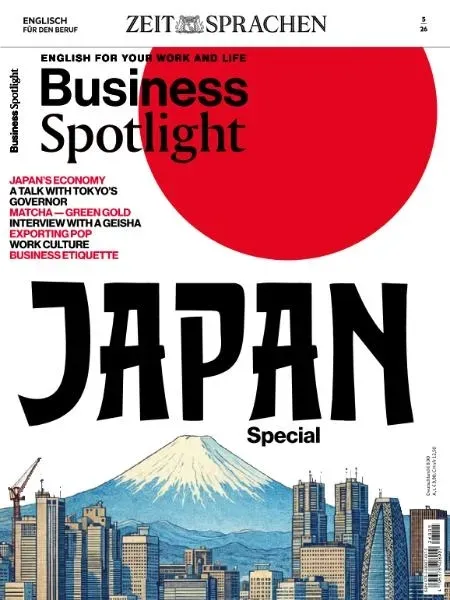
Summary
Shunsaku Sagami became Japan's youngest billionaire by disrupting the used-car market, Tokyo Governor Yuriko Koike discusses the city's future, and 34 pages of Japan-themed content make Business Spotlight Issue 5/2026 a dedicated deep-dive into the world's third-largest economy. The Japan Special covers matcha exports, the geisha tradition, workplace culture conflict, and Japanese etiquette. The magazine's cover feature explores how Japan is exporting pop culture — from anime to fashion — to a global audience.
The Japan special includes: Profile of Shunsaku Sagami (p.12), an interview with Yuriko Koike (p.20), a report on matcha as "green gold" (p.28), workplace balance in a culture in conflict (p.30), traditional paper craft (p.33), an interview with a geisha (p.34), and Japanese etiquette (p.36). Each article is graded EASY, MEDIUM, or ADVANCED. The language section includes robotics vocabulary and an insurance-themed Skill Up.
Regular sections include The Big Picture (Japan's new nightlife), Names and News, Facts and Figures (Japan in numbers), Global Business, and Business Skills (the art of delegating).
—————
Content Guide
▸ Interview / Politics
p.20 · Yuriko Koike — Tokyo's Trailblazing Governor
Koike discusses Tokyo's 2030 carbon-neutral target, the city's ageing population challenge, and her push for more female representation in corporate boardrooms. The interview is graded MEDIUM and uses indirect speech structures. Language learners should note how Koike uses "should" and "must" to express policy conviction.
▸ Profile / Entrepreneurship
p.12 · Shunsaku Sagami — A Game-Changing Billionaire
Sagami founded a digital used-car platform valued at 2.8 billion dollars, becoming Japan's youngest self-made billionaire at age 32. His company uses AI for vehicle inspection, reducing appraisal time from 45 minutes to 8 minutes. The profile (MEDIUM) practises superlatives and comparatives.
▸ Food Industry / Exports
p.28 · Matcha — Green Gold
Japan's matcha exports reached 350 million dollars in 2025, up 40 percent year-on-year. The article traces matcha from traditional tea ceremony to global ingredient in lattes, ice cream, and cosmetics. Key vocabulary focuses on supply chain terms: cultivation, harvesting, grinding, and export logistics.
▸ Culture / Tradition
p.34 · Interview with a Geisha
A maiko (apprentice geisha) in Kyoto describes a typical training day beginning at 6:00 AM, the 3 traditional instruments she must learn, and the 5-year apprenticeship before full qualification. The interview (EASY level) uses simple present tense for routines. Use this article to practise daily-routine vocabulary.
p.33 · Modern Niche — Paper from Japan
Washi paper makers are adapting a 1,300-year-old craft for modern products including wallpaper, lighting, and even smartphone cases. The article (MEDIUM) uses passive voice: "the paper is made from mulberry bark," "fibres are hand-laid in patterns."
▸ Work Life / Society
p.30 · Balancing Act — Work, Life and a Culture in Conflict
Japan's government is pushing for a 4-day workweek, but only 8 percent of companies have adopted it. The article explores the gap between policy and workplace culture, where 70-hour weeks remain common in advertising and finance. HR professionals can use the 8 percent adoption figure in flexible-work discussions.
p.36 · Understanding Japanese Etiquette
A practical guide covering bowing angles (15 degrees for casual, 30 for formal, 45 for apologies), business card exchange protocol, and dining customs. The article is graded EASY and uses imperative forms for instructions. Before your next business trip to Tokyo, review the 45-degree apology bow.
—————
Editor's Take
The 34-page Japan special is ambitious in scope and largely succeeds — it covers enough ground (economy, culture, food, work, tradition) that every learner will find something relevant. The Yuriko Koike interview and Shunsaku Sagami profile give the issue hard business news value. The geisha interview and washi paper feature provide welcome cultural depth. The weakest section is The Big Picture on nightlife, which is too brief to add meaningful vocabulary. The language grading across the Japan section is generally well-calibrated, though the matcha article could have been pushed to ADVANCED given its supply-chain vocabulary density.
Strengths
• 34-page Japan special provides strong thematic coherence
• Koike interview and Sagami profile deliver business news value
• Cultural features (geisha, washi, etiquette) broaden learner appeal
Weaknesses
• The Big Picture on nightlife is too short to be useful
• Matcha article vocabulary level may overwhelm EASY readers
Verdict: Essential — The best Business Spotlight issue of the year for thematic focus; the Japan special makes this a keeper for any learner interested in Japanese business culture.
