
Harvard Business Review USA – July-August 2026
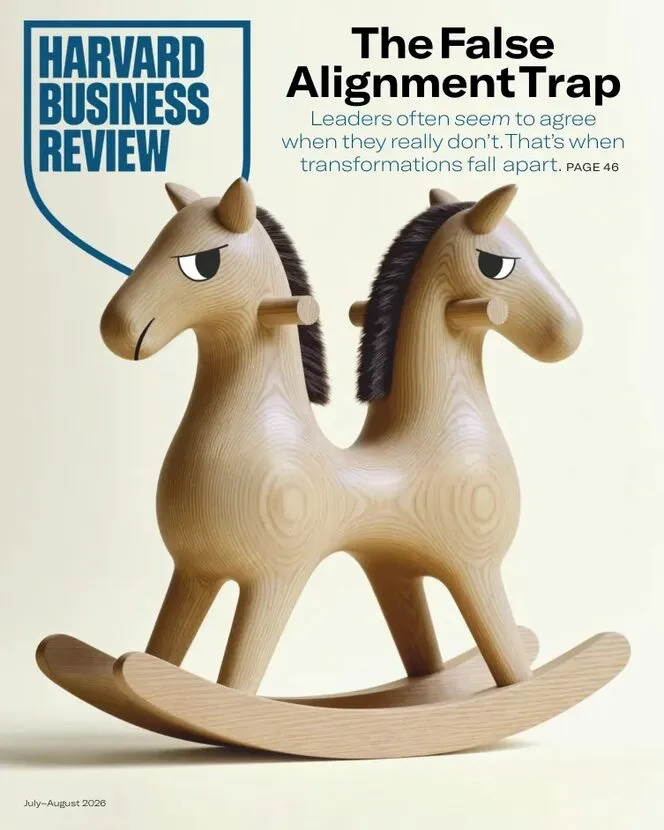
Summary
"When company leaders say, 'We are aligned,' what they usually mean is, 'We are not in one another's way'"—Julia Dhar, Kristy R. Ellmer and Philip Jameson of BCG open the July-August 2026 Harvard Business Review cover story "The False Alignment Trap" (page 46) with this diagnosis. The article argues that surface-level alignment is the single biggest cause of transformation failure. Editor in Chief Amy Bernstein titles her note "Are We All in Agreement?" and challenges leaders to build true, detailed agreement rather than comfortable ambiguity.
The features are unusually diverse. "What Companies Get Wrong About Decision Rights" (page 58) by Greer, Jordan and Sytch provides a framework for mapping who actually decides. Rita McGrath's "The Power of Strategic Centering" (page 68) argues that focus, not agility, drives performance in turbulent markets. "Making the Leap from Corporate Leader to PE-Backed CEO" (page 80) addresses a growing career transition. "Why the Best Immersive Experiences Succeed" (page 88) by Nunes and Heimann decodes experience design. "Six Ways Leaders Harness Stress" (page 100) by Miller and Keller reframes pressure as performance fuel.
In Focus examines the hidden risks of AI tools. Experience includes life's work from chef Jose Andres. The issue closes with 146 pages of content, making it the year's thickest HBR.
—————
Content Guide
▸ Change Management
p.46 · The False Alignment Trap
Dhar, Ellmer and Jameson present a framework requiring leadership teams to answer three questions: Why change? What changes (and what does not)? How will change happen? Teams that documented detailed written agreements on all three questions had 2.4x higher transformation success rates in a BCG study of 89 companies. Require each executive to write their own answers to all three questions before any transformation kick-off meeting.
▸ Organizational Design
p.58 · What Companies Get Wrong About Decision Rights
Greer, Jordan and Sytch studied 74 organizations and found that only 12% had documented decision-rights maps. In companies without them, decisions took 3x longer and had 40% more reversals. The article provides a RAPID-style mapping template and an implementation checklist. Map decision rights for your top 10 cross-functional decisions within 30 days.
▸ Strategy
p.68 · The Power of Strategic Centering
Rita McGrath argues that companies that articulate a clear "strategic center"—a fixed point around which everything else adapts—outperform pure agile players by 22% on ROIC. Examples include Apple (premium user experience), IKEA (democratic design) and Amazon (customer obsession). Write your company's strategic center in one sentence of 12 words or fewer.
▸ Leadership / Private Equity
p.80 · Making the Leap from Corporate Leader to PE-Backed CEO
Hellauer et al. interviewed 42 executives who transitioned from corporate roles to PE-backed CEO positions. Success factors: comfort with rapid Board reporting cycles (weekly rather than quarterly), ability to manage debt covenants, and willingness to make personnel changes in the first 90 days. Prepare a 100-day plan specifically addressing debt-covenant management before accepting a PE-backed CEO role.
▸ Customer Experience
p.88 · Why the Best Immersive Experiences Succeed
Nunes and Heimann analyzed 38 immersive experiences (museums, retail stores, brand activations). The top quartile shared 3 design principles: narrative coherence, sensory layering and participant agency. Immersive experiences that scored high on all 3 principles generated 3.5x higher per-visitor spending. Audit your customer experience against the 3 principles before designing your next flagship store or brand activation.
▸ Well-being / Performance
p.100 · Six Ways Leaders Harness Stress
Miller and Keller distinguish between "good stress" (eustress) and "bad stress" (distress) and provide 6 regulation techniques: breathing protocols, cognitive reappraisal, social buffering, recovery micro-breaks, task-switching limits and sleep optimization. Leaders who practiced 3+ techniques scored 33% higher on 360-degree performance ratings. Practice at least 3 stress-regulation techniques for 2 weeks before judging their effect.
—————
Editor's Take
The False Alignment Trap is HBR's most honest piece on transformation failure in years—it names the problem every executive knows but rarely admits. The decision-rights article by Greer, Jordan and Sytch is the dark horse standout: a practical, implementable framework that most organizations lack entirely. Weakest content: the PE-backed CEO transition piece addresses a narrow audience (maybe 2% of HBR readers). The immersive experiences article is fascinating but more applicable to consumer brands than B2B readers. Production quality is outstanding—the issue includes two original data-visualization frameworks worth studying. Best for CEOs, transformation leaders and COOs.
Strengths
• False Alignment Trap provides a specific, answerable 3-question framework
• Decision-rights article offers a RAPID-style template ready for implementation
• Strategic Centering gives a counterintuitive argument against pure agility
Weaknesses
• PE-backed CEO piece is too niche for HBR's general readership
• Immersive experiences article applies mainly to consumer-facing brands
Verdict: Essential — The False Alignment Trap and Decision Rights articles together make this the year's most operationally useful HBR issue.
