
Indian Business Journal – January 2026
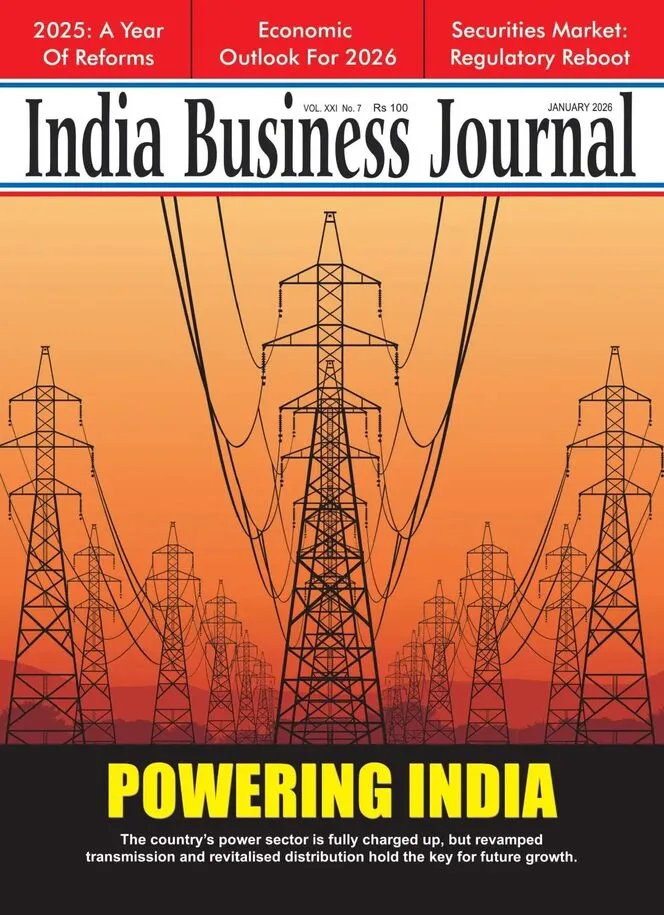
Summary
The rupee's free fall and a budget wish-list dominate the January 2026 Indian Business Journal (Volume XXI, No 7, Rs 100), where the cover story "Powering India" examines the energy sector's role in driving the nation's economic engine. As NHPC targets 23,000 MW by 2032 and PRIDE Hotels expands to 34 properties, the issue balances macro policy analysis with specific corporate case studies. India's GDP growth of 8.2% provides the backdrop, but the articles consistently ask whether structural reforms are keeping pace.
Viewpoint "The Rupee's Free Fall" opens the issue with an analysis of the currency hitting ₹86 to the US dollar and its impact on import-dependent sectors. Current Affairs "All Eyes On 2026" (page 16) previews the reform agenda that will shape the year—from GST simplification to labour-code implementation. Economy "A Year Of Reforms" (page 19) argues that 2025's legislative changes set the stage for 2026's execution. Securities Market "Regulatory Reboot" (page 22) covers SEBI's tightening of F&O norms and insider-trading rules. Spotlight "REC: Lighting Up A New World" (page 24) profiles REC Limited's role in India's power-distribution transformation.
Management Mantra (page 36) features a CEO who advises "Think In Decades, Not Months." Knowledge Zone profiles At The Helm and Facts For You. Hot Seat features a multi-tasking entrepreneur.
—————
Content Guide
▸ Cover Story / Energy
p.– · Powering India
The article profiles NHPC's plan to reach 23,000 MW renewable capacity by 2032, REC's ₹4.5 lakh crore loan book for transmission and distribution upgrades, and the government's ₹2.4 lakh crore outlay for the Revamped Distribution Sector Scheme (RDSS). Smart-meter installation targets: 25 crore units by 2027. The article notes that aggregate technical and commercial (AT&C) losses are still at 15.4% nationally. Prioritize states with AT&C losses below 10% for new renewable project investments.
▸ Currency / Macroeconomics
p.– · Viewpoint — The Rupee's Free Fall
The rupee touched ₹86/USD in December 2025, depreciating 12% over 24 months. The article identifies three drivers: widening current-account deficit, capital outflows from emerging markets, and RBI's managed-float intervention costs. Import-dependent sectors—electronics, chemicals and edible oils—face margin compression. Hedge import payables when the rupee trades above ₹84/USD for three consecutive sessions.
▸ Policy / Governance
p.16 · Current Affairs — All Eyes On 2026
Four reform milestones tracked: GST rate rationalization (expected April 2026), the four labour codes' full implementation, the Digital Personal Data Protection Act rules notification, and the production-linked incentive (PLI) scheme expansion to 6 new sectors. Each is assessed for likelihood and business impact. Prepare your data-protection compliance framework before the DPDP Act rules are gazetted.
▸ Capital Markets / Regulation
p.22 · Securities Market — Regulatory Reboot
SEBI's new F&O entry barriers (minimum contract size ₹10 lakh, up from ₹5 lakh) reduced monthly retail F&O turnover by 34% in Q4 2025. New insider-trading norms require pre-clearance for any trade above ₹50 lakh by designated persons. The article also covers the expanded SRO framework for financial influencers. Revise your company's insider-trading code to include the ₹50-lakh pre-clearance threshold.
▸ Economy / Analysis
p.19 · Economy — A Year Of Reforms
The article argues that 2025's legislative output—the three farm laws repeal, the Digital Competition Bill and the revised telecom act—needs 2026 execution through rules and enforcement. A reform-implementation scorecard ranks 14 central ministries. The Ministry of Power leads at 72% implementation; the Ministry of Labour trails at 38%. Benchmark your regulatory-compliance team against the top-ranked ministries' implementation pace.
▸ Leadership / Interview
p.36 · Management Mantra — "Think In Decades, Not Months"
The anonymous CEO interview (attributed by context to a large NBFC founder) covers building a financial-services firm through three credit cycles. Key metrics: maintain gross NPA below 2% through boom and bust, keep the cost-to-income ratio under 40%, and never grow loan book by more than 25% in any single year. Cap annual loan-book growth at 25% regardless of market demand.
—————
Editor's Take
"Powering India" is a solid but not groundbreaking cover story—it profiles three well-known energy companies without adding much new analysis. The real value in this issue is the "All Eyes On 2026" reform tracker (page 16) and the SEBI regulatory-reboot piece (page 22), both of which give compliance teams specific thresholds to plan for. Weakest content: the anonymous "Think In Decades" Management Mantra reads as generic leadership advice without the specific numbers that would make it useful. The Hot Seat profile is too brief to provide meaningful insight. Production is standard IBJ: text-heavy, no infographics, serviceable photography. Best for compliance officers, energy-sector analysts and policy watchers.
Strengths
• Reform-implementation scorecard across 14 ministries is genuinely new data
• SEBI regulatory-reboot article includes specific new thresholds
• REC Spotlight provides detailed transmission-infrastructure data
Weaknesses
• Powering India cover story profiles companies without new analytical insight
• Anonymous Management Mantra lacks verifiable specifics
Verdict: Selective read — The regulatory articles justify the purchase for compliance teams; the cover story is skippable.
