
Business Today – 21 June 2026
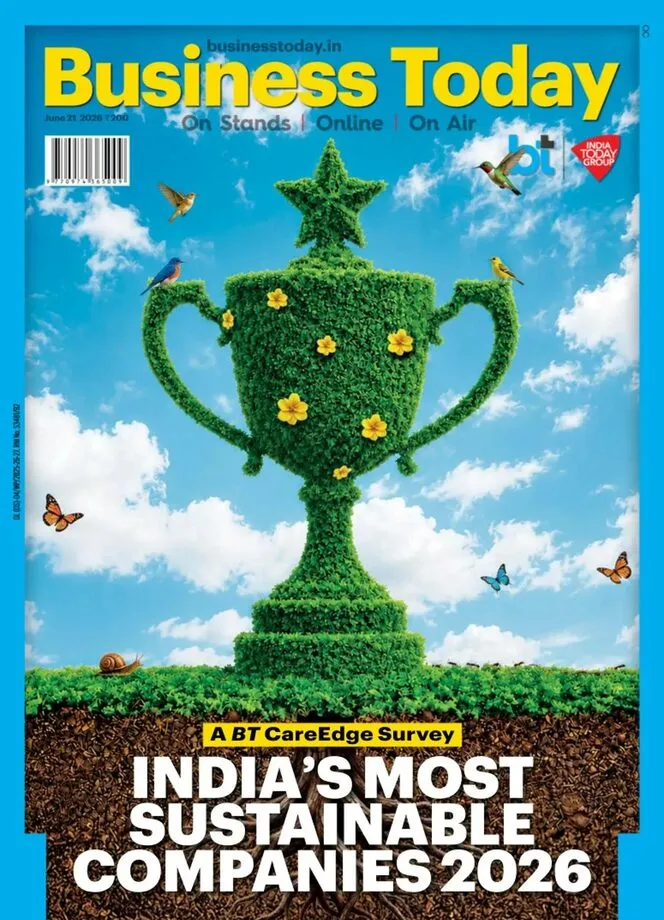
Summary
L&T Finance, Tata Steel, Mahindra & Mahindra, and 11 other companies made the cut — Business Today's June 21, 2026 issue (Vol 35 No 13) publishes the annual "India's Most Sustainable Companies 2026" ranking in partnership with CareEdge. The cover story profiles the top performers across energy, financial services, steel, and consumer goods, grading each on environmental metrics, social impact, and governance scores. A lead essay questions whether India's ethanol push is truly sustainable, and the BT Interview asks a top executive why vague climate commitments will no longer pass investor muster.
The ranking covers 15 companies with detailed one-page profiles, including ONGC, BPCL, ABB, JSW Energy, Dabur, and Adani Ports. Each profile includes carbon intensity data, water positivity ratios, and board diversity metrics. The Alternative Fuel section reports on the debate around blending ethanol with petrol, and the Food Security column examines the crop-versus-fuel trade-off.
Regular features The Point and BT Interview open the issue. The sustainability survey methodology and KPMG ranking details are included.
—————
Content Guide
▸ Cover Story / Sustainability
p.34-70 · India's Most Sustainable Companies 2026 Profiles
Each profile includes a standardised scorecard: carbon intensity per crore of revenue, renewable energy share, female board representation, and water consumption per unit of output. L&T Finance scored highest on social impact for its rural lending programmes; Tata Steel led on governance metrics; Mahindra & Mahindra posted the lowest carbon intensity in the auto sector at 18.2 tonnes per crore. ESG analysts can directly compare the 15 company scorecards for benchmarking.
▸ Energy / Biofuels
p.82 · Controversial Blend
India's 20 percent ethanol blend target faces criticism as sugarcane diversion to ethanol reduced sugar exports by 2 million tonnes in 2025. The article cites IIT-Delhi research showing that second-generation ethanol from agricultural waste remains commercially unviable at current crude prices below 85 dollars. Energy policy researchers should track the 2G ethanol cost curve against the subsidy timeline.
p.88 · How Sustainable is Ethanol?
The Food Security column calculates that the land required to meet India's 20 percent ethanol blending target would feed approximately 60 million people. It compares Brazil's sugarcane-ethanol model with India's maize-and-rice-based approach. Agricultural economists can use the land-use comparison table in their policy submissions.
▸ Economy / Finance
p.8 · India Still Loves the FD
The Point column reports that bank fixed deposits grew 14.6 percent year-on-year despite equity markets hitting new highs. The household savings shift toward bank deposits reached 5.4 lakh crore in FY2026, driven by risk aversion among investors aged 50-plus. Retail banking teams should note the demographic driver behind this deposit growth.
▸ Interview
p.24 · Vague Commitments Will No Longer Pass Muster
An interview with a senior sustainability executive argues that India Inc must move beyond carbon pledges and publish audited climate accounts. The executive points to SEBI's new BRSR core framework as the reporting standard that will separate leaders from laggards. Compliance officers can use the interview to build their BRSR Core readiness checklist.
—————
Editor's Take
The sustainability ranking is the issue's centrepiece and delivers exactly what the title promises: a data-driven, comparable scorecard of India's corporate ESG leaders. The profiles give readers 15 mini-case studies that are useful for both investors and corporate strategy teams. The ethanol debate articles are a welcome counterpoint to the government's official narrative. The issue's main weakness is that outside the ranking and the two energy pieces, the editorial density is thin — the front section feels like it is marking time before the profiles begin. Subscribers who do not work in ESG or energy will find limited material beyond The Point and the interview.
Strengths
• Standardised ESG scorecards enable genuine peer comparison
• Ethanol articles challenge a popular policy narrative
• L&T Finance social-impact data is a model for sector reporting
Weaknesses
• Front section feels thin outside the ranking
• Limited coverage of tech, start-ups, or consumer sectors
Verdict: Recommended — Essential for ESG professionals and energy analysts; general business readers may find the front half underwhelming.
