
Indian Business Journal – September 2026
Summary
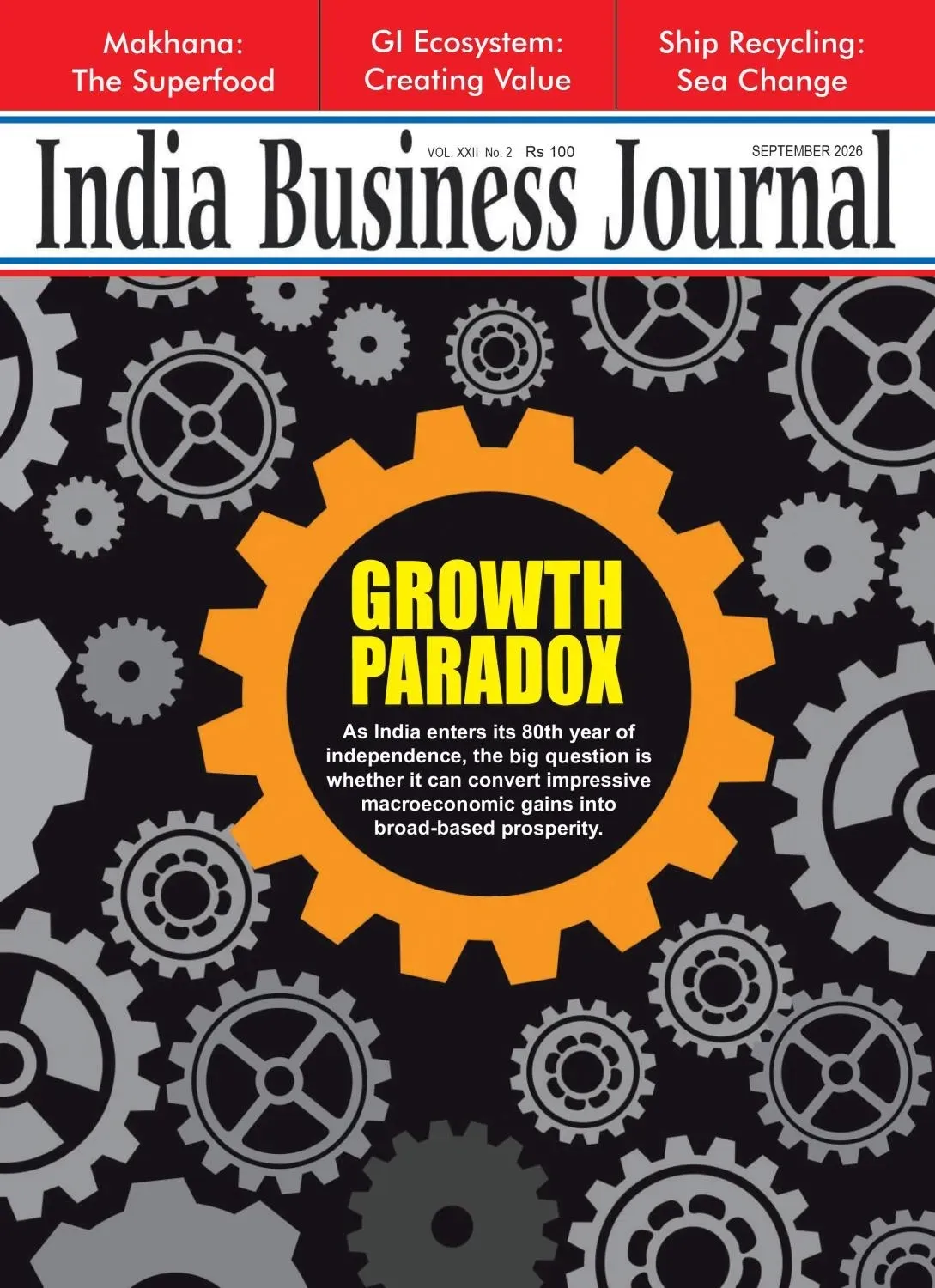
As India enters its 80th year of independence, the September 2026 Indian Business Journal poses the central question: can the country convert impressive macroeconomic gains into broad-based prosperity? The cover story "Growth Paradox" (Volume XXII, No 2, Rs 100) leads an issue that ranges from ship recycling to superfoods. Editor Amit Brahmabhatt assembles 13 sections examining where India's headline numbers meet on-the-ground reality.
The GI Ecosystem spotlight traces how Geographical Indication certification creates lasting economic value for local producers—Mysore silk, Darjeeling tea, Kolhapuri chappal. Agriculture follows with "Sought-After Superfood," a deep dive on makhana (fox nut) evolving from Bihar's traditional staple into a nationally distributed healthy snack. Industry Report "A Sea Change" documents India's transformation into the world's largest ship recycling centre, driven by strong legislation and circular-economy principles. Focus "Plugging The Gaps" warns against complacency as peace returns to the Gulf region, arguing India must sharpen governance and trade execution.
Regular sections include News Round-Up (Miscellaneous, Finance, PSU, Corporate), Management Mantra (featuring Zakir Hussain, CEO of BD Software Distribution), Global Wrap-Up, Readers' Lounge (new book titles), Star Talk by GaneshaSpeaks, Knowledge Zone (At The Helm: Tewolde Gebremariam, MD & CEO of Air India), and Hot Seat profiling Diksha Rajawat, Director of Fulchand Gulabchand Jewellers.
—————
Content Guide
▸ Cover Story / Economy
p.– · Growth Paradox
The gap between India's 8.2% GDP growth and household consumption data is analyzed through five lenses: employment elasticity, rural wage stagnation, credit access, tax-base narrowness and corporate profit retention. The article argues that without employment-linked growth in manufacturing, macro numbers will not translate into mass prosperity. Track core-sector employment data monthly rather than quarterly to spot turning points before GDP revisions.
▸ Industry / Circular Economy
p.– · Industry Report — A Sea Change
India now recycles 30% of the world's end-of-life ships at Alang, under Hong Kong Convention-compliant facilities. The shift from beaching to dry-dock recycling reduced waste discharge by 60%. The piece profiles three yards that have achieved ISO 30000 certification. Source steel plate from certified Indian recyclers to reduce your supply chain's carbon footprint.
▸ Agriculture / Superfood
p.– · Agriculture — Sought-After Superfood
Makhana production in Bihar grew 22% year-on-year, reaching 95,000 metric tonnes. The article maps the value chain from pond cultivation to packaged snack, noting that mechanized popping reduced processing labor by 40%. The central government's Makhana Board, proposed in the 2025 budget, is expected to standardize grading. Source directly from Bihar-based FPOs to capture the best margin.
▸ IP / Heritage
p.– · Spotlight — The GI Ecosystem
India holds 432 registered Geographical Indications, but only 18% have active commercial licensing programs. The article profiles success stories: Mysore silk (₹1,200 crore annual turnover), Solapur chaddar (export growth of 35% post-GI), and Kashmir saffron (ISO certification achieved). File GI applications for any region-specific product your company sources.
▸ Governance
p.– · Focus — Plugging The Gaps
With Gulf stability returning, the article argues India must accelerate FTAs, reform customs digitization and streamline SEZ rules. The piece warns that bureaucratic inertia could squander the opportunity created by China-plus-one supply-chain shifts. Audit your company's export documentation cycle time against the 48-hour benchmark suggested by the article.
▸ Leadership / Interview
p.28 · Management Mantra — "Have A Clear Vision So That Everyone Knows The Direction"
Zakir Hussain, CEO of BD Software Distribution, discusses scaling a software distribution business from ₹5 crore to ₹120 crore over 12 years. Key lessons: reinvest 60% of annual profits into technology infrastructure and maintain a flat organizational structure under 50 employees. Cap your management layers at three as you scale.
—————
Editor's Take
This is Indian Business Journal's most coherent issue of 2026. The makhana supply-chain piece and the GI ecosystem article are both original, well-reported and useful for anyone in agriculture or consumer goods. The Growth Paradox cover story is intellectually honest, but it lacks practical recommendations for business readers—it diagnoses without prescribing. Weakest section: the News Round-Up pages are thin—three paragraphs per item with no analyst commentary. The Knowledge Zone is formulaic. Production quality is consistent but plain: no infographics, few charts, text-heavy layouts. Best for mid-market business owners and policy watchers in India.
Strengths
• Makhana supply-chain data is original and trade-useful
• GI ecosystem article quantifies commercial value of IP protection
• Growth Paradox cover story avoids government cheerleading
Weaknesses
• Cover story diagnoses problems but offers no actionable solutions
• News Round-Up lacks analysis depth
Verdict: Recommended — Strong issue for Indian business readers; the makhana and GI pieces alone are worth the Rs 100 cover price.
