
The European Business Review – March-April 2026
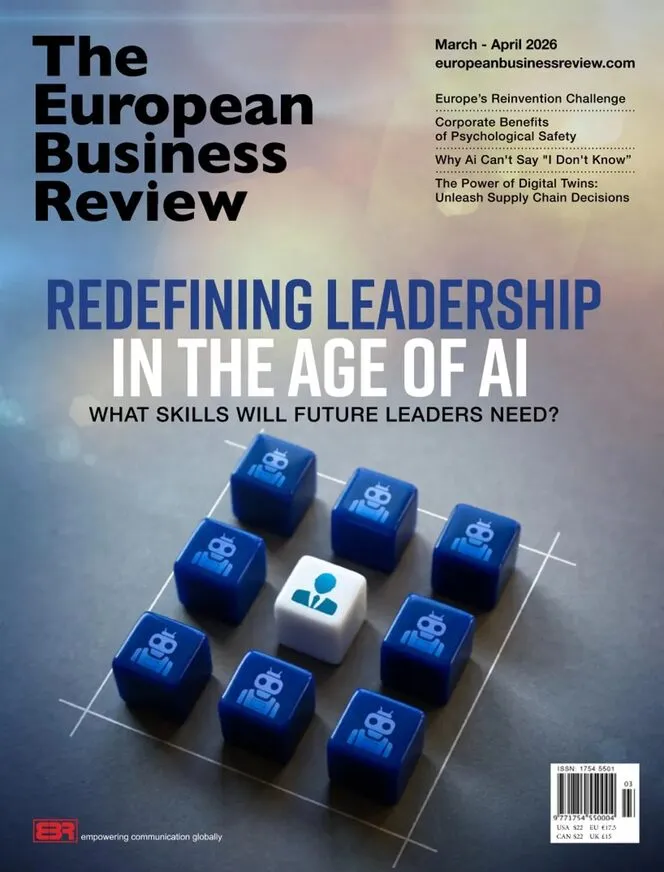
Summary
US$22 / EU 17.5 buys The European Business Review March-April 2026, headlined "Redefining Leadership in the Age of AI" with a cover story on what skills future leaders will need. Vedika Lal, Zuzanna Staniszewska and Geraldine Galindo anchor the cover. Jacques Bughin and Filip Van Innis argue agentic AI is reinventing software economics beyond the SaaS-pocalypse.
The cover story (p.4) by Vedika Lal, Zuzanna Staniszewska and Geraldine Galindo examines the leadership skills AI will demand. Mostafa Sayyadi and Michael Provitera (p.14) address digital culture and corporate AI design. Jacques Bughin and Filip Van Innis (p.22) move beyond SaaS-pocalypse to agentic AI economics. Simon L. Dolan and co-authors (p.28) revolutionise HR management with AI. Fernanda Arreola and David Jaidan (p.34) explain why AI cannot say "I don't know." Adrian Furnham and Amanda Potter (p.42, Editor's Pick) cover psychological safety. Gilles Pache (p.54) applies digital twins to supply chain decisions. Severine Mastikian and co-authors (p.60) examine 5G-FRMCS accelerating EU rail transformation.
Regular sections include Leadership, AI in Business, Human Resources, Artificial Intelligence, Business Education, Workplace, Supply Chain, Transportation, Fashion, and SME and Sustainability. Contributors include Kate Klepper, David De Cremer, Anna Rostomyan and Rebecca Elliott Carballo.
—————
Content Guide
▸ Cover Story
p.4 · Redefining Leadership in the Age of AI — What Skills Will Future Leaders Need?
Vedika Lal, Zuzanna Staniszewska and Geraldine Galindo survey the capability gap between traditional leadership models and AI-augmented organisations. The article identifies three competencies — algorithmic reasoning, ethical judgment and adaptive communication — that correlate with successful AI integration. Use the self-assessment table to score your leadership team against each competency.
▸ AI in Business
p.22 · Beyond SaaS-pocalypse — How Agentic AI Is Reinventing Software Economics
Jacques Bughin and Filip Van Innis argue that agentic AI shifts value from subscription software to outcome-based pricing. Data from early-adopter companies shows revenue-per-user changes of 30-60 percent under the new model. Run the pricing-migration scenario tool against your own SaaS portfolio before your next renewal negotiation.
p.14 · Digital Culture — Transforming the Way Leaders Need to Design Corporate Culture for AI
Mostafa Sayyadi and Michael Provitera present a framework for intentionally designing culture to support AI adoption. Case examples contrast companies where AI landed successfully versus those where it created resistance. Audit your organisation against their six culture-dimension scorecard before deploying your next AI tool.
▸ Artificial Intelligence
p.34 · Why AI Can't Say "I Don't Know" — Understanding the Illusion of Omni-Knowledge in Large Language Models
Fernanda Arreola and David Jaidan explain the statistical mechanisms that cause LLMs to produce confident-sounding wrong answers. The article includes a taxonomy of hallucination types and detection methods. Apply their confidence-calibration test to any LLM output that will inform a business decision.
▸ Business Education
p.38 · Inside MBA Admissions — What Applicants Get Wrong and Schools Look For
Interview with Kate Klepper and David De Cremer covering the real criteria behind admissions decisions. Topics include the declining weight of GMAT scores, the rise of portfolio-based applications and what distinguishes a compelling personal statement. Use their list of common applicant mistakes to re-evaluate your own application materials.
▸ Workplace
p.42 · Belt Up and Belt Out — Corporate Benefits of Psychological Safety (Editor's Pick)
Adrian Furnham and Amanda Potter present evidence linking psychological safety to team performance, innovation and retention. The article includes the specific survey questions used to measure psychological safety in Fortune 500 companies. Deploy their seven-question survey in your team next week to establish a baseline.
p.48 · Sticks and Stones May Break My Bones — The Psychology of Microaggressions
Adrian Furnham reviews the research on microaggressions in the workplace, covering definitional debates and impact evidence. The article includes intervention strategies that go beyond training courses. Use the incident-classification framework to standardise how your HR team records and responds to microaggression reports.
▸ Supply Chain & Transportation
p.54 · The Power of Digital Twins — Unleash Supply Chain Decisions
Gilles Pache demonstrates how digital-twin technology moves supply-chain simulation from occasional use to continuous optimisation. Case study from a European logistics operator shows a 12 percent cost reduction in the first quarter of deployment. Map your own supply chain nodes against the twin-readiness criteria in the article.
p.60 · How 5G-FRMCS Can Accelerate EU's Rail Transformation
Severine Mastikian, Maros Mraz and Vikas Dubey explain the next-generation railway communication system mandated for EU corridors. The article covers deployment timelines, cost structures and the expected operational safety improvements. Check whether your rail-dependent supply chain routes align with the 2027-2029 rollout schedule.
▸ Sustainability & SMEs
p.72 · The Exemption Illusion — Why European SMEs Still Need Sustainability Data Post-Omnibus
Rebecca Elliott Carballo, Florian Hoos, Giulia Neri-Castracane and Sara Ratti argue that the EU Omnibus directive exemptions do not free SMEs from market pressure for sustainability data. The article presents buyer-survey data showing 73 percent of corporate procurement teams still require ESG disclosures from SME suppliers. Start building your data-collection system now even if you are below the reporting threshold.
—————
Editor's Take
The March-April 2026 issue has a clearer thematic spine than most EBR editions: what changes when AI meets leadership. The cover story itself is competent but stays at a relatively high altitude — more framework than field notes. The real value sits in the supporting articles: Bughin and Van Innis on software economics is genuinely provocative, and Arreola and Jaidan on AI hallucinations is the kind of technical clarity that most management press avoids. Furnham on microaggressions is thorough but feels recycled from earlier work. The rail-transport piece is unexpectedly strong for a niche topic. Weakest section is Fashion (p.66), which reads as a single-case study stretched to article length. This issue suits strategy officers and HR leaders navigating AI adoption inside large organisations.
Strengths
• Bughin and Van Innis offer a genuinely new pricing model thesis
• AI hallucination taxonomy has immediate practical application
• Psychological safety survey tool is ready to deploy
Weaknesses
• Cover story stays at framework level without proprietary data
• Fashion case study is too thin for the section it occupies
Verdict: Recommended — Strong supporting articles lift a competent but not exceptional cover package.
