
National Geographic USA – July 2026
Summary
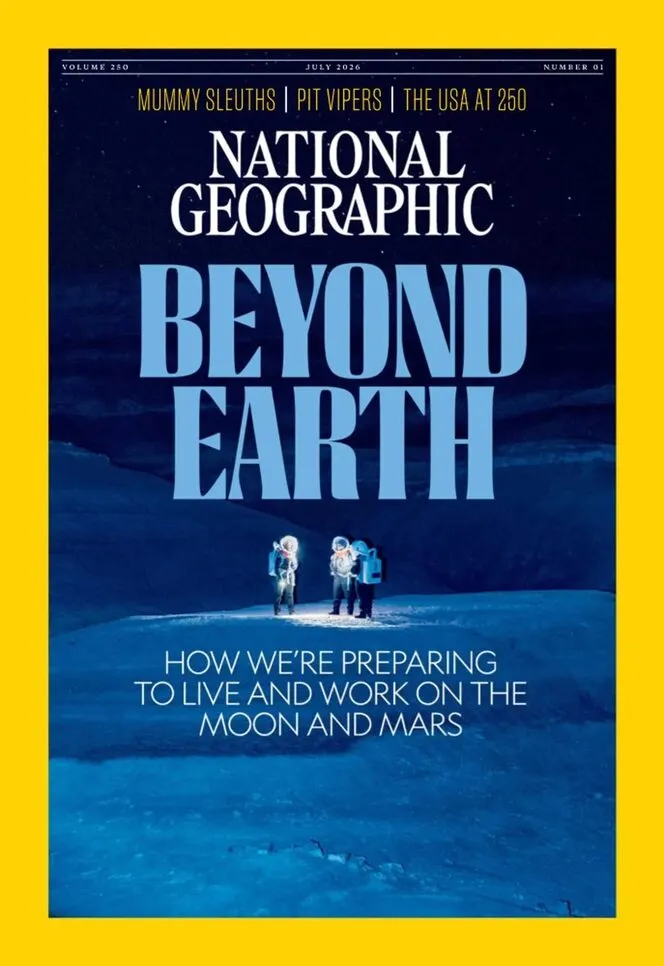
National Geographic USA Volume 250 Number 01 (July 2026) goes "Beyond Earth" on the cover—reporting how NASA's Artemis II success and a series of Moon and Mars analog missions are preparing humanity for long-duration off-world living and working. The issue also reveals secrets that mummies keep through ancient DNA analysis (p.16), opens National Geographic's brand-new Museum of Exploration (p.40), and asks whether tiny insects can stop the next wildlife pandemic (p.80).
The Artemis coverage leads across 26 pages (p.108), covering the habitat design, radiation shielding, and psychological challenges of living beyond Earth. The mummy article uses faecal DNA to reconstruct ancient diets in Italian mummies. The Museum of Exploration piece is a preview of the 45,000-square-foot space in Washington, DC.
Smaller entries cover koalas' new shot at survival (p.106), a snake that saves mountains (p.84), and the future of fresh food in vertical farms (p.102).
—————
Content Guide
▸ Cover Story / Space Exploration
p.108 · WHAT IT TAKES TO LIVE BEYOND EARTH
The feature reports directly from the Artemis II crew—Commander Reid Wiseman describes the vehicle's life-support performance during the 10-day lunar flyby. The article covers three enabling technologies: the Environmental Control and Life Support System (ECLSS) that achieved 90 percent water recycling; the woven polyethylene radiation shield that reduces GCR dose by 30 percent; and the psychological support protocol (weekly private video calls, personalised food packs). A cutaway diagram shows the habitat layout.
p.16 · REVEALING THE SECRETS THAT MUMMIES KEEP
Ancient DNA from the mummified remains of 20 individuals from the Basilica of San Domenico Maggiore in Naples reveals that the Italian elite of the 16th century had a gut microbiome dominated by Prevotella copri, associated with a high-fibre diet. The article matches DNA evidence to historical records of Renaissance-era banquets.
▸ Museum
p.40 · INSIDE NATIONAL GEOGRAPHIC'S BRAND-NEW MUSEUM OF EXPLORATION
A preview of the 45,000-square-foot museum opening on 14 October 2026 on the National Geographic Society's Washington, DC campus. The immersive galleries include a full-size mock-up of the International Space Station's Destiny module, a 270-degree screen showing bioluminescent deep-sea creatures, and a live insect colony room.
▸ Wildlife / Disease
p.80 · CAN THESE TINY INSECTS STOP THE NEXT WILDLIFE PANDEMIC?
Researchers are deploying drosophila traps at live-animal markets in Southeast Asia to screen for unknown coronaviruses. The technique caught a novel bat sarbecovirus in a Vietnamese market in 2025. The article argues that insect-based viral surveillance costs one-tenth of traditional mammalian sampling.
p.84 · THE SNAKE THAT SAVES MOUNTAINS
The eastern indigo snake (Drymarchon couperi), reintroduced to Florida's Apalachicola National Forest in 2017, has reached a self-sustaining population of 340 individuals. The article argues that the snake's burrow-sharing behaviour benefits 30 other species, including the gopher tortoise.
▸ Environment / Conservation
p.106 · KOALAS' NEW SHOT AT SURVIVAL
Vaccination trials against chlamydia in wild koala populations in Queensland show that the single-dose vaccine reduced infection rates by 60 percent in the first 18 months. The project has vaccinated 1,200 koalas since 2024.
▸ Regulars
p.6 · OUR WORLD
Two stories: a marine biologist training humpback whales to accept satellite tags using positive reinforcement, and a team in Madagascar discovering a new species of mouse lemur (Microcebus gerpi) weighing 48 grams.
p.132 · FROM THE VAULT
A previously unpublished 1925 photograph of Alexander Graham Bell flying a tetrahedral kite over Cape Breton Island.
—————
Editor's Take
The "Beyond Earth" cover feature is solid journalism with technical depth—the 90 percent water recycling number and the 30 percent GCR reduction from polyethylene shielding are specific and verifiable. The mummy-DNA piece (p.16) is the issue's sleeper: clever science, well contextualised with Renaissance history. The Museum of Exploration preview (p.40) is an extended advertisement—interesting for DC-area visitors but thin in editorial content. The insect-pandemic piece (p.80) is genuinely important but deserves more space. The koala chlamydia vaccination article (p.106) offers a rare conservation success story. Best for space-program enthusiasts and wildlife disease researchers.
Strengths
• Artemis II life-support detail: specific, technical, crew-sourced
• Mummy-DNA diet reconstruction: clever cross-disciplinary research
• Koala chlamydia vaccine: a rare conservation win with numbers
Weaknesses
• Museum preview reads like a press release
• Insect pandemic surveillance piece deserved feature-length treatment
Verdict: Recommended — Strong space and archaeology coverage; the mummy piece is the hidden gem.
