
Harvard Business Review USA – March-April 2026
Summary
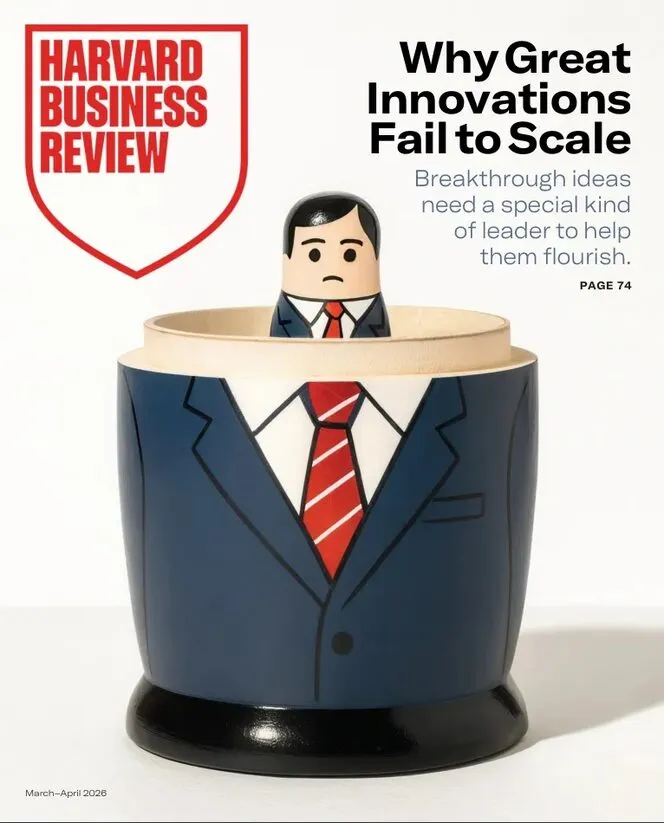
Breakthrough ideas aren't enough—Linda A. Hill, Emily Tedards and Jason Wild argue on page 74 that innovations fail to scale without "bridgers," leaders who excel at collaborating across boundaries. The March-April 2026 Harvard Business Review cover story "Why Great Innovations Fail to Scale" anchors an issue preoccupied with boundary-crossing: between humans and AI, between investors and strategy, between brands and agentic agents. Editor Amy Bernstein titles her note "What It Really Takes to Turn Ideas into Impact."
The lineup is unusually practical. "Why Gen AI Feels So Threatening to Workers" (page 54) by Hermann, Puntoni and Morewedge diagnoses the psychological roots of AI anxiety. "Will Your Investors Support Your Strategic Pivot?" (page 64) by DesJardine and Shi provides a framework for reading shareholder signals. "Preparing Your Brand for Agentic AI" (page 86) by Acar and Schweidel anticipates a world where AI agents make purchase decisions. "Why the Digital Product Model Beats Project-Based Approaches" (page 96) offers IT leaders a migration path. "The Solution to Service-Worker Churn" (page 106) by Gallino and Apaolaza presents data on retention strategies.
Idea Watch includes Doug McMillon's HBR interview ("Listen to Your Gut"). In Focus covers AI's impact on talent management across 5 articles. Experience includes managing insecure leaders and Jimmy Wales on Life's Work.
—————
Content Guide
▸ Innovation / Leadership
p.74 · Why Great Innovations Fail to Scale
Hill, Tedards and Wild studied 25 innovation initiatives across 15 organizations. The common failure pattern: technical success + organizational rejection. "Bridgers" who translate between technical teams, business units and external partners were present in 80% of successful scale-ups. The article profiles a "bridger" at a medical-device company who reduced cross-team friction by 40%. Identify potential bridgers in your organization by looking for people who rotate across functions every 2-3 years.
▸ AI / Workforce
p.54 · Why Gen AI Feels So Threatening to Workers
Hermann, Puntoni and Morewedge found that 63% of workers perceive gen AI as a threat to their professional identity, not just their job security. The threat is strongest among high-experience, high-education employees. The article recommends framing AI as an augmentation tool and involving workers in deployment design. Involve a cross-section of employees in AI tool selection before announcing any deployment.
▸ Strategy / Investors
p.64 · Will Your Investors Support Your Strategic Pivot?
DesJardine and Shi analyzed 200 strategic pivot announcements and found that companies with high "investor-communication clarity" saw 8% less stock-price volatility during pivots. The article provides a 4-question framework for assessing shareholder alignment before announcing a pivot. Survey your top 10 investors anonymously before the board meeting where you present a pivot plan.
▸ Marketing / AI
p.86 · Preparing Your Brand for Agentic AI
Acar and Schweidel project that by 2028, 25% of online purchases will be made by AI agents on behalf of humans. Brands need machine-readable product data, standardized taxonomy and agent-compatible review formats. The article includes a brand-readiness assessment tool. Audit your product feed schema for agent-compatibility—missing structured data means AI agents cannot find your products.
▸ IT / Product Management
p.96 · Why the Digital Product Model Beats Project-Based Approaches
Nelson and Davenport present 5 case studies of organizations that switched from project-based to product-based IT delivery. Average outcomes: 34% faster time-to-market, 28% lower maintenance costs, and 22% higher user satisfaction. The migration takes 12-18 months. Start by reorganizing your first 3 product teams before rolling out the model enterprise-wide.
▸ HR / Retention
p.106 · The Solution to Service-Worker Churn
Gallino and Apaolaza studied 450 retail and hospitality locations. Locations that implemented flexible scheduling, skills-based training and career-path visibility reduced annual turnover from 73% to 41%. The article includes a cost-per-hire calculator to quantify the ROI of retention programs. Calculate your cost-per-hire and compare it to the cost of implementing the three retention strategies.
—————
Editor's Take
Hill, Tedards and Wild's "bridger" concept is the most original management idea HBR has advanced this year—it names a critical but previously unnamed leadership role. The Gen AI workforce anxiety piece is essential reading for any leader managing an AI deployment. Weakest content: the service-worker churn article is solid but limited to retail and hospitality contexts, reducing its relevance for HBR's broader corporate audience. The investor-communication piece is well-researched but the advice ("communicate clearly") is underwhelming. Production quality is excellent. Best for innovation leaders, CHROs and IT transformation executives.
Strengths
• "Bridger" concept identifies a previously unnamed but critical leadership role
• Gen AI anxiety article provides practical deployment-communication strategies
• Agentic AI brand-readiness tool helps marketers prepare for machine buyers
Weaknesses
• Service-worker churn solutions are specific to retail and hospitality
• Investor-communication article states the obvious in academic language
Verdict: Essential — The "bridger" framework will change how organizations think about scaling innovation.
